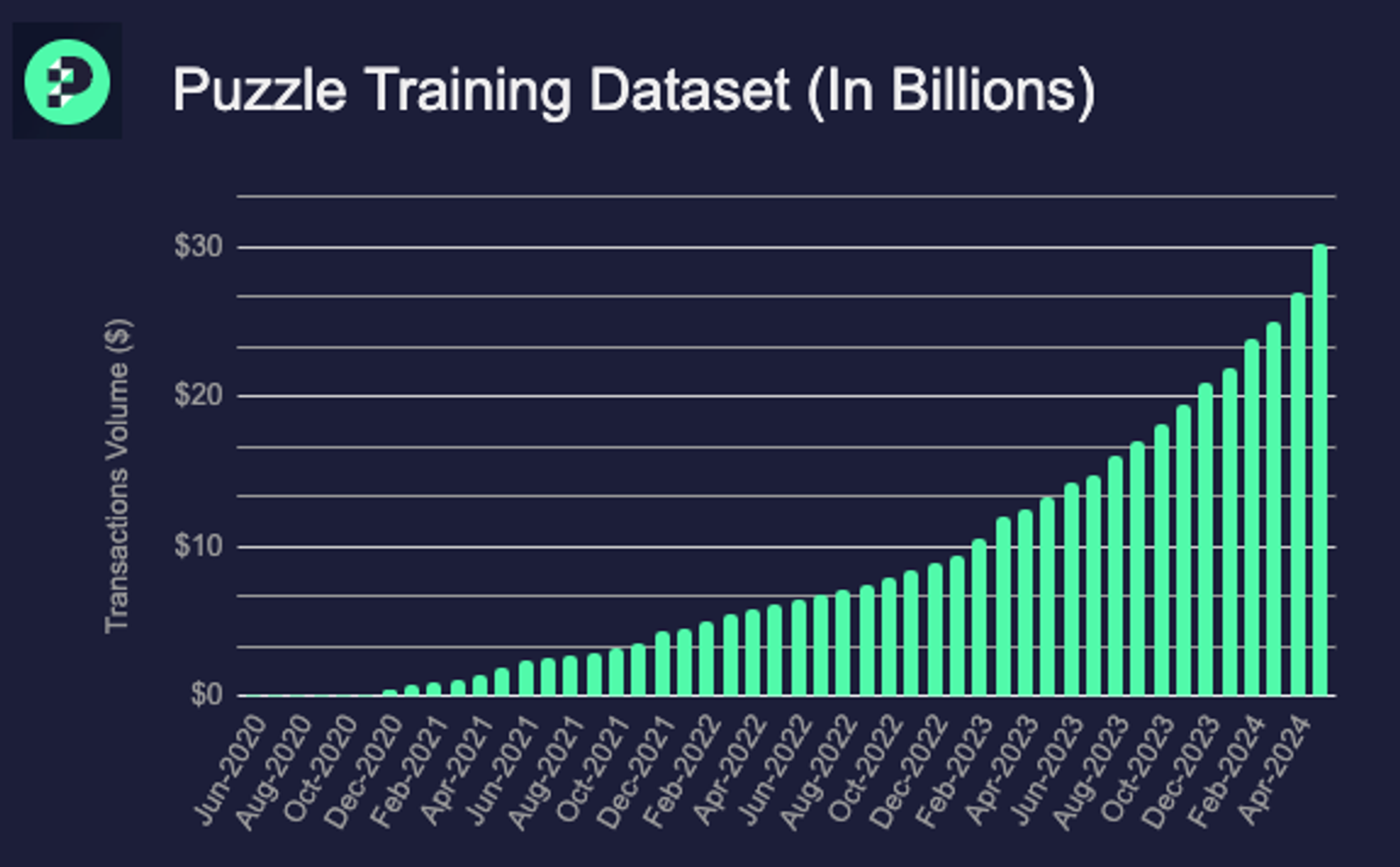
$30B is the largest data set we know of that has been trained specifically on startup accounting. And it’s growing fast. Like, really fast.
At a high level, there are two foundational concepts in early stage accounting: completeness and accuracy. Having access to a large amount of data, like Puzzle’s $30 billion in transactions, helps in achieving better accuracy. This large dataset is tailored to meet the specific needs of startups. It helps in categorizing transactions accurately, handling unusual situations and edge cases, and setting up effective processes and rules that are important for the accounting of startups.
This results in more accurate financial reports. Since Puzzle also built the underlying accounting core (general ledger), you can get drafted financial statements every day just by using our proprietary software.
In QuickBooks, or at companies that use their general ledger software, accounting accuracy is only as good as the bookkeeper and their attention to detail. QuickBooks adopts a data quarantine model, a bookkeeper manually reviews each transaction categorization, manually finalizes the reconciliations, and then manually generates the financial statements from the general ledger. Consequently, financial statements are prepared and closed weeks after the month ends.
Puzzle’s $30B training set gives your startup a major advantage:
Scalability + Accuracy + Automation = Daily Drafted Financials and Insights
It would require rebuilding the underlying software architecture and user experience focused on automation. Here’s what we did differently at Puzzle:
| Capability | QuickBooks | Puzzle |
|---|---|---|
| Chart of accounts | No enforced standardization; every company builds in a silo | Industry-specific template assigned on setup; customizable without losing automation |
| Transaction categorization | Data quarantine model — bookkeeper manually reviews each transaction | Rules engine trained on $30B in startup transactions; low-confidence items flagged for review |
| Journal entries | Must be created manually by a bookkeeper | Generated automatically from high-confidence categorizations |
| Accrual schedules | Managed manually in spreadsheets each month | Managed natively inside the application; entries generated automatically |
| Financial statements | Prepared and closed weeks after month-end | Drafted financial statements generated daily from the live general ledger |
The Puzzle rules engine is trained on data from thousands of startups, including those from Y Combinator, Village Global, Techstars, and 500 Global (formerly 500 Startups), as well as portfolio companies from Sequoia, A16Z, General Catalyst, and Felicis, and many, many others. In addition, startups that use Stripe, Ramp, Brex, Mercury, Meow, BILL, and others provide additional metadata which allows your startup to benefit from all their transactions.
The monthly close is a relic of a world where every journal entry had to be built by hand. A small finance team — or a solo founder wearing the CFO hat — can't afford to spend the last week of every month doing what software should handle automatically. Here's what a modern close looks like when the underlying accounting system does its job — and what it takes to automate month-end close the right way:
The result: a close that takes hours, not weeks — and financials your investors, board, and lenders can trust the moment the month ends.
The gap between AI-native accounting and bolt-on AI is widening fast. As of 2026, accounting AI has shifted from simple task assistance into what analysts now call agentic systems — platforms that handle document intake, transaction categorization, exception flagging, and review-ready outputs end-to-end, without waiting for a bookkeeper to kick off each step. Founders still on legacy software are starting to feel that gap: according to Karbon's State of AI in Accounting Report 2026, 63% of accounting professionals now believe a firm's value drops if it doesn't use AI — up 7 points year over year.
The pressure to move is broad: KPMG's 2026 AI in Finance report found that 93% of U.S. companies expect to deploy or scale AI within their finance functions over the next 18 months, and nearly half are already planning multi-agent systems capable of coordinating accounting workflows end-to-end. That's not a pilot-stage experiment; it's a procurement signal that AI-native platforms are becoming the baseline expectation, not a premium add-on.
What separates the platforms is the training data underneath. Legacy tools like QuickBooks retrofitted AI onto an architecture built before machine learning existed — which is why the result is bolt-on categorization suggestions, not a system that can generate a drafted income statement daily. Puzzle was built the other way around: the $30B training set, the standardized chart of accounts, and the native general ledger were designed together so that automation compounds. That's not a feature added to old software; it's an architectural bet that's increasingly hard to replicate from a standing start.
For most day-to-day transaction work at a 10-person startup — categorization, reconciliation, accrual journal entries, drafted financials — yes, a well-trained AI-native system can offer more consistency than a part-time bookkeeper working in a general-purpose tool. Puzzle categorizes the majority of transactions automatically using a rules engine trained on $30B in startup transactions; items below the confidence threshold are flagged for human review rather than guessed.
That said, "replace" is the wrong frame. The more accurate picture: AI handles the repetitive, rules-based work (categorizing a Ramp card charge, generating a prepaid amortization entry, reconciling a Stripe payout) so that the human layer — whether that's a fractional CFO, a CPA firm, or a sharp ops hire — spends their time on judgment calls, tax strategy, investor prep, and decisions that require business context. The IRS still requires you to maintain complete and accurate books; the software doesn't eliminate that responsibility, it makes meeting it faster and less error-prone. A 10-person startup that is investor-funded or operating on accrual accounting still benefits from a human reviewer — but that reviewer needs to spend far fewer hours per month when the underlying system is AI-native.
Most VC-backed startups at seed and Series A use a combination of an accounting platform and a cap table tool like Carta. The accounting platform handles the journal entries that flow from equity events — SAFEs, convertible notes, priced rounds — while Carta (or a similar tool) tracks ownership and generates the cap table itself.
Where startups run into problems is the handoff: Carta tracks your equity; it does not automatically push the correct journal entries into your general ledger. That means someone — a bookkeeper, a fractional CFO, or a controller — needs to record the SAFE liability, the conversion entries, the stock compensation expense, and the paid-in capital adjustments correctly. Puzzle is purpose-built for this: it recognizes large, unknown bank deposits as potential capital events (SAFEs, convertible notes, priced rounds) and surfaces them for categorization rather than auto-booking them as revenue. For investor reporting, Puzzle generates drafted income statements and balance sheets daily, so founders always have current financials ready for board decks or LP updates — without waiting for a month-end close.
The practical trigger for most funded startups is a priced round or a Series A process — investors and acquirers expect GAAP-compliant accrual financials, and auditors will require it if you ever pursue a 409A, a strategic exit, or a public offering. For a deeper look at the tradeoffs, see our guide on cash vs. accrual accounting for startups. In practice, switching earlier is less painful: the longer you run on cash-basis books, the more historical restatement work a controller or CPA has to do to convert them.
Puzzle is a native accrual platform, which means you can start on accrual from day one without retrofitting. If you're migrating from QuickBooks or a cash-basis setup, Puzzle's migration process preserves your historical books while moving you onto an accrual general ledger — bills, invoices, prepaid expenses, deferred revenue, and payroll accruals are all managed inside the application, not in a spreadsheet bolted on the side. For startups transitioning mid-stream, that means you don't have to choose between keeping history and getting clean going-forward books.
Real-time burn rate requires two things working together: live bank and card data feeding into an accounting system that generates a current cash position every day. Most seed-stage founders don't have this — they check their Mercury or Brex balance manually, or wait for a bookkeeper to close the month before they know where they stand.
Puzzle connects directly to your bank accounts (Mercury, Silicon Valley Bank, First Republic) and fintech cards (Ramp, Brex, Stripe) and uses that live data to update your general ledger daily. Because Puzzle generates drafted financial statements every day, your cash balance, burn rate, and implied runway are always current — not a snapshot from three weeks ago. Founders using Puzzle can see their burn rate on any given day without waiting for a monthly close or asking a bookkeeper to run a report. That's the visibility that lets you make hiring decisions, vendor commitments, and fundraising timing calls with confidence instead of guesswork.
The short answer: earlier than most founders think. The common mistake is treating accounting software as something you set up once you have revenue, investors, or a bookkeeper on staff. By that point, you've already accumulated months of uncategorized transactions, inconsistent chart-of-accounts decisions, and cash-basis records that need restatement before any serious investor will look at them.
The practical value before revenue or funding is about establishing clean habits that don't cost you later. Puzzle assigns a standardized chart of accounts on day one, connects to your bank and card accounts, and starts categorizing transactions automatically — so when your first SAFE closes or your first customer invoice goes out, those events land in a system that already knows how to handle them. You're not retrofitting order onto two years of chaos. The cost of getting accounting right at pre-seed is low. The cost of cleaning it up at Series A — under investor scrutiny, with a hard diligence deadline — is not.
Puzzle's AI runs two layers: a rules engine trained on $30B in startup transactions, and CoWork, the AI chat interface built on top of that engine. The rules engine handles the high-volume, repeatable work — categorizing transactions, flagging low-confidence items for review, generating accrual journal entries (prepaid expenses, deferred revenue, bill accruals, payroll), and reconciling bank feeds daily. It doesn't wait for a bookkeeper to trigger each step; it runs continuously as transactions arrive.
CoWork lets you interact with that system in plain language. You can ask it to split a transaction across multiple categories, identify a purchase as a fixed asset that should be depreciated, pull a P&L for a specific date range, or explain why a transaction was categorized a certain way. For revenue recognition, Puzzle manages deferred revenue schedules natively inside the application — invoices are matched to the correct recognition schedule without a spreadsheet intermediary. The practical result: the automatable layer (categorization, reconciliation, accrual entries, drafted financials) runs without manual intervention, and CoWork handles the judgment-call layer through conversation rather than a support ticket.
Yes, with some important specifics. Puzzle connects natively to Stripe, which is the primary revenue rail for most digital product and e-commerce startups — subscription fees, one-time purchases, and usage-based billing all flow in through the integration. Stripe payouts land in your general ledger with the correct categorization (revenue, refunds, processing fees split out), rather than being booked as a single lump-sum deposit.
For profit margins, Puzzle's daily drafted income statement gives you gross revenue, cost of goods sold (if you've set up COGS categories), and gross margin without waiting for a monthly close. The rules engine handles recurring Stripe transactions with high confidence — so a SaaS subscription renewal or a digital download sale categorizes correctly the first time, not after a bookkeeper reviews it. Where Puzzle is stronger than general-purpose tools: it understands deferred revenue by default, so if you sell annual plans, the revenue recognition schedule is managed inside the application rather than in a spreadsheet your accountant maintains manually.
Puzzle supports multi-entity setups — meaning you can manage separate legal entities (operating company, holding company, international subsidiary) under one account and view consolidated financials across them. Each entity maintains its own general ledger, chart of accounts, and bank connections; the consolidation layer rolls them up into a single view for reporting purposes.
This matters most for venture-backed startups that have spun up a Delaware C-corp alongside an operating entity, or for funds and holding companies managing multiple portfolio companies from one place. It's not designed for large enterprise consolidations with complex intercompany eliminations — Puzzle is sized for startups and growing companies, not Fortune 500 ERPs. If you're a seed-stage single entity, you won't need this. If you're scaling into a multi-entity structure, it's available without having to migrate to a different platform.
Digits positions autonomy as its core value proposition: the idea that AI can handle accounting with minimal human involvement. That model optimizes for speed of output, but by the time you see the result, the AI has already made decisions without your review. For startups where accurate books drive real decisions (fundraising, tax, investor reporting), an autonomous-first approach shifts risk onto the founder when the AI gets something wrong.
Kick is built primarily for independent contractors and sole proprietors: its AI categorization is designed for simpler, high-volume personal-expense-style transactions, not for startup accounting concepts like deferred revenue, SAFE conversions, or accrual schedules. It's the right tool for a freelancer; it's not sized for a VC-backed startup running accrual books. For a full comparison of AI accounting alternatives for startups, see our dedicated breakdown.
Puzzle inverts Digits' model: the AI does the work, but you approve before anything touches the final books. Low-confidence items are flagged for human review; high-confidence categorizations are automated. The difference is architectural: Puzzle was built on a native general ledger and a training set of $30B in startup-specific transactions, so the AI's confidence thresholds are calibrated to startup accounting patterns, not generic small-business transactions. The result is automation you can trust rather than automation you have to audit after the fact.
_____
Important notes