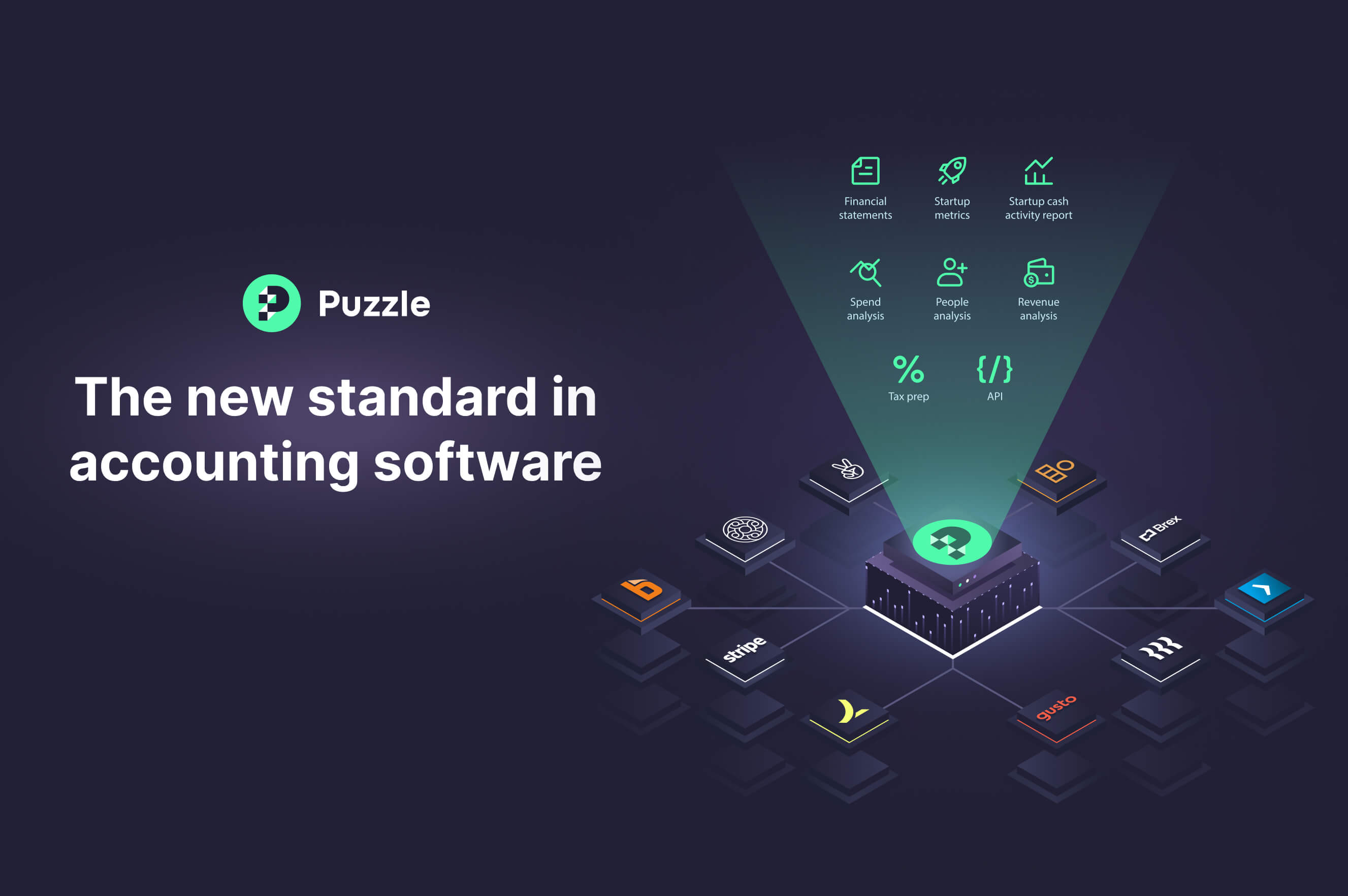
It’s no longer enough for founders to build great products. Serious founders need to build great businesses too. Puzzle starts with the premise that numbers are the basic truth of a business. As founders, if we can understand our numbers, we can understand how our business works. When we understand how our business works, we make better decisions. Not every founder knows accounting or finance, but with Puzzle, every founder can understand their numbers, be fundraise ready, and confidently lead their companies.
TLDR:
Within minutes of connecting, founders see their financials, metrics and reconciliations, automatically drafted, flagging what is needed for expert review. It’s so intuitive that founders can actually get set up themselves, and invite their bookkeeper or get matched with an on-demand expert via Puzzle’s network anytime.
The best part is the system learns and gets better every day… better at categorizing, identifying and surfacing important changes, and automatically squaring up your accounts all designed to save you time and money while improving transparency and accuracy. It is rare to still find such large opportunities where software can lower costs and improve capabilities at the same time.
So how can we automate so much that was manually prepared before? We are riding the impressive wave started by the teams at Stripe, Brex, Ramp, Mercury, Rippling, Gusto, and Plaid who built modern APIs that power industry-defining automation and differentiation for their customers. Puzzle is the modern complement to these solutions, allowing you to scale faster with less effort and higher confidence.
Accounting software was built decades ago, at a different time for a different kind of business. Snapshots from legacy accounting software tell founders very little, yet finance teams often report spending a week or more piecing together data manually across various systems, and even then the outputs require a fundamental understanding of accounting to interpret. Puzzle streams and squares up data in real-time to make the outputs intuitive and traceable to the rich details lost in traditional accounting summaries. When founders are working through fast change, they can't wait weeks to adapt to an ever-changing market.
At first glance, it is easy to confuse Puzzle as just a new accounting system. But that would be a category error. Puzzle checks off the core accounting system boxes, but is also a powerful, API-powered accounting software to manage a startup’s complete finances in one place. Making decisions on stale data or in data silos is no longer acceptable and no longer necessary. Accounting can be upgraded from the dead-end of a startup’s data to the driver of confident, informed, and aligned decision-making.
When Puzzle was built, the premise that a smart general ledger could learn and automate the majority of startup accounting was a contrarian bet. It isn't contrarian anymore. Capterra's 2026 Accounting Software Trends survey of 500 accounting professionals found that 53% now use AI inside their accounting software, and 89% of those report positive ROI. Faster closes, fewer errors, better data visibility. The shift is real and it's accelerating.
What the data also shows: the gap between AI adoption and full automation is still wide. More than half of teams still handle financial reporting manually at least some of the time, and 51% still store financial data in Excel or Google Sheets. The problem Puzzle was built to solve, founders flying blind on stale, siloed numbers, is still the dominant reality for most startups. The infrastructure to fix it just keeps getting stronger.

Modern companies want to use the best software, not mediocre software that happens to be bundled into their accounting system. So we built an API that will unbundle the legacy ERP model used by larger companies. Here are a few early proofs of concepts (with a lot more coming soon) …
| Integration | Partner | What It Does |
|---|---|---|
| Financial Planning | Runway / startuprunway.io | One-click push of real-time Puzzle data to FP&A tools, from the simplest runway tracker for pre-seed startups to one of the most powerful planning tools for scaling companies. |
| Investor Dashboards | AngelList Stack | Real-time financial insights delivered through AngelList dashboards powered by Puzzle, embedded alongside cap tables and bank accounts for investor updates and business management. |
| Native Stripe App | Stripe App Marketplace | The first accounting software built native to the Stripe API; founders see financial summaries and key figures directly inside Stripe, reducing context switching. |
| Real-Time Credit Underwriting | Arc | Puzzle's verified, up-to-date financials let Arc offer real-time credit underwriting for startups, increasing trust for both lender and borrower. |
The short answer: day one. Before you have revenue, you have expenses: incorporation costs, software subscriptions, contractor payments, cloud infrastructure. If those transactions aren't categorized correctly from the start, you'll pay to reconstruct them later, usually at the worst possible time, like the week before a fundraise. Puzzle connects in minutes and starts categorizing automatically, so your books are clean from the first transaction. The value before revenue: you always know your burn rate, your runway, and exactly what you've spent. That's what investors ask for first, and it's what lets you move fast without flying blind.
Legacy accounting software relies on manual rules you set once and never update. Modern AI-native systems like Puzzle learn from every transaction across your connected accounts (bank feeds, credit cards, Stripe, Brex, Ramp, Mercury) and apply machine-learning models to categorize spending and revenue automatically. The system gets faster and more accurate over time: the more transactions it processes, the sharper its pattern recognition. Puzzle categorizes up to 98% of transactions automatically, flags the remainder for human review, and squares up your accounts in real time, so your books reflect today's numbers, not last month's.
Traditional accounting software records revenue but doesn't model it; you're left exporting to spreadsheets and calculating SaaS metrics by hand. Puzzle pulls recurring revenue data directly from your payment processor (Stripe, for example) and surfaces ARR, MRR, and net revenue retention as live metrics inside your dashboard, updated daily. Because Puzzle sits on top of your actual general ledger instead of a data layer disconnected from it, your SaaS startup accounting metrics tie directly to your financial statements, with no manual mapping and no month-end catch-up.
Yes. Puzzle connects directly to the payment processors and platforms digital and e-commerce businesses use (Stripe, Shopify, PayPal, and others) and pulls transaction data into your general ledger in real time. Revenue is recognized as it happens, cost of goods sold is tracked by product line when your integrations support it, and gross margins are visible in your dashboard without manual exports. Because Puzzle maintains a true accrual general ledger (more than a cash feed), your profit margins reflect the actual economics of each period, not merely when cash cleared. You also get live burn and net revenue figures without waiting for month-end.
The constraint fractional CFOs run into isn't analysis skill; it's data latency. If the books are three weeks stale, no dashboard fixes that. The right stack starts with an accounting layer that streams and squares up data in real time: Puzzle connects to a client's startup banking stack (Stripe, Mercury, Brex, Ramp, Rippling, Gusto) and keeps the general ledger current without manual intervention. From there, Puzzle's API pushes live data to FP&A tools like Runway for planning and forecasting. The result: a fractional CFO can walk into any client conversation with current burn, runway, and revenue figures, not estimates built on last month's close.
Puzzle's AI is designed for exactly this kind of task-level work, well beyond surface-level categorization. You can ask it to split a transaction across multiple expense accounts, flag a purchase as a fixed asset instead of an operating expense, or pull a quick P&L for a specific time range, all in a chat interface without leaving the platform. The AI acts on your actual general ledger data, so the outputs are traceable: every figure in a mini P&L links back to the underlying transactions, and every split or reclassification is logged. This is different from a chatbot that summarizes data; Puzzle's AI can execute accounting actions directly inside your books, with a human-in-the-loop approval step before anything is finalized.
A Delaware C-Corp SaaS startup needs a chart of accounts that satisfies GAAP accrual requirements, supports ASC 606 revenue recognition for subscription revenue, and gives investors the line-item visibility they expect at a Series A diligence process. At minimum that means separating recurring SaaS revenue from professional services or one-time fees, tracking COGS distinctly (hosting, support, third-party API costs), and structuring operating expenses by function (R&D, S&M, G&A). Puzzle ships with a startup-optimized chart of accounts pre-configured for this structure, so founders can connect in minutes without hiring an accountant to build the framework from scratch.
Yes. Puzzle supports multi-entity structures, whether that's a holding company with subsidiaries, a fund with multiple portfolio entities, or a founder running parallel businesses. Each entity has its own general ledger, chart of accounts, and reconciliation layer. Consolidated reporting pulls across all entities into a single view: combined P&L, consolidated balance sheet, and intercompany transaction visibility. You can drill from the consolidated summary down to the individual entity transaction level without switching contexts or exporting to spreadsheets. This makes Puzzle a fit beyond single-entity startups where cash vs. accrual accounting decisions are still being made; it also serves operators managing complex entity structures from the start.
The bottleneck for most bookkeeping firms isn't client acquisition; it's the manual work required to keep each client's books current. Puzzle's multi-client architecture lets accounting firms and bookkeepers manage a full client roster from a single dashboard: automated transaction categorization, real-time reconciliation, and exception-based review mean staff spend time on judgment calls, not data entry. Firms connected to Puzzle can onboard new clients in minutes via API integrations with the tools those clients already use. The result is a practice that scales revenue without scaling headcount at the same rate.
Multi-jurisdiction sales tax is one of the fastest-moving compliance problems in startup accounting: rates change, nexus thresholds shift, and jurisdiction codes need to match exactly or you're exposed. Puzzle's approach is to integrate directly with dedicated sales tax engines instead of trying to replicate their rulesets inside an accounting system. That means rate tables stay current automatically, nexus tracking is handled by software built just for that problem, and the resulting tax data flows back into your general ledger correctly categorized. The result: your books reflect the right tax liability by jurisdiction without your team manually pulling rate charts or squaring up mismatches after the fact.
Digits and Kick are both AI-native accounting tools, and both made different architectural bets than Puzzle. Digits positions autonomy as its core value proposition: the AI acts first, and you review the output after. Puzzle inverts that model; the AI does the categorization, reconciliation, and flagging work, but a human approves before anything is finalized in the books. For startups where auditability and fundraise-readiness matter, that distinction carries real weight: your books need to be defensible, not merely fast. Kick focuses heavily on the solo-operator and sole proprietor market. Puzzle was built expressly for venture-backed and high-growth startups and the accounting firms that serve them, which shapes everything from the chart of accounts defaults to the SaaS metric integrations to the multi-entity support. The depth of the general ledger, the quality of the API integrations with fintech infrastructure (Stripe, Mercury, Brex, Ramp, Rippling, Gusto), and the direct path to fundraise-ready financials are where Puzzle's accounting depth compounds over time in ways AI accounting alternatives don't.
Yes. Puzzle has a public API that allows third-party SaaS platforms to embed accounting functionality directly into their products; this is exactly how the AngelList and Stripe App Marketplace integrations work. For platforms that want to offer their users real-time financial visibility, automated bookkeeping, or live general ledger data without building an accounting system from scratch, Puzzle's API provides that infrastructure layer. White-label and embedded deployments are available for qualified partners; the architecture is designed so Puzzle's ledger runs behind the scenes and the experience surfaces natively inside the partner platform. If you're building a fintech, vertical SaaS, or startup tooling product and want to embed accounting, reach out directly to discuss partnership options.
Direct business customers, founders and operators connecting Puzzle to their own company, get a self-serve onboarding experience designed to get your books live in minutes: connect your bank, fintech accounts, and payment processors, and Puzzle starts categorizing and squaring up immediately. In-app guidance, documentation, and access to Puzzle's on-demand expert network are all available when you need human support. Accounting firm partners get a dedicated partner program with a separate onboarding track, a multi-client dashboard, and direct access to the Puzzle partner team. Firms are more than customers; they're part of the network Puzzle routes clients through when founders need expert help. That means firm partners get earlier access to new features, co-marketing support, and a feedback loop directly into the product roadmap. Both tracks are designed to minimize the time between connecting and having accurate, current books; the difference is in the depth of the partnership layer available to firms.