I'll be frank: book value rarely comes up in early conversations about your startup's worth, so it's easy to deprioritize. But when due diligence starts, a stale or inaccurate balance sheet creates friction fast. Understanding what book value actually tracks, and why your recorded net assets will always look tiny compared to what investors pay, makes you a much sharper founder at the table.
TLDR:
Book value is what your balance sheet says your company is worth if you stripped away everything you owe. The formula is straightforward: total assets minus total liabilities. What's left is the net recorded value of everything your company owns, according to your accounting records.
The "book" in book value refers to the accounting books, not any pricing guide. In accounting, book value reflects what your assets cost when you acquired them, adjusted downward over time as they depreciate. Understanding how this fits into your startup financial statements is useful groundwork.
For a startup, that number tends to be modest: a laptop, some prepaid software, and cash in a Mercury account, minus what you still owe.
Two formulas cover most of what you need.
For individual assets, the net book value formula is:
Net Book Value = Original Cost - Accumulated Depreciation
Say you bought a MacBook for $2,400. After two years of straight-line depreciation over a five-year useful life, you've accumulated $960 in depreciation. Net book value: $1,440.
For the company as a whole:
Book Value = Total Assets - Total Liabilities
If your startup holds $80,000 in cash, $5,000 in prepaid software, and $1,440 in equipment, total assets are $86,440. Subtract $14,000 in outstanding accounts payable and accrued expenses, and your book value is $72,440. No market speculation, no future revenue projections, just what you own minus what you owe.
Straight-line depreciation spreads an asset's cost evenly across its useful life, and it's the most common method under GAAP for physical assets because of its simplicity and predictability. For a full walkthrough, see how to account for depreciation as a startup.
The math is simple: a $12,000 server with a three-year useful life loses $4,000 in book value each year, reaching $0 after year three.
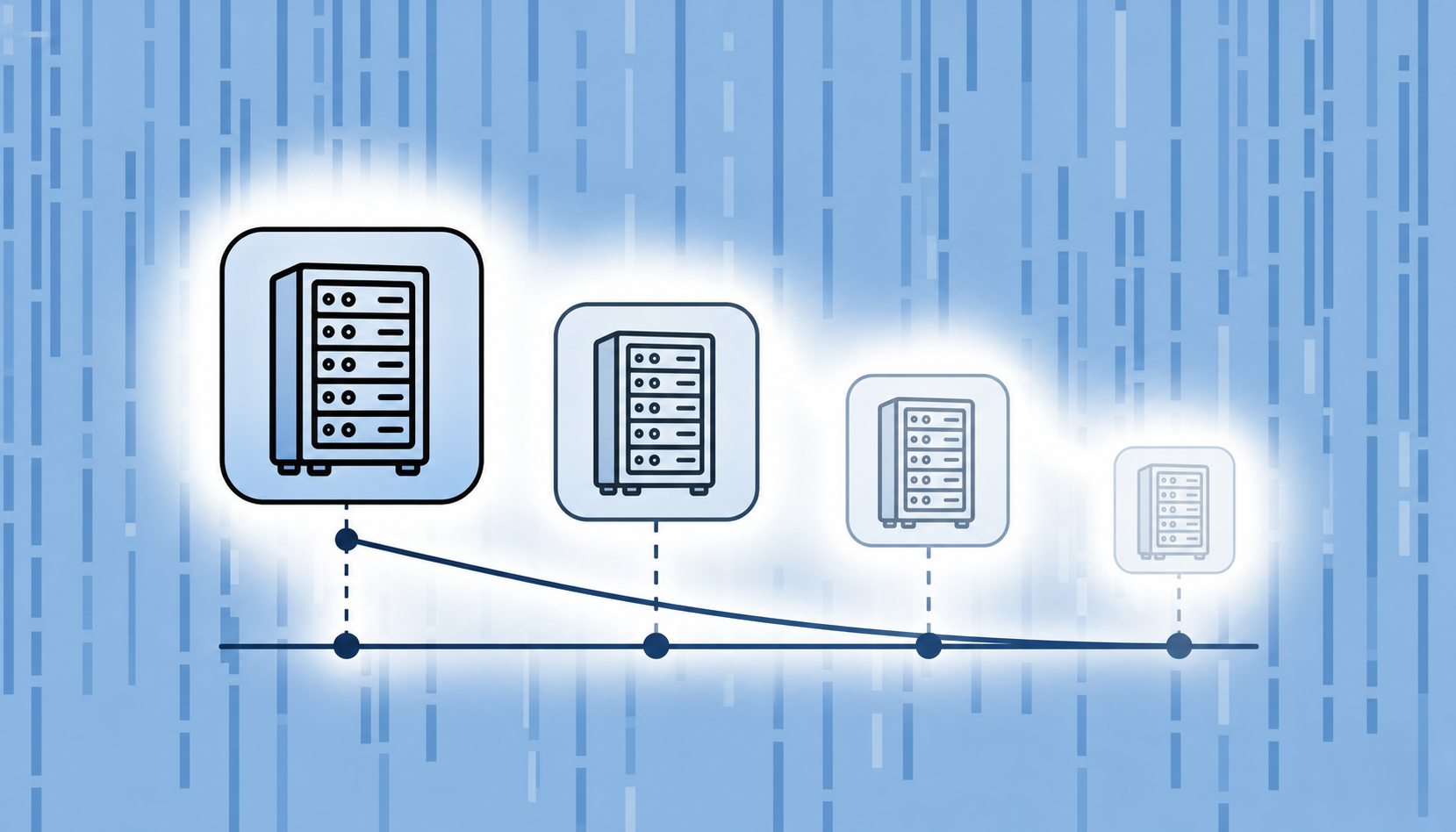
Two line items carry this on your financial statements:
When an asset hits $0, you likely still own and use it, but its recorded value is zero. That gap between replacement cost and book value is one reason market value and book value diverge.
Most startup balance sheets are thin by design. You're carrying a handful of asset categories that repeat across nearly every early-stage company:
The distinction that trips founders up is expense vs. record as an asset. A $500 monitor hits operating expenses immediately. $5,000 in servers becomes a fixed asset that depreciates over time. Assets recorded on the books reduce book value gradually; expensed items reduce profit immediately and never appear as assets.
Intangibles like your software codebase are trickier. Recorded software costs follow specific GAAP rules, but most early-stage SaaS companies expense development costs as incurred, which changes your book value materially.
Book value per share (BVPS) takes your company's total shareholders' equity and divides it by the number of common shares outstanding:
BVPS = (Total Shareholders' Equity - Preferred Equity) / Total Common Shares Outstanding
If your startup has $500,000 in total shareholders' equity, $100,000 attributed to preferred shareholders, and 400,000 common shares outstanding, your BVPS is $1.00 per share.
For most pre-seed and seed companies, this number stays in the background until your equity structure starts mattering to someone else: a potential acquirer, a secondary market buyer, or an investor running due diligence. This intersects directly with your 409A valuation as you scale. At that point, BVPS gives them a per-share floor grounded in recorded net assets, not growth projections.
Book value looks backward; market value looks forward. Book value records what you paid for your assets, adjusted for depreciation. Market value reflects what a buyer believes your business will earn in the future.

For a SaaS startup, that gap can be enormous. Your balance sheet might show $80,000 in net assets while an investor prices you at $4 million. The difference isn't an error; it's the value of things accounting never records: your recurring revenue base, your software codebase expensed as incurred, your team, your customer relationships.
As Ramp explains, book value and market value measure fundamentally different things: book value is a snapshot of recorded net assets, market value is a consensus on future cash flows. The accounting rules create this gap by design. Engineer salaries hit operating expenses, not assets. Customer acquisition spend is expensed immediately, so the resulting ARR shows up in revenue but never as a recorded balance sheet asset: a pattern covered in depth in SaaS startup accounting.
| Book Value | Market Value | |
|---|---|---|
| What it measures | Recorded net assets (assets minus liabilities) | What a buyer believes the business will earn in the future |
| Time orientation | Backward-looking: what you paid, adjusted for depreciation | Forward-looking: a consensus on future cash flows |
| What it captures | Laptops, equipment, prepaid software, cash | Recurring revenue, software, team, customer relationships |
| What it misses | Internally developed software, customer acquisition, brand | Nothing: investor pricing reflects all available signals |
| SaaS example | $80,000 in net assets on the balance sheet | $4,000,000 investor valuation on the same company |
| Why the gap exists | GAAP expenses engineering salaries and CAC as incurred | ARR and growth rate priced into the multiple |
A high market-to-book ratio signals investor confidence in future growth, not accounting inaccuracy.
For startups, the most valuable asset is usually the software itself, and US GAAP won't let you put it on the balance sheet.
Every engineering salary paid to build your product was expensed as incurred. Customer relationships, brand, proprietary algorithms, institutional knowledge in your codebase: none of it gets recorded as an asset. Your balance sheet records near-zero asset value for the thing an acquirer would actually pay for.
This is an accounting convention designed for capital-heavy industries where value lived in factories and equipment. Software companies broke that model.
An NBER working paper on the market-to-book gap traced the disconnect between recorded book value and market value directly to unrecorded intangible capital. For startups, that gap is structural: the more you invest in building product, the more your book value understates what you're actually worth. When an investor prices your seed round at $5 million on $60,000 in net assets, that multiple reflects future cash flows your balance sheet simply cannot see.
The price-to-book ratio divides a company's market capitalization by its total book value of equity. A P/B of 10 means the market values the company at ten times its recorded net assets.
For most startups, this ratio sits in the background. Investors pricing a SaaS seed round aren't running P/B calculations; they're looking at ARR, growth rate, and retention. SaaS Capital's data shows the median ARR multiple for SaaS companies sat as of early 2026 at decade-plus lows following AI-driven market repricing, and even at compressed multiples, revenue-based valuation dominates.
P/B becomes relevant in three specific situations:
That last case matters for founders. When your company gets acquired, the buyer's accountants will allocate the purchase price across your recorded net assets first, then attribute the remainder to intangibles and goodwill. Knowing your book value going into that conversation tells you how much of the deal price sits on defensible, audited ground versus growth-expectation premium.
Book value moves every time your balance sheet changes, which means it's never standing still.
The main drivers:
If book value is declining quarter over quarter while you're claiming to build product value, that's a prompt to understand why: the balance sheet as a failure signal is worth understanding before it becomes urgent. Losses outpacing asset accumulation is expected at pre-revenue stages, but worth tracking deliberately so the findings don't surface for the first time during due diligence.
When an investor or acquirer opens your data room, the balance sheet is often the first financial statement they use to check whether your numbers are trustworthy. Book value tells them whether your records are clean, not what your company is worth.
They're checking three things: whether asset costs are recorded correctly, whether accumulated depreciation is current, and whether liabilities are complete. Stale depreciation schedules or assets carried at original cost with no adjustments signal that the books haven't been maintained carefully. Proper fixed asset depreciation under accrual accounting prevents exactly this, and sloppy records raise questions about everything else in the data room.
For a Delaware C-Corp at Seed through Series B, the stakes are practical. Missing depreciation entries make net income look artificially high. Overstated assets make equity look stronger than it is. Neither error survives serious due diligence, and correcting them mid-deal creates friction most founders never see coming.
Keeping book value accurate is a daily problem, not a month-end one. Depreciation accumulates continuously, asset accounts drift when transactions go unreconciled, and equity entries get missed when your cap table lives separately from your books.
Puzzle handles the mechanical parts automatically: the automated fixed asset depreciation module applies straight-line depreciation on schedule, native cash vs. accrual accounting keeps asset values consistent across both views, and the Carta integration flows stock issuances directly into the GL without a spreadsheet in between.
When a due diligence request lands, the gap between daily-current books and books assembled from disconnected sources shows immediately. Automated daily reconciliation means your balance sheet reflects today's position, not last month's close.
Book value is one of those numbers that sits quietly in the background until someone important asks about it. When they do, the quality of your records either builds confidence or raises questions fast. Keeping depreciation current and your balance sheet up to date daily means you're never caught off guard. Book a demo with Puzzle to see how the fixed-assets module and Carta integration handle the mechanical parts for you.
For most startups, book value understates actual worth by a wide margin. GAAP requires you to expense engineering salaries, customer acquisition costs, and internally developed software as incurred, so your most valuable assets never appear on the balance sheet. An investor pricing your seed round at a multiple of your recorded net assets is pricing what the books structurally cannot capture.
Yes, depreciation is central to the book value formula for any depreciable asset: Net Book Value = Original Cost minus Accumulated Depreciation. A $2,400 laptop depreciated straight-line over five years loses $480 per year, so after two years its net book value is $1,440. Accumulated depreciation sits on the balance sheet as a contra-account reducing the gross asset cost, while depreciation expense hits the income statement each period.
Investors pricing a SaaS seed or Series A round use revenue-based multiples (ARR, growth rate, net revenue retention), not book value. Book value becomes relevant in three situations: asset-heavy acquisitions where a buyer needs a hard asset floor, distressed scenarios where liquidation recovery matters, and purchase price allocation during any acquisition where the buyer's accountants must separate recorded net assets from goodwill. Knowing your book value before a deal closes tells you how much of the purchase price sits on audited, defensible ground versus growth-expectation premium.
Accurate book value requires depreciation running on schedule, asset accounts syncing daily, and equity entries posted when stock is issued: none of which should live in a disconnected spreadsheet. Puzzle's built-in fixed-assets module applies straight-line depreciation automatically, native dual-basis accounting keeps asset values consistent across cash and accrual views, and the Carta integration flows stock issuances directly into the general ledger. When a due diligence request arrives, the gap between daily-current books and manually assembled records shows immediately.
Book value matters from day one if you're a Delaware C-Corp, because every share issuance, asset purchase, and depreciation entry affects shareholders' equity, which is the number acquirers and investors will audit. Pre-revenue, the practical stakes are lower, but stale depreciation schedules and missing equity entries compound over time. Correcting them mid-Series A due diligence creates friction that clean, real-time books prevent entirely.