Startup Accounting
15 Best AI Accounting Software Tools for October 2026
Compare 15 best AI accounting software tools for January 2026. Find solutions with automated categorization, burn rate tracking, and native integrations.

1.31.26

Compare 15 best AI accounting software tools for January 2026. Find solutions with automated categorization, burn rate tracking, and native integrations.
Most AI accounting software either serves general small businesses with basic needs or targets post-Series B companies ready for full ERP systems. If you're a startup between pre-seed and Series B, you need something right-sized: native Stripe integration, automated burn rate tracking, and dual-basis accounting without the complexity of NetSuite. We tested which tools actually fit that stage and whether they partner with your accounting firm or try to replace them.
TLDR:
AI accounting software uses machine learning to automate transaction categorization, reconciliation, and financial reporting. Traditional accounting systems rely on static rules and manual data entry. AI learns from your patterns and gets smarter over time.
The difference goes beyond basic automation. Traditional software might connect to your bank, but you still spend hours categorizing transactions and reconciling accounts. AI accounting software processes these tasks automatically, delivering real-time insights into burn rate and runway instead of making you wait for month-end close.
For startups, this matters because running out of money kills more companies than bad products. When your accounting runs weeks behind, you spot problems too late to fix them.
We ranked each tool based on what startups and their accounting partners actually need. The analysis reflects publicly available information and documented features.
AI automation capability carried the most weight. We look at how much manual categorization, reconciliation, and reporting each tool removes. Solutions built AI-native from the start ranked above those retrofitting AI onto legacy code.
Integration strength came next. Startups need native connections to Stripe, Mercury, Ramp, and Gusto without manual journal entries or third-party middleware. We prioritized tools that sync automatically with the fintech stack most early-stage companies use.
Real-time visibility into burn rate, runway, and ARR separated leaders from laggards. Founders make daily decisions and can't wait 30 days for financial clarity. Startup-focused features like dual-basis accounting and automated revenue recognition also factored in, since these remove hours of spreadsheet work each month.
Puzzle is AI-native accounting software built for startups and their accounting partners. The system delivers 85–90% automated transaction categorization while keeping accountants in control. You get real-time financial visibility without the manual work that makes legacy tools painful.
Core strengths include automated categorization with AI that learns from your patterns, real-time burn rate and runway tracking built into the dashboard, native integrations with Stripe, Mercury, Ramp, Brex, and Gusto, simultaneous cash and accrual accounting with automated revenue recognition, and a partner-only model that never competes with accounting firms.
Puzzle cuts month-end close time by up to 50% with AI Accuracy Reviews catching errors proactively and delivers bank reconciliations up to 96% faster.
QuickBooks retrofits AI features onto decades-old architecture. The product handles basic accounting but requires manual work and struggles with startup integrations like Stripe and Ramp.
What they offer: General small business accounting with Intuit Assist AI on higher-tier plans, an established accountant ecosystem, and a third-party integration marketplace.
Good for: Traditional small businesses with standard banking who need accountant-familiar software and don't require startup-specific metrics like burn rate or runway.
The limitation: QuickBooks Live bookkeeping services compete directly with accounting firms for clients.
Xero is cloud-based accounting with JAX AI assistant for invoice creation and basic queries. The system handles multi-currency work well but wasn't built for US startup finance.
What they offer:
Good for: International businesses needing multi-currency support with broad app marketplace coverage.
The limitation: Stripe, Mercury, and Ramp require third-party apps. No burn rate tracking or revenue recognition automation for SaaS companies.
Zoho Books delivers budget-friendly accounting within the broader Zoho suite. Zia AI assists across invoice creation and transaction categorization, though it serves dozens of business functions beyond accounting.
The free tier covers businesses under $50K revenue and includes invoicing, expense tracking, and connections to other Zoho products like CRM and Projects.
Best fit: Companies already invested in Zoho's ecosystem who need basic accounting at minimal cost.
The gap: Most US accounting firms don't work with Zoho. It lacks revenue recognition automation, burn rate tracking, runway visibility, and ARR/MRR reporting that venture-backed companies require. The tool works for general small businesses but misses startup-specific needs and native fintech stack integrations.
Rillet targets hyper-growth SaaS companies scaling toward IPO with AI-native ERP capabilities. The system handles multi-entity consolidation and complex revenue recognition that enterprise finance teams need.
They offer advanced ASC 606 compliance, intercompany accounting automation, and native support for usage-based billing models. Best for Series B+ companies with $50M+ ARR and dedicated finance teams managing multiple entities.
The tradeoff is quote-based enterprise pricing and lengthy implementations built for IPO-ready complexity. Pre-seed through Series A startups typically find better value in right-sized accounting software that matches their stage without ERP overhead.
Campfire is an AI-native ERP built for mid-market tech companies that have outgrown QuickBooks but aren't ready for NetSuite. They focus on multi-entity consolidation, complex revenue recognition, and treasury management for companies with dedicated finance teams.
Best for companies with 50-500+ employees managing multiple legal entities and enterprise-level contracts. Requires internal Controllers or CFOs to operate.
The tradeoff: ERP-level complexity that's overkill for early-stage startups. No partner model for accounting firms. Campfire serves post-Series B companies scaling finance operations, while Puzzle is right-sized for pre-seed through Series B startups.
Digits markets an "Autonomous General Ledger" with AI agents replacing bookkeepers, offering both self-serve software and full-service CPA packages. The system targets general SMBs across industries.
What they offer:
Good for: General small businesses (retail, healthcare, consulting) wanting AI automation combined with outsourced bookkeeping services in one vendor.
Limitation: Digits competes directly with accounting firms for client relationships, lacks startup metrics like burn rate and runway, and serves general SMBs instead of tech startups.
| Feature | Puzzle | QuickBooks | Xero | Zoho Books | Rillet | Campfire | Digits |
|---|---|---|---|---|---|---|---|
| AI Automation | 85–90% | Varies by plan | JAX assistant | Zia assistant | 93% | Yes | 97.8% |
| Real-Time Burn Rate | Yes | No | No | No | Yes | Yes | No |
| Runway Calculation | Yes | No | No | No | Yes | Yes | No |
| ARR/MRR Tracking | Yes | Manual | No | No | Yes | Yes | No |
| Native Stripe Integration | Yes | Third-party | Third-party | Third-party | Yes | Yes | Via Plaid |
| Native Mercury Integration | Yes | Limited | Limited | No | Yes | Yes | Via Plaid |
| Dual-Basis Accounting | Yes | Manual or separate | Manual | Cash or accrual | Yes | Yes | No |
| Revenue Recognition Automation | Yes | Manual spreadsheets | Basic | Limited | Advanced | Advanced | No |
| Partner-Only Model | Yes | No (competes) | No | No | Limited | No | No (competes) |
| Typical Setup Time | Hours | Days to weeks | Days | Hours to days | Weeks | Weeks | Days |
This comparison shows how AI-native accounting software differs from legacy options. Puzzle's partner-only model means your firm never competes with your software vendor, while QuickBooks Live and Digits now offer direct bookkeeping services that compete with accounting firms.
Puzzle was built AI-native for startups, not retrofitted onto legacy systems. While 46% of accountants use AI daily, most software bolts AI onto architecture that still needs manual work.
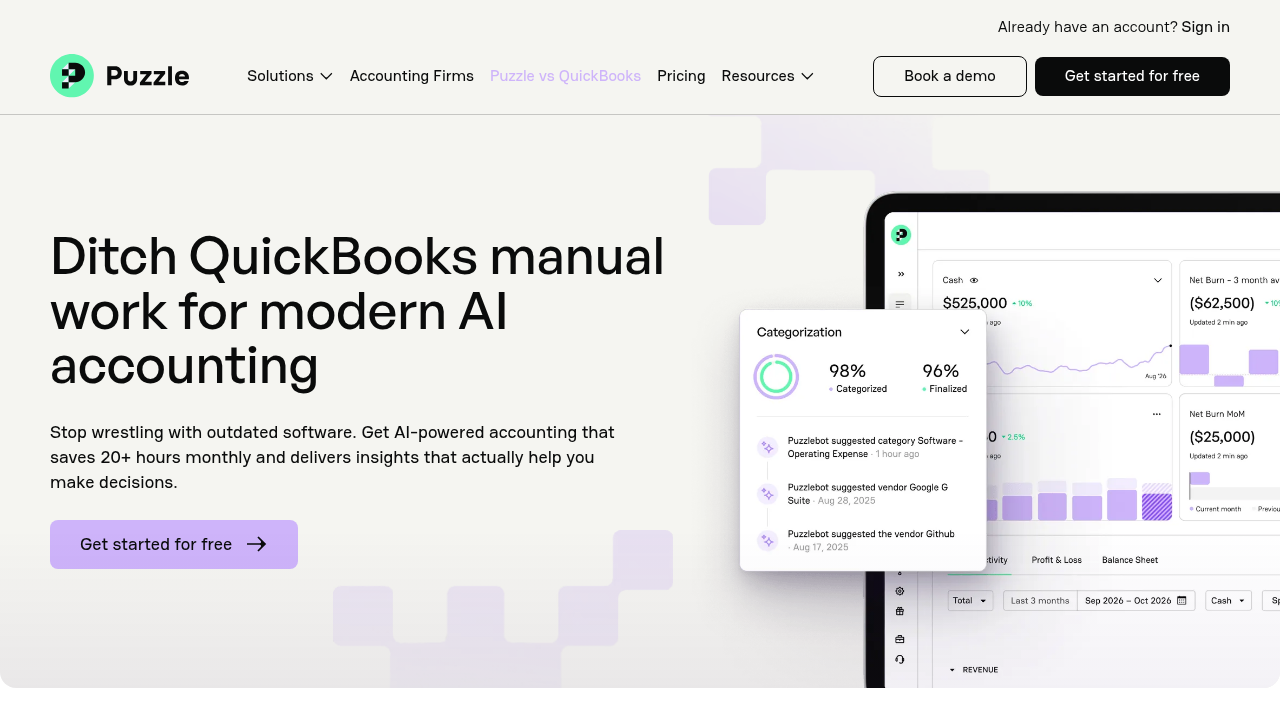
We deliver 85–90% automated categorization while keeping accountants in control. That matters when nearly 3 in 10 startups fail from running out of cash. Real-time burn rate and runway tracking catches problems early, not weeks after month-end when it's too late. We're the only solution tracking these metrics automatically without spreadsheets.
Switching to best AI accounting software means your books stay current without the manual work that slows everything down. AI handles transaction categorization while maintaining the accuracy your accountant needs for month-end close. You see your burn rate and runway update in real time, and your finance team spends less time on data entry and more time on analysis that moves your startup forward.
Start by identifying whether you need startup-specific features like burn rate tracking, runway calculation, and ARR/MRR reportingt, hese aren't available in general small business tools like QuickBooks or Zoho Books. Then check if the software integrates natively with your fintech stack (Stripe, Mercury, Ramp, Gusto) without requiring third-party apps or manual journal entries. AI-native tools built from the ground up typically deliver better automation than legacy systems with AI retrofitted on top.
AI-native software was designed from day one with AI at its coret, he product architecture, data models, and workflows were built specifically to support machine learning. AI-powered typically means AI features were added to existing legacy software, which limits how well the AI can learn and improve over time. This distinction matters because AI-native tools can categorize 85–90% of transactions automatically while continuously learning from your patterns, whereas retrofitted AI often still requires manual work.
Yes, if you want to avoid competing with your own vendors. QuickBooks Live and Digits both offer direct bookkeeping services that compete for your clients, while partner-only models guarantee the software company will never compete with your firm. This matters for long-term business relationships, you don't want to invest time learning software and migrating clients only to watch the vendor steal your customers later.
Consider switching when you're spending more than 10 hours per month on manual categorization and reconciliation, when you need real-time visibility into burn rate and runway instead of waiting for month-end close, or when your fintech integrations (Stripe, Mercury, Ramp) require constant manual journal entries. Pre-seed through Series B startups typically benefit most from right-sized AI accounting built for their stage, while post-Series B companies may need ERP-level complexity.
Free tiers typically lack startup-specific features like automated revenue recognition, dual-basis accounting, burn rate tracking, and runway calculations. They work for basic invoicing and expense tracking but won't support fundraising prep, investor reporting, or the integrations most tech startups need. Most venture-backed companies outgrow free tools quickly once they raise their first significant round.