Stripe Revenue Recognition Automated by Puzzle (October 2026)
Puzzle Guides
Stripe Revenue Recognition Automated by Puzzle (October 2026)
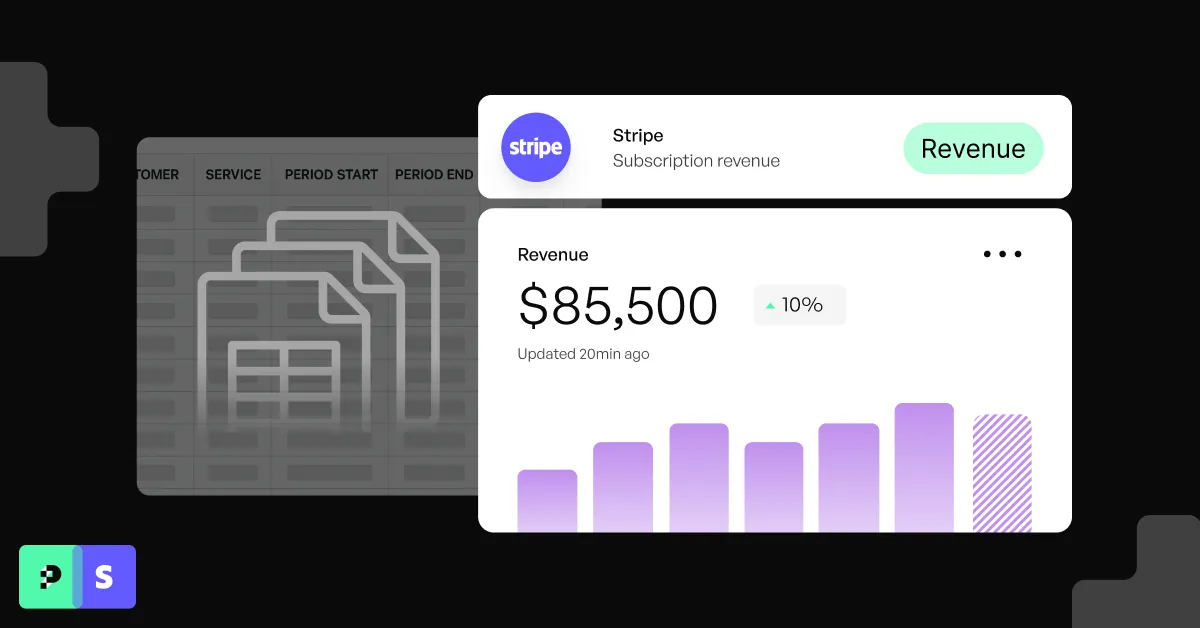
No more sifting through cluttered spreadsheets or navigating third-party connectors to import transaction data to your general ledger. Puzzle’s Stripe integration enables both formation and growth-stage companies to stream high volumes of Stripe transactions directly into our accounting software.
Denny Hollick
5.16.25
In article:
Accounting. Simplified
A bad product lacks competitive advantage. Successful businesses have something unique that's hard to copy. It could be cost efficiency, brand power, or proprietary tech. Without this, you're just waiting to get outperformed. Think of physical retailers being outperformed by e-commerce.
Thank you for being part of our Puzzle community. Stay tuned!
Oops! Something went wrong while submitting the form.
With over 4.7 million businesses leveraging its rapidly growing ecosystem of products, Stripe is one of the modern technology industry’s most established payment solutions – full stop.
While Stripe is leading the charge in simplifying financial infrastructure, integrating its data into legacy accounting software (like QuickBooks) is anything but simple. Between error-prone third-party APIs and tedious transaction matching, accounting teams have their work cut out to centralize financial data and automate revenue recognition in one place.
As a company built from the ground up by multiple former accountants, we’ve felt your pain firsthand and understand exactly what you’re going through. That's why we built Puzzle's native Stripe integration, a seamless and automated solution for accurate financial data tracking.
TLDR:
Puzzle's native Stripe integration automates revenue recognition without spreadsheets or third-party connectors
Connect your Stripe account in minutes to get 85–90% automated transaction categorization and real-time revenue tracking
Fondo cut revenue recognition time by 60% using Puzzle's Stripe integration with automated journal entries
Puzzle is AI-native accounting software that delivers real-time financial insights for startups and accounting firms
Meet Puzzle's Native Stripe Integration
Puzzle’s Stripe integration enables both formation and growth-stage companies to stream high volumes of Stripe transactions directly into our accounting software.
No more sifting through cluttered spreadsheets or navigating third-party connectors to import transaction data to your general ledger. This integration is key to making accounting software of critical importance in your finance stack for companies with revenue powered by Stripe.
Trying to get next-gen solutions like Ramp, Rippling, Brex and more to work seamlessly alongside legacy accounting software is a losing battle for startups and fast-growing companies alike. If you're evaluating options across your full fintech stack, see our breakdown of the best accounting software for SaaS startups using Stripe and Mercury. With this native integration, accounting workflows no longer need to remain silo'd across multiple platforms.
Accounting Software
Native Stripe Integration
Integration Method
Key Limitations
Puzzle
Yes
Direct API connection without middleware or connectors
None - fully automated revenue recognition with real-time data streaming
Additional costs for connectors, manual revenue recognition processes
By using Puzzle’s direct Stripe API connection (without middleware or connectors), companies can now seamlessly automate revenue recognition without the spreadsheets. As a result, teams are better equipped with real-time visibility into revenue and other key metrics – in turn improving confidence in automated accrual finances while freeing up time for strategic growth decisions.
“Almost all of my clients use Stripe as their primary payment source, so any accounting functions that work directly with Stripe are ideal.” — Brandon Correll, CPA & Lead Accounting Manager at Fondo
Building On Our Team’s Learnings From Affirm
Like many initiatives on our roadmap, Puzzle's Stripe integration was spearheaded by customer feedback and learnings from our core engineering team. A key contributor was our Principal Software Engineer, Jason Mitchell. His experience working with disparate financial data sources as a Software Engineering Manager at Affirm was critical in bringing this integration to life.
In his previous role, Jason observed the pain point we strive to fix: accountants managing large amounts of financial data across bloated spreadsheets and legacy software. Beyond the frustrations of working with outdated tools, Jason was struck by the inefficiency of the work – locating a discrepancy was like "looking for a needle in a haystack." He knew he needed a modern system to sift through and organize millions of data points automatically.
So, Jason developed a new cash tracking & reconciliation system to automatically reconcile all loan and merchant-servicing money movements at Affirm. Fast-forward to his current role at Puzzle, Jason was able to apply this automation-first approach in building our Stripe integration.
By focusing on native integrations, we’re able to obtain more data that in turn helps power our categorization and reconciliation automations. In other words, more data means more context, which in turn delivers better AI workflows. As our team at Puzzle continues to ship new features and integrations on our product roadmap, we frequently return to this guiding philosophy.
"What we're doing at Puzzle is solving the most common accounting problems that companies face with technology. We're constantly listening to our customers and developing new ways to save them time, while also improving financial visibility." — Jason Mitchell, Principal Software Engineer at Puzzle
A Guide: How Puzzle’s Stripe Integration Works
Using our native integration, teams can now connect their Stripe account in minutes and immediately start generating automated revenue schedules. From there, journal entries are automatically created within Puzzle, in turn delivering real-time financial metric calculations.
These drafted journal entries can be manually edited or adjusted as needed, including adding or removing specific Stripe data during a standard review process. From a technical lens, Puzzle’s Stripe integration streamlines accounting workflows in three core steps:
1. Routing Stripe Transaction Data Into Your Subledger
Rather than jamming up the general ledger, Puzzle first sends Stripe transaction data into the subledger. This workflow keeps your transactions clean despite the flow of Stripe data coming in. No matter how many transactions you’re processing; the general ledger remains readable.
For visibility, common examples of subledgers are Stripe accounting software tools like ChartMogul or Baremetrics, both of which track daily revenue (new, expansion, contraction, churn resurrection).
2. Feeding Stripe Transaction Data From the Subledger Into the General Ledger
After your Stripe data has been pushed into the subledger, you can incrementally summarize it into the general ledger on your preferred timeline. Whether that's 30 or 300 transactions every day, Puzzle keeps your team in control of how they visualize and process their Stripe data.
This incremental process makes the data much easier to understand at a glance. But if accountants need to drill down into a specific week or month and scrutinize particular transactions, that data is all readily available in the subledger.
3. Automating Revenue Recognition and Reporting
Once your Stripe data lands in Puzzle, our software automates revenue recognition and daily reporting. This saves accountants a significant amount of time while eliminating inevitable errors that come with spreadsheets and manual revenue recognition.
Plus, with Puzzle handling the most time-consuming steps of your accounting workflow, your month-end close is likely to see a dramatic improvement.
“Revenue recognition calculations can be highly inconsistent. There are hundreds of variations. So, having an automated process via Puzzle is a game changer.” — Brandon Correll, Lead Accounting Manager at Fondo
Puzzle + Stripe Helped Fondo Cut Revenue Recognition Time by 60%
Puzzle's Stripe integration is already delivering outsized benefits to our existing customers across a broad range of industries. Take the leading bookkeeping and tax platform for startups, Fondo, as a prime example. Before Puzzle, its team was conducting manual revenue recognition across all its Stripe payments, a time-consuming and frustratingly error-prone process.
With Puzzle's Stripe integration, journal entries are now automated across both cash basis and accrual basis. Each entry is fully traceable & reconcilable back to Stripe, with Puzzle as a validation layer. Better yet, Puzzle rolls up revenue from Stripe and other sources to provide Fondo with a complete accounting picture, delivering a single source of financial truth. Here are the results since implementing the new Stripe integration:
Deferred revenue setup reduced by 75-100%
Transaction coding reduced by 50%
Deferred revenue review reduced by 30%
“Not only is my job easier, but my clients can see accurate, mission-critical metrics in real time. I plan to share Puzzle with other startup clients so they can reap the benefits as well.“ — Brandon Correll, Lead Accounting Manager at Fondo
Ready to Automate Your Stripe Revenue Recognition?
Learn how Puzzle's Stripe integration can help your team modernize its accounting workflows and boost financial visibility, while eliminating spreadsheets and manual processes to save you time and money – and critically – the peace of mind to make strategic business decisions from your real time financial data.
New to Puzzle? Book a demo with our team to learn more.
Why Automated Stripe Revenue Recognition Matters More Than Ever in 2026
The stakes for getting revenue recognition right have risen sharply. SaaS billing models have grown significantly more complex — usage-based pricing, multi-element arrangements, and hybrid subscription structures are now the norm rather than the exception. Under ASC 606, each of these requires careful identification of performance obligations and precise allocation of transaction prices, making manual spreadsheet-based processes increasingly untenable.
At the same time, investor due diligence has tightened. Startups heading into a Series A or B in 2026 are expected to present clean, ASC 606-compliant revenue schedules from day one — not reconstructed after the term sheet arrives. Accounting automation platforms that connect directly to Stripe are increasingly the difference between a smooth fundraise and a delayed one.
The demand for this automation is real: revenue recognition software for subscription businesses is one of the fastest-growing categories in the startup finance stack this year, driven by companies that can no longer afford the compounding errors that come with manual rev rec. For teams running high volumes of Stripe transactions, a native integration — one that routes data directly into a subledger without middleware — is no longer a nice-to-have. It's the baseline for staying audit-ready and fundraise-ready at any moment.
FAQ
How long does it take to connect Stripe to Puzzle?
You can connect your Stripe account to Puzzle in minutes through our direct API connection, no third-party connectors or middleware required. Once connected, transaction data starts flowing immediately into your subledger.
What makes Puzzle's Stripe integration different from QuickBooks?
Puzzle uses a native, direct API connection to Stripe without any middleware, while QuickBooks requires third-party connectors that often break or create errors. This means you get automated revenue recognition, real-time data streaming, and no manual transaction matching, all without the fragmented workflows that plague legacy software.
Can I still manually review or adjust automated journal entries from Stripe?
Yes, you maintain complete control. Puzzle automatically creates drafted journal entries from your Stripe data, which you can manually edit, adjust, or remove during your standard review process. The AI handles the heavy lifting, but you stay in control of the final output.
How much time can I save on revenue recognition with Puzzle's Stripe integration?
Fondo cut their revenue recognition time by 60% using Puzzle's Stripe integration, with deferred revenue setup reduced by 75-100% and transaction coding cut in half. Your results will vary based on transaction volume, but most teams see significant time savings within the first month.
Does Puzzle's Stripe integration work for both cash and accrual accounting?
Yes, Puzzle automatically maintains both cash and accrual books simultaneously from your Stripe data. Journal entries are created for both bases, with automated revenue recognition schedules, so you can track daily cash flow while staying compliant for taxes and fundraising without managing separate systems or spreadsheets. For a deeper look at when each method matters, see our guide on cash vs. accrual accounting for startups.
How do I set up revenue recognition policies in Puzzle so recurring Stripe invoices post to the right GL accounts automatically?
In Puzzle, you configure a revenue recognition policy by mapping an invoice type (e.g., annual SaaS subscription, monthly seat license) to a recognition schedule and target GL account. Once the policy is saved, every Stripe invoice that matches that type is automatically routed — deferred to the correct liability account on receipt, then recognized into the right revenue account on the schedule you set, with no manual journal entry each month. To set this up: go to Revenue Recognition in your Puzzle dashboard, create a new policy, select the matching invoice category from your Stripe data, define the recognition period (monthly straight-line is the most common for subscriptions), and assign the GL accounts. From that point forward, matching transactions are handled automatically.
How does deferred revenue recognition work in Puzzle, including confirmation workflows?
When a Stripe payment arrives for a subscription that spans future periods, Puzzle automatically creates a deferred revenue entry — crediting your deferred revenue liability account and debiting cash. Each month, Puzzle generates a draft recognition entry that moves the earned portion from deferred revenue into recognized revenue. You review and confirm those draft entries before they post, which gives you a human-in-the-loop checkpoint without any manual calculation. You can apply a recognition policy to an invoice type retroactively, and Puzzle will recalculate the unrecognized balance from the original invoice date forward.
Does Puzzle handle both annual and monthly subscription revenue recognition automatically?
Yes. Puzzle applies your recognition policies to both billing cadences simultaneously. A monthly subscription is typically recognized in full in the month it's invoiced. An annual subscription is deferred on receipt and recognized in equal monthly installments over the 12-month service period — with Puzzle generating the draft journal entries each month automatically. If you have customers on both plans (common for SaaS businesses with a monthly-to-annual upgrade path), Puzzle tracks each contract's recognition schedule independently, so your deferred revenue balance and recognized revenue always reflect the mix accurately.
What accounting plan do I need to access deferred revenue and revenue recognition features?
Revenue recognition and deferred revenue features are available on Puzzle's paid plans — not the free tier. The specific plan depends on your transaction volume and entity complexity; you can see current plan tiers on the Puzzle pricing page. If you're a SaaS business with subscription revenue, you'll want at least the plan that includes the Stripe native integration and revenue recognition policies. Book a demo and our team can confirm which tier fits your volume before you commit.
Does Puzzle have a free tier, or is it subscription-only?
Puzzle offers a free tier for early-stage companies with lower transaction volumes, as well as paid monthly subscription plans that unlock advanced features like native Stripe revenue recognition, deferred revenue automation, and multi-entity support. There is no pay-as-you-go pricing model — plans are monthly subscriptions. The free tier is a genuine starting point, not a trial with a hard cutoff; you can stay on it until your needs grow. See the pricing page for the current feature breakdown by tier.
What accounting software is best for a Delaware C-Corp raising a Series A or Series B?
For a Delaware C-Corp heading into a Series A or B, you need software that produces ASC 606-compliant revenue schedules, maintains clean accrual books, and connects directly to your payment processor — without requiring a controller or expensive ERP implementation. Puzzle is built exactly for this stage: it automates revenue recognition from Stripe, maintains dual cash and accrual books simultaneously, and gives investors the audit-ready financial data they expect from day one. Legacy tools like QuickBooks require third-party connectors and manual rev rec work that tends to surface as a diligence problem precisely when you can least afford one. Puzzle eliminates that risk by keeping your books fundraise-ready continuously, not just when a term sheet arrives.
How do I automatically track ARR, MRR, and net revenue retention inside my accounting software?
Most accounting software can't track ARR, MRR, or net revenue retention natively — you end up exporting data to a spreadsheet or a separate analytics tool and reconciling manually. Puzzle changes that equation: because the integration pulls Stripe transaction data directly into your subledger in real time, your revenue metrics update daily without any manual exports. Deferred revenue schedules, recognized revenue by cohort, and expansion versus contraction revenue are all derived from the same underlying Stripe data that drives your journal entries — so your SaaS metrics and your books always agree. You get ARR and MRR visibility inside the same system you use to close your books, rather than maintaining a separate source of truth.
What accounting tools integrate natively with Stripe, Mercury, and Ramp for startups?
Puzzle integrates natively with Stripe, Mercury, Ramp, Brex, and Rippling — the core fintech stack most venture-backed startups are already running. "Native" here means a direct API connection without middleware or third-party connectors: transaction data flows in automatically, gets categorized (85–90% automatically), and lands in your subledger and general ledger without manual imports. QuickBooks and Xero support some of these tools through third-party apps, but each connector is a separate subscription and a separate failure point. Puzzle was built to treat all of these integrations as first-class data sources so your accounting reflects your entire financial stack in real time — not just whichever tool has the best connector available that month.
Let us help you solve your financial puzzles.
Thank you for being part of our Puzzle community. Stay tuned!
Oops! Something went wrong while submitting the form.