No items found.
Puzzle vs QuickBooks for Startups: October 2026
Compare Puzzle vs QuickBooks in February 2026. See which accounting software handles startup metrics, AI automation, and fintech integrations better for your business.

3.10.26
Compare Puzzle vs QuickBooks in February 2026. See which accounting software handles startup metrics, AI automation, and fintech integrations better for your business.
When you signed that annual contract through Stripe, QuickBooks recorded the full payment immediately on a cash basis or sent you hunting for manual journal entries on an accrual basis. Now you're managing deferred revenue schedules in spreadsheets because software built before SaaS existed doesn't understand subscription revenue. The QuickBooks vs Puzzle choice matters most when your business model doesn't fit into accounting software designed decades ago.
TLDR:
| Feature | QuickBooks | Puzzle |
|---|---|---|
| AI Automation | Manual rules that don't improve over time | AI-native with 85–90% auto-categorization that learns your patterns |
| Fintech Integrations | Third-party marketplace apps that break frequently | Native integrations with Stripe, Mercury, Ramp, Gusto (under 2 minutes) |
| Financial Visibility | Reports available 5-10 days after the month-end close | Real-time daily dashboards with burn rate, runway, ARR, MRR |
| Dual-Basis Accounting | Choose cash OR accrual; requires spreadsheets for both | Maintains cash and accrual simultaneously without extra work |
| Revenue Recognition | Manual journal entries and spreadsheets for subscriptions | Automated deferred revenue and accrual schedules for Stripe |
| Reconciliation Time | ~2 hours per month | ~5 minutes with 81% completing without human review |
| Target Customer | Traditional SMBs across all industries | Venture-backed startups (pre-seed through Series B) |
| Accounting Firm Partnership | Competes with firms through bookkeeping services | Partner-only model; never competes for clients |
QuickBooks Online is cloud-based accounting software from Intuit that serves millions of small to medium businesses worldwide. Originally launched as desktop software decades ago, QuickBooks has evolved into its current cloud-based version, handling core bookkeeping functions such as invoicing, expense tracking, bank reconciliation, and financial reporting.
The software works across industries from retail and restaurants to professional services and contractors. QuickBooks includes accounts payable and receivable management, inventory tracking, payroll processing through add-ons, and tax reporting. The product connects with hundreds of third-party applications through its app marketplace, covering payment processors, point-of-sale systems, and e-commerce tools.
QuickBooks offers multiple subscription tiers, from basic bookkeeping for sole proprietors to advanced versions with project tracking and inventory management. Users can access their financial data through web browsers and mobile apps, with a configurable chart of accounts and reporting templates designed to work across different business types.
Puzzle is AI-native accounting software built for startups and the accounting firms that serve them. We automate transaction categorization, bank reconciliation, and revenue recognition while delivering real-time financial insights that help founders track burn rate, runway, and cash position without waiting for month-end close.
Our software integrates with the fintech tools startups actually use: Stripe, Mercury, Ramp, and Gusto. AI processes 85–90% of transactions automatically, learning from your patterns to improve accuracy over time while maintaining human oversight for final review.
We handle both cash and accrual accounting simultaneously, so you can understand daily cash flow while staying compliant with tax and fundraising requirements. The product automatically tracks startup-specific metrics like ARR, MRR, and monthly burn, with financial dashboards that update daily.
Puzzle serves venture-backed startups from pre-seed through Series B, as well as accounting firms looking to scale their practices. We partner exclusively with accounting firms and never compete for their clients.
QuickBooks added AI features to software designed before AI existed. Their automated categorization and bank feed matching require you to build rules manually and don't get smarter over time. While 95% of accountants use automation for core processes in 2026, QuickBooks treats it as an add-on instead of a foundation.
Puzzle was built AI-native from the start. Our AI categorizes 85–90% of transactions automatically and learns from your patterns without configuration. Bank reconciliations that take 2 hours in QuickBooks take 5 minutes in Puzzle, with 81% of them completed without human review. AI Accuracy Reviews run in the background to flag potential errors before they hit your books.
The difference: QuickBooks' AI works within constraints built for manual processes. Puzzle's AI improves continuously because every part of the software was designed around it. You stay in control with human oversight while automation handles the repetitive work.
QuickBooks connects with fintech tools through third-party marketplace apps. You'll install separate apps for Stripe, Ramp, or Mercury, then configure how data flows between systems. Each integration requires field mapping and custom rules for transaction handling.
These connections break frequently. Stripe subscription revenue needs manual journal entries because QuickBooks wasn't built for recurring billing. When data syncs incorrectly, you won't know until reconciliation forces you to hunt down discrepancies. Many firms skip integrations entirely and enter transactions manually because it's more reliable.
Puzzle built native integrations with your fintech stack that connect in under 2 minutes. No third-party apps, no field mapping, no configuration. Your fintech stack syncs automatically with data flowing correctly from day one.
Stripe integration handles subscription revenue correctly, automatically recognizing deferred revenue and creating accrual schedules without spreadsheets. Mercury and Ramp transactions appear categorized and ready for review. Gusto payroll posts accurately without manual entries. When something looks wrong, AI Accuracy Reviews flag it immediately instead of waiting for month-end discovery.

QuickBooks generates reports after you complete the month-end close. You categorize transactions, match up accounts, make adjustments, then export P&L statements and balance sheets. Founders wait 5-10 days into the following month to understand what happened weeks ago. Tracking burn rate and runway requires separate spreadsheets pulling data from closed periods.
82% of startup failures trace back to cash flow problems. By the time QuickBooks shows you're burning faster than expected, you've already burned through weeks of runway you can't recover. You're making hiring decisions and committing to marketing spend based on outdated information.
Puzzle updates your financial position daily. Open the dashboard and see cash balance, burn rate, and runway automatically. ARR and MRR track subscription revenue without formulas. Revenue trends and spending patterns appear as they happen.
When burn increases unexpectedly, you know within days instead of finding out about it at month-end. You can adjust hiring plans, renegotiate contracts, or have funding conversations while you still have options.
QuickBooks forces you to choose between cash and accrual accounting at setup. Pick cash, and you'll understand daily operations, but lack GAAP-compliant financials for investors. Pick accrual, and you'll lose visibility into the actual cash position. Running both requires maintaining parallel spreadsheets for deferred revenue, prepaid expenses, and depreciation schedules, a problem we cover in depth in our guide to cash vs. accrual accounting for startups.
For startups selling subscriptions through Stripe, this becomes painful fast. Annual contracts require revenue to be recognized monthly, while cash hits your account upfront. QuickBooks records the full payment when received in cash basis, or requires manual journal entries and spreadsheet tracking for deferred revenue balances in accrual. That is the exact problem that revenue recognition software for subscriptions is designed to solve.
Puzzle maintains cash and accrual books simultaneously without extra work. When Stripe processes an annual subscription, Puzzle automatically creates the deferred revenue liability and schedules monthly recognition. Your cash basis view shows the money you received. Your accrual view shows revenue recognized correctly over the contract term. No spreadsheets, no manual journal entries, no choosing between understanding your cash position and having investor-ready financials.
The gap between legacy and AI-native accounting software widened considerably this year. AI adoption among finance teams doubled from 23% in 2024 to 49% in 2025, and 63% of finance leaders now report that AI is fully deployed and actively running in their finance function. That momentum hasn't slowed; it's shifted into a new phase.
The defining trend of 2026 is agentic AI: software that goes beyond automating individual tasks to acting autonomously across workflows. In accounting, that means systems that match, categorize, flag anomalies, and update financial dashboards without being prompted. Gartner projects 33% of enterprise apps will include agentic AI capabilities by 2028, up from less than 1% in 2024. Finance functions are among the fastest adopters because accounting tasks are exactly what agentic AI was built for: repetitive, rules-based, and data-intensive.
For startups, the urgency is sharper. 73% of finance professionals say their business is growing faster than their team can handle manually. Layering AI onto software designed before AI existed (as QuickBooks has done) produces incremental gains. Building from an AI-native foundation, as Puzzle did, produces a structurally different outcome: automation that compounds, not automation that requires constant maintenance.
QuickBooks serves traditional businesses with standard banking relationships and proven accounting workflows. If you run a restaurant or retail shop with basic bookkeeping needs, it's fine.
For venture-backed startups with Stripe subscriptions, Ramp cards, and Mercury accounts, Puzzle is the stronger choice. We were built from day one for your stack, your metrics, and your speed. QuickBooks retrofits features onto software designed when transactions moved through paper checks. You get native connections to the fintech tools you already use, real-time burn rate visibility without waiting for month-end, and AI-native categorization that learns your business instead of fighting against generic rules.
Accounting firms face a different calculation. QuickBooks now competes directly for your clients through its bookkeeping services. We never will. Our partner-only model means your growth is our business model.
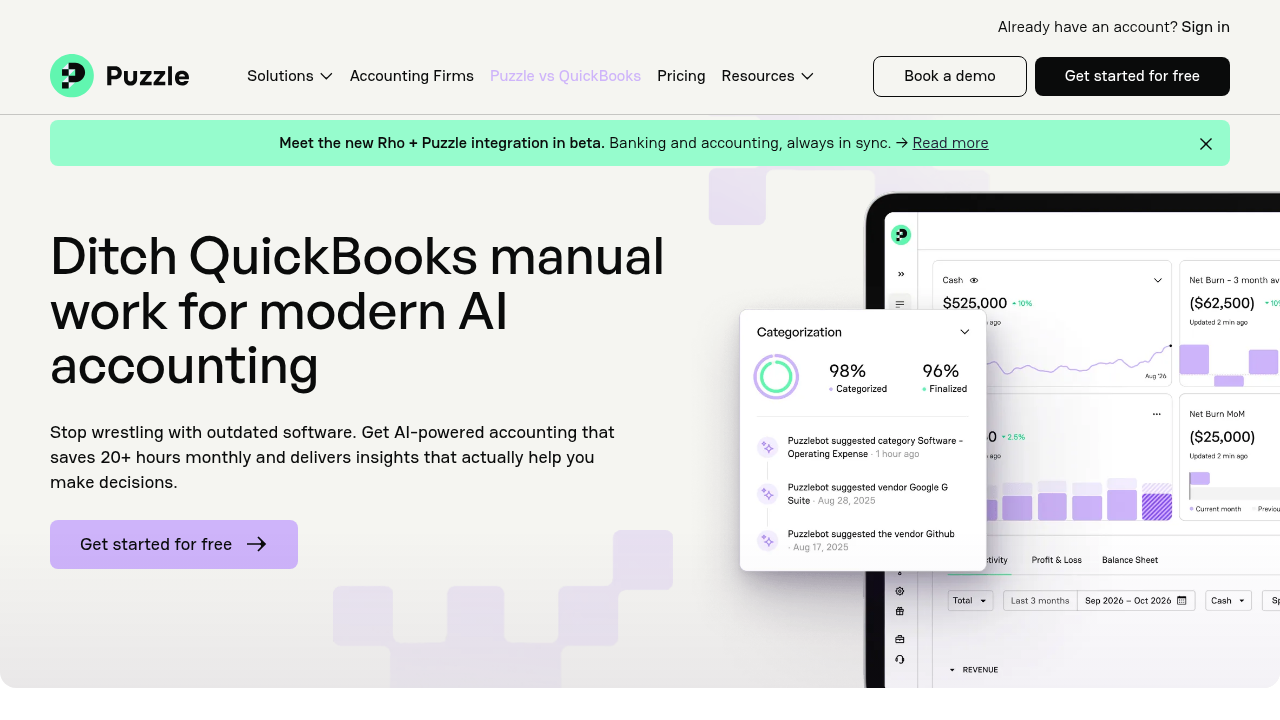
Puzzle was built AI-native for startups using modern fintech tools, while QuickBooks retrofits features onto architecture designed decades ago. If you run a traditional business with basic bookkeeping needs, QuickBooks works fine. But if you're a venture-backed founder who needs real-time burn rate visibility, native Stripe integration, and dual-basis accounting without manual journal entries, you need software built for your reality. Your financial data should help you make better decisions faster, not force you to wait until the month is already over.
If you're a venture-backed startup using Stripe, Mercury, Ramp, or similar fintech tools, Puzzle is the stronger choice because it was built for your stack and delivers real-time burn rate and runway visibility. QuickBooks works better for traditional businesses with basic bookkeeping needs that don't require subscription revenue tracking or daily financial insights.
Puzzle was built AI-native from day one, so our AI categorizes 85–90% of transactions automatically and learns from your patterns over time. QuickBooks added AI features to decades-old software, requiring you to build rules manually that don't improve with use, and many firms skip their integrations entirely because they break frequently.
Puzzle serves venture-backed startups (pre-seed through Series B) and the accounting firms that exclusively serve them. QuickBooks serves traditional small-to-medium businesses across all industries, from restaurants to retail shops, making it too broad for startup-specific needs such as burn-rate tracking and subscription revenue recognition.
No. Puzzle maintains both cash and accrual books simultaneously without extra work or spreadsheets. QuickBooks forces you to choose one at setup: cash means you lack investor-ready financials, while accrual means you lose visibility into your actual cash position and need parallel spreadsheets for compliance.
Puzzle's native integrations with Stripe, Mercury, Ramp, and Gusto connect in under 2 minutes with no third-party apps or field mapping required. QuickBooks requires a separate marketplace app for each tool that needs manual configuration and frequently breaks, causing many firms to enter transactions manually instead.
For seed-stage startups, Puzzle is purpose-built for automated bank reconciliation in a way QuickBooks is not. QuickBooks reconciliation requires manual transaction matching and rule configuration, work that doesn't get easier as your transaction volume grows. Puzzle's AI matches and categorizes transactions automatically, completing 81% of reconciliations without human review. The median reconciliation time drops from around 2 hours to 5 minutes. At seed stage, when you don't have a controller or finance team, that difference is the gap between closing your books on time and chasing transactions through spreadsheets at month-end.
Puzzle's partner-only model is built around firm scale, not individual client billing. Because AI handles 85–90% of transaction categorization automatically and reconciliations complete mostly without human review, your team spends time on advisory work instead of data entry. You can take on more clients without proportional headcount increases. QuickBooks Online Accountant offers wholesale billing and client management tools but competes directly with firms through its own bookkeeping services. Puzzle never does. Our business model only works if your firm grows, which means every product decision we make is designed to make your practice more efficient, not to replace it.
Xero and QuickBooks were both built for traditional small businesses and retrofitted for SaaS use cases. Xero is strong on multi-currency and international compliance; QuickBooks is the default for US-based SMBs. Neither was designed for subscription revenue, fintech-first banking, or real-time burn-rate visibility. For a SaaS startup on Stripe with Mercury and Ramp, both platforms require third-party apps, manual journal entries for deferred revenue, and a month-end close process before you can see accurate financials. Puzzle was built natively for that stack: Stripe subscription revenue is recognized automatically, burn and runway update daily, and you maintain cash and accrual books simultaneously without spreadsheets. If you're comparing Xero vs. QuickBooks vs. AI-native platforms, the deciding question is whether you want software that tolerates your SaaS model or software built around it.
Puzzle natively integrates with Ramp and Gusto, posting payroll journal entries automatically without manual configuration. Ramp transactions sync categorized and ready for review; see how Ramp accounting integrations handle payroll journal entries for the full details. Gusto payroll posts accurately to the correct accounts without manual entries. Rippling integration is on our roadmap. By contrast, QuickBooks and Xero support Gusto and Ramp through third-party connectors that require field mapping and break when APIs update, so payroll journal entries often need manual correction after the fact. If your startup runs payroll through Gusto or Rippling and spend management through Ramp, Puzzle eliminates the reconciliation work those disconnected integrations create.
Puzzle is a full replacement for QuickBooks, not a companion tool. It handles the complete accounting stack: transaction categorization, bank reconciliation, revenue recognition, financial reporting, and dual-basis books. You don't need QuickBooks running in parallel once you've migrated. Most firms complete the migration for a given client and close out QuickBooks access entirely. The only reason to keep QuickBooks temporarily is during a parallel-run pilot period (typically 30 to 60 days) while you verify that Puzzle's output matches historical records. After that, QuickBooks is no longer needed.
The standard approach is a parallel run: connect Puzzle to your client's live bank feeds and fintech accounts, then compare Puzzle's categorization and reconciliation output against what QuickBooks produces for the same period. Most firms run this for one full month-end close automation cycle, long enough to validate accuracy without committing to a full migration. Onboarding is handled through Puzzle's partner program: your firm gets a dedicated onboarding contact, and new clients are provisioned with your existing chart of accounts and integration connections. You don't have to rebuild the client's books from scratch, because Puzzle imports historical data from QuickBooks during setup.
Migration typically follows four steps: (1) export the client's QuickBooks data including chart of accounts, historical transactions, and open balances; (2) import into Puzzle, where historical journal entries and account mappings are reviewed and aligned; (3) run a parallel period (usually one month) to verify Puzzle's output matches; (4) cut over fully and close QuickBooks access. To avoid double-billing during the transition, time the QuickBooks subscription cancellation to the end of the current billing period, after the parallel run is complete. Puzzle's partner onboarding team can walk you through the exact sequencing for your firm's billing cycle. Contact your Puzzle partner manager to coordinate timing.
When Puzzle imports historical data from QuickBooks, journal entries tied to accounts that no longer exist in the chart of accounts are flagged instead of silently dropped. Puzzle maps them to a suspense or unclassified holding account so nothing is lost, and the import log identifies each affected entry with its original QuickBooks transaction ID. That lets you trace the entry back to its source data in QuickBooks and decide whether to remap it, write it off, or leave it in suspense. For firms migrating older clients with years of QuickBooks history, it's worth doing a chart-of-accounts cleanup pass in QuickBooks before the import to reduce the number of orphaned entries.
Accounting AI chat is a conversational interface: you ask a question about your books (for example, "What drove the increase in operating expenses last month?") and the AI queries your live financial data to answer it. It's available across plans and designed for on-demand analysis. AI Close agents are task-executing agents that run recurring close steps automatically on a schedule: they can categorize transactions, flag anomalies, run reconciliation checks, and update dashboards without you logging in. Agent availability and scheduling frequency vary by plan; higher tiers unlock more agent runs and custom scheduling. Contact Puzzle for current plan-level details, as agent capabilities are expanding throughout 2026.
AI credits cover agent-driven tasks that go beyond standard automation, such as running AI Close agents on a schedule, processing complex categorization batches, or triggering on-demand AI analysis across large transaction sets. Routine categorization of connected transactions and standard bank reconciliation are included automatically and don't draw from your credit balance. Think of credits as the fuel for higher-frequency or compute-intensive AI actions. Credit allocations are tied to your plan tier, and usage is visible in your Puzzle dashboard. If you're deciding between plans, it's worth estimating your monthly transaction volume and close frequency, as those are the two biggest drivers of credit consumption.
Puzzle's Bill.com integration syncs bill and payment data directly, bypassing the clearing account approach that QuickBooks and Sage Intacct use. Payments post directly to the correct AP accounts without an intermediate clearing step. For duplicate or ambiguous payment matching (situations where a payment in Bill.com could match multiple open bills), Puzzle surfaces the ambiguity for human review instead of auto-matching incorrectly. Regarding Bill.com's own bill-to-payment linkage data: Puzzle applies its own matching logic to the raw transaction data instead of inheriting Bill.com's linkage, because Bill.com's linked data can contain errors or gaps that would propagate into your books if accepted uncritically. If you're running a high volume of Bill.com transactions, the partner onboarding team can walk you through the matching configuration during setup.
Zoho Books is a general-purpose accounting platform built for small businesses, similar in positioning to QuickBooks: broad industry coverage, standard bookkeeping features, and a lower price point. It lacks native integrations with startup-specific fintech tools (Stripe subscription revenue, Mercury, Ramp), has no dual-basis accounting, and doesn't provide real-time burn rate or runway dashboards. For a traditional SMB that doesn't run on fintech infrastructure, Zoho Books is a reasonable option. For a venture-backed startup, it has the same fundamental gaps as QuickBooks. Running both side by side is straightforward: connect Puzzle to your live bank and fintech feeds while keeping Zoho Books for a parallel period, then compare the output at month-end. The gap typically becomes obvious within one close cycle.