Best Accounting Software with Modern Banking Integrations (October 2026)
Startup Accounting
Best Accounting Software with Modern Banking Integrations (October 2026)
Compare accounting software with native Mercury, Ramp & Brex integrations. Direct API connections automate categorization & reconciliation. January 2026 guide.
The Puzzle Team
1.30.26
In article:
Accounting. Simplified
A bad product lacks competitive advantage. Successful businesses have something unique that's hard to copy. It could be cost efficiency, brand power, or proprietary tech. Without this, you're just waiting to get outperformed. Think of physical retailers being outperformed by e-commerce.
Thank you for being part of our Puzzle community. Stay tuned!
Oops! Something went wrong while submitting the form.
If your accounting software loses the connection to your bank every few weeks, that's not a bug. That's what happens when fintech banking accounting runs through screen scrapers instead of direct APIs. Legacy tools were built before Mercury, Ramp, and Brex existed, so they rely on middleware that strips out transaction details and breaks at the worst possible time. Direct API integrations give you stable connections and rich metadata that actually automate your categorization, turning reconciliation from a multi-day project into background work that happens automatically.
TLDR:
Legacy accounting tools rely on screen scrapers that break constantly; direct API connections with Mercury, Ramp, and Brex deliver stable data and automated categorization.
Puzzle automates 85–90% of transaction categorization and cuts bank reconciliation from 2 hours to 5 minutes with AI trained on startup financial data.
Real-time burn rate and runway tracking prevents cash crises by showing financial health daily instead of weeks after month-end.
Puzzle is AI-native accounting software built exclusively for startups, with direct Mercury API integration and a partner-only model that never competes with accounting firms.
What Is Accounting Software with Banking Integrations?
Legacy systems often rely on third-party aggregators like Plaid to scrape data. This middleware approach frequently results in broken feeds and missing context right when you need to close the books.
True fintech banking accounting uses direct API connections instead of screen scraping:
Data Fidelity: A native Mercury accounting integration or Brex accounting software connection ingests rich metadata, not just raw numbers.
Automated Context: A direct Ramp accounting integration captures spend details instantly to automate categorization.
Reliability: API connections eliminate the synchronization errors that plague aggregator-based feeds, saving you from manually fixing transactions at month-end.
How We Ranked Accounting Software for Banking Integrations
Finding the right accounting tech isn't about counting logos on an integrations page. It’s about data fidelity. A connection is useless if it breaks constantly or requires manual intervention. We evaluated these solutions based on five specific factors:
Direct API depth with providers like Mercury, Ramp, and Brex to ensure data stability rather than relying on brittle screen scrapers.
Automation capabilities that ingest rich transaction metadata to auto-categorize expenses and speed up monthly reconciliation.
Real-time data sync reliability so founders never make decisions based on stale, outdated financials.
Startup-native features that translate raw banking data into essential metrics like burn rate and runway immediately.
Low-maintenance setup to prevent your finance team from wasting hours repairing broken data feeds.
Best Overall Accounting Software with Banking Integrations: Puzzle
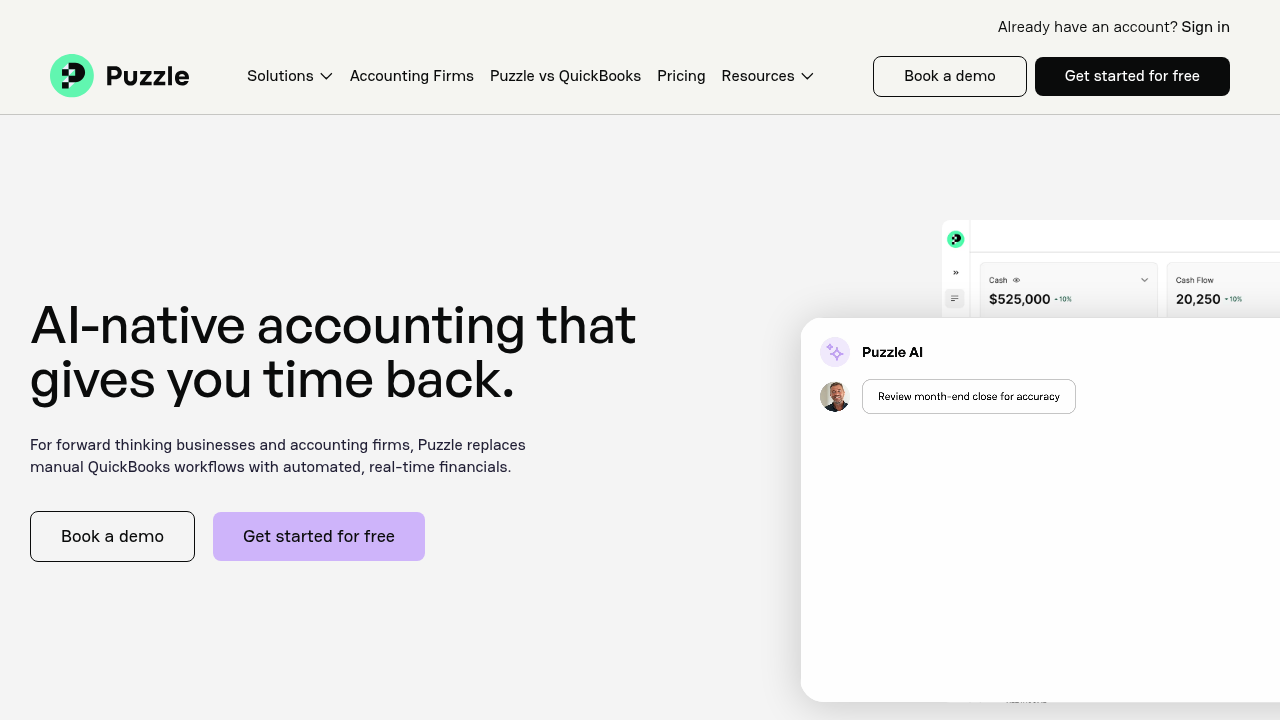
Puzzle is positioned as an AI-native bookkeeping software purpose-built for startups using modern fintech tools like Mercury, Ramp, and Brex, with deep, reliable banking integrations.
It emphasizes direct API connections, high automation, and real-time metrics so founders can see burn, runway, and cash at a glance instead of waiting for month-end closes.
What they offer
Direct API banking integrations with Mercury, Ramp, Brex, and Stripe for instant, reliable transaction syncing.
AI-native automation that categorizes and reconciles the vast majority of startup transactions in the background.
Real-time dashboards for burn rate, runway, cash position, and SaaS metrics without waiting for month-end close.
Dual cash and accrual views plus automated revenue recognition for subscription billing aligned with GAAP.
Good for: Startups banking with modern fintech platforms (like Mercury, Ramp, or Brex) that need accurate, always-on books and real-time financial visibility without heavy manual bookkeeping.
Limitation: Optimized for venture-backed or tech-forward startups using the new fintech stack; traditional small businesses or those on legacy banks and workflows may not benefit as much from its specialized integrations.
Bottom line: Puzzle combines deep fintech integrations, AI-driven automation, and live metrics to give founders a reliable, continuously up-to-date view of their finances, making it a strong choice when speed and accuracy matter more than generic small-business features.
Intuit QuickBooks
Intuit QuickBooks is the default for general small businesses because nearly every accountant knows it. However, its architecture predates the fintech stack, relying on standard bank feeds instead of deep API connections.
What they offer
Legacy familiarity.
An app ecosystem to connect with 650+ apps, though often via middleware.
Good for: Main street and general small businesses that prioritize widespread accountant familiarity, a broad app ecosystem, and standard accounting workflows over specialized startup tooling.
Limitation: Built on older bank-feed architecture that can drop or mangle rich transaction data, leading to broken connections and manual reconciliation; it also lacks native startup metrics, so founders often export to spreadsheets to track burn, runway, and SaaS performance.
Bottom line: QuickBooks remains a solid default for traditional small businesses, but startups relying on modern fintech stacks and needing stable, API-level banking integrations may encounter more manual work and less reliable visibility.
Xero
Xero remains a strong option for international startups requiring robust multi-currency capabilities. It offers a cleaner interface than legacy competitors and supports a vast ecosystem of third-party apps.
What they offer
Multi-currency support suited to startups operating across several countries.
Simple interface that many finance teams find easier to use than older legacy tools.
Broad ecosystem of third-party apps for invoicing, expenses, and reporting.
Core small-business accounting features (invoicing, bills, bank reconciliation, basic reporting).
Good for: International startups and businesses that need strong multi-currency support and a cleaner UX than traditional small-business accounting tools.
Limitation: Often depends on third-party aggregators instead of direct fintech APIs, leading to unstable connections for modern banking tools and a lack of built-in startup metrics like burn rate or runway, which pushes founders into manual spreadsheet models.
Bottom line: Xero is a solid choice for global operations, but US startups on modern fintech stacks may face data instability and delayed visibility compared with tools built on direct banking integrations.
Zoho Books
Zoho Books excels at cost efficiency, making it a logical choice for general small businesses already deeply embedded in the Zoho ecosystem. It offers a competitive free tier and an AI assistant, Zia, for basic tasks.
What they offer
Low-cost, SMB-friendly accounting with a competitive free tier for smaller teams.
Native fit for companies already using the broader Zoho suite (CRM, support, and other apps).
Core small-business features such as invoicing, expenses, and standard reporting.
Good for: General small businesses that prioritize affordability and already operate within the Zoho ecosystem, where tight integration and low total cost matter more than startup-specific metrics.
Limitation: Lacks deep, native API integrations for modern fintech banks and cards, often requiring CSV uploads or unstable connectors, and does not surface key startup metrics like burn rate or runway out of the box.
Bottom line: Zoho Books delivers strong value for cost-conscious SMBs, but startups scaling on tools like Brex, Mercury, or Ramp may find the manual workflows and limited real-time insight too restrictive.
Digits
Digits targets general small businesses with AI agents designed to run accounting autonomously. It integrates with fintech banking accounting tools like Mercury and claims 97.8% accuracy, monetizing through in-house CPA services.
What they offer
AI-driven bookkeeping and accounting workflows aimed at running much of the process without an accountant.
Automated transaction categorization designed for general small-business use cases.
Optional in-house CPA and bookkeeping services wrapped around the software.
Good for: Small businesses that want to offload most of their accounting to an AI-powered system and are comfortable consolidating both software and bookkeeping with a single provider.
Limitation: Competes with external accounting firms by selling its own services and lacks startup-specific features like detailed burn tracking and automated SaaS revenue recognition tuned for high-growth companies.
Bottom line: Digits can work for businesses looking to replace their accountant, but it is a poor fit for startups that need nuanced metrics or accounting firms that require a non-competitive software partner.
Campfire
Campfire operates as an AI-native ERP, positioning itself alongside NetSuite for companies scaling past Series B. It targets mid-market operations instead of early-stage startup agility.
What they offer
Multi-entity consolidation for complex corporate structures.
Advanced revenue recognition logic for enterprise contracts.
Infrastructure designed specifically for large in-house finance teams.
Good for: Post-Series B and later-stage companies, typically with 100+ employees or multi-entity structures, that need enterprise-level control and consolidation rather than lightweight startup tooling.
Limitation: Overbuilt for pre-seed to Series A startups, with long implementations, higher costs, and no strict partner-only model creating friction for teams that depend on external advisory firms.
Bottom line: Campfire is a strong fit once a company reaches true mid-market scale, but for earlier-stage startups it introduces complexity and overhead long before it delivers meaningful clarity.
Feature Comparison Table of Accounting Software Banking Integrations
Legacy accounting tools often depend on screen scraping or third-party aggregators that frequently disconnect. Puzzle connects directly via API. This native architecture makes your Mercury accounting integration, Brex accounting software sync, and Ramp accounting integration stable and precise. Instead of fixing broken feeds, you get accurate fintech banking accounting that flows into your books instantly. We designed this system to maintain continuous accuracy, removing the manual data cleanup required by older tech.
Feature
Puzzle
QuickBooks
Xero
Zoho Books
Digits
Campfire
Native Mercury Integration
Yes
No
No
No
No
No
Native Ramp Integration
Yes
No
No
No
No
No
Native Brex Integration
Yes
No
No
No
No
No
Native Stripe Integration
Yes
No
No
No
No
Yes
Plaid Bank Connections
Yes
Yes
Yes
Yes
Yes
Yes
Automated Burn Rate Tracking
Yes
No
No
No
No
No
Automated Runway Calculation
Yes
No
No
No
No
No
Revenue Recognition Automation
Yes
Manual
Requires Add-on
Limited
No
Yes
Real-Time Bank Reconciliation
Yes
Manual
Manual
Manual
Yes
Yes
Dual-Basis Accounting
Yes
Manual
Manual
Manual
No
Yes
Partner-Only Model
Yes
No
No
No
No
No
Why Puzzle Is the Best Accounting Software for Banking Integrations
Puzzle relies on native API connections rather than brittle screen scrapers that frequently disconnect. This architecture supports deep Mercury accounting integration, Brex accounting software, and Ramp accounting integration. By ingesting rich transaction metadata, our AI automates categorization with precision that legacy tools cannot match.
For the 100,000+ startups using Mercury, Puzzle offers the only accounting software built directly on their API. This eliminates broken bank feeds and enables real-time visibility into burn rate and runway. We combine these direct fintech banking accounting connections with a partner-only model, empowering accounting firms with automation rather than competing with them.
Final Thoughts on Selecting Accounting Software with Native Banking Connections
Screen scrapers break. Ramp accounting integration built on native APIs stays stable and captures the metadata you need for automated categorization. For startups using the modern fintech stack, that reliability turns accounting from a monthly headache into a real-time advantage.
FAQs
Which accounting software is best for startups using Mercury or Ramp?
Puzzle offers the only native Mercury API integration and direct Ramp connections, eliminating the broken feeds and manual fixes common in legacy tools. For startups banking with modern fintech providers, native API depth matters more than logo counts on an integrations page.
How do I choose between QuickBooks and newer accounting software for my startup?
If you need real-time burn rate tracking, automated revenue recognition for Stripe subscriptions, or stable connections to Mercury, Brex, or Ramp, newer software built for the fintech stack will save you hours of manual work. QuickBooks works well for general businesses but relies on third-party connectors that frequently break for startup banking tools.
What's the difference between native API integrations and standard bank feeds?
Native API connections ingest rich transaction metadata directly from your bank or payment processor, enabling automated categorization and instant reconciliation. Standard bank feeds use screen scraping or aggregators that strip context, break frequently, and force you into manual cleanup at month-end.
When should an accounting firm switch from QuickBooks to AI-native software?
If your firm spends hours monthly fixing broken fintech connections, manually categorizing transactions, or building spreadsheets for client metrics like burn rate and runway, AI-native software can cut month-end close time by up to 50% while delivering the real-time insights modern clients expect.
Let us help you solve your financial puzzles.
Thank you for being part of our Puzzle community. Stay tuned!
Oops! Something went wrong while submitting the form.