You chose Xero because it worked for your last company, but that was a consulting business with straightforward invoicing. Now you're running a SaaS startup, and Xero vs Puzzle becomes an obvious comparison when you need automated revenue recognition and real-time burn rate tracking. Let's look at what's built for venture-backed companies instead of general small businesses.
TLDR:
Xero is cloud-based accounting software that's been around since 2006. Originally from New Zealand, it handles invoicing, bank reconciliation, expense tracking, payroll, and financial reporting.
The software connects with over 1,000 third-party apps, letting you build out a custom financial stack. Xero recently launched JAX (Just Ask Xero), an AI assistant that answers questions about your finances and automates routine tasks.
Where Xero stands out: unlimited user access across all pricing tiers. While most accounting software either caps users or charges per seat, Xero lets your whole team log in without extra fees. This matters when you're scaling headcount and need your ops team, department heads, and finance team all accessing the same data.
The interface is built for founders without accounting backgrounds. You can pull reports and check your cash position without needing a CPA to walk you through it. Xero targets small to medium-sized businesses looking for something more capable than spreadsheets but less complex than enterprise solutions.
Xero handles the basics well, especially for international businesses needing multi-currency support. Companies exporting worldwide appreciate how it manages foreign bank accounts and exchange rates.
But for US-based startups, the gaps show quickly.
Xero doesn't track burn rate, runway, or ARR natively. When an investor asks about your runway in a board meeting, pulling up a separate spreadsheet isn't a great look.
Integrations with US fintech tools like Stripe, Mercury, Ramp, or Brex rely on third-party apps instead of native connections. For SaaS companies, revenue recognition for subscription businesses stays mostly manual. If you're selling subscriptions, you're back to spreadsheets or paying for additional tools.
Support is another sticking point. Getting someone on the phone when your books don't balance before a funding deadline? Reviewers consistently mention this frustration.
The pricing looks reasonable until you add up the extra apps needed to make Xero work for your needs. About half of reviewers mention cost concerns.
If you need real-time startup metrics, automated revenue recognition, or software built for venture-backed companies, these gaps matter.
Puzzle is AI-native accounting software built for US startups and the accounting firms that serve them. Unlike Xero's general small business focus, Puzzle was designed for tech companies that need real-time burn rate tracking, automated revenue recognition, and deep integrations with the fintech stack startups actually use.
85–90% automated transaction categorization with AI that learns from your patterns. Native integrations with Stripe, Mercury, Ramp, Brex, and Gusto connect in minutes. Real-time burn rate, runway, and ARR/MRR tracking built into every dashboard. Simultaneous cash and accrual accounting with automated revenue recognition schedules that adapt to your contracts.
Best for US-based tech startups from pre-seed to Series B, SaaS startups using Stripe and Mercury, and accounting firms serving startup clients who want a partner that won't compete for their business.
The dominant cloud accounting software for small to medium-sized businesses with over 750 integrations and broad accountant availability.
Good for small businesses with general accounting needs that favor familiarity over AI-native automation.
The tradeoff: retrofitting AI onto decades-old architecture, no native startup metrics like burn rate and runway, and direct competition with accounting firms through QuickBooks Live bookkeeping services.
AI-native ERP built for high-growth SaaS companies scaling toward IPO. Best for Series B+ companies with $50M+ ARR, multiple legal entities, and dedicated finance teams preparing for eventual public markets.
The gap: enterprise-priced with complex implementation that assumes you have controllers and CFOs who can work through ERP systems.
Affordable accounting within the broader Zoho business suite. Good for small businesses already using the Zoho ecosystem who want low cost and unlimited users.
What's missing: burn rate tracking, runway calculation, ARR/MRR metrics, and limited revenue recognition capabilities.
Positions itself as autonomous general ledger with AI agents that replace bookkeepers at $65/month for self-serve or $100/month for the standard plan.
The conflict: full-service offering directly competes with accounting firms and focuses on general SMB needs over startup-specific metrics.
AI-native ERP positioning itself as the NetSuite replacement for mid-market tech companies with 50-500+ employees.
The mismatch: built for companies that need ERP capabilities, making it oversized for early-stage startups with implementation taking days to weeks versus hours.
When you're comparing accounting software for your startup, the differences between tools built for general small businesses versus venture-backed companies become obvious. Here's how Xero stacks up against alternatives designed for different stages and needs.
| Platform | Best For | AI Architecture | Startup Metrics | Revenue Recognition | Key Integrations | Starting Price |
|---|---|---|---|---|---|---|
| Xero | International SMBs needing multi-currency support | Recently added JAX AI assistant | No native burn rate, runway, or ARR tracking | Manual or third-party apps required | 1,000+ third-party apps, no native US fintech integrations | $25 to $90/month |
| Puzzle | US startups pre-seed to Series B, SaaS companies, accounting firms | AI-native with 85–90% automated categorization | Real-time burn rate, runway, ARR, and MRR built into dashboards | Automated revenue recognition for subscriptions and contracts | Native: Stripe, Mercury, Ramp, Brex, Gusto | Custom pricing |
| QuickBooks Online | Small businesses that favor familiarity | AI retrofitted onto legacy architecture | No native startup metrics, requires spreadsheets | Manual tracking or QuickBooks Advanced | 750+ integrations, broad accountant availability | $38/month |
| Rillet | Series B+ SaaS companies with $50M+ ARR preparing for IPO | AI-native ERP built for high-growth companies | Full suite of SaaS metrics and forecasting | Automated multi-entity revenue recognition | Enterprise integrations with implementation support | Enterprise pricing |
| Zoho Books | Small businesses in Zoho ecosystem focused on low cost | Limited AI capabilities | No burn rate, runway, or ARR tracking | Basic revenue recognition, limited automation | Zoho suite integrations, limited fintech connections | $20/month |
| Digits | General SMBs wanting autonomous bookkeeping | AI agents positioned to replace bookkeepers | General metrics, not startup-specific | Automated through AI agents | Standard banking and payment integrations | $65/month |
| Campfire | Mid-market tech companies with 50-500+ employees needing ERP | AI-native ERP architecture | Full suite of financial metrics for scaling companies | Full ERP revenue recognition capabilities | Enterprise-grade integrations | Enterprise pricing |
The right choice depends on where you are in your journey. If you need real-time startup metrics without waiting for month-end close, software built for venture-backed companies saves you from cobbling together spreadsheets and third-party apps.
The gap between general-purpose accounting tools and startup-specific platforms widened noticeably this year. At Xerocon Denver in August 2026, Xero announced agentic AI workflows aimed at small businesses, a sign that even legacy platforms are racing to catch up on automation. In the same month, Xero added embedded payroll and new US payments capabilities, signaling a push to deepen its foothold in the American market.

But the structural limitation remains: these additions are layered onto architecture designed for general SMBs, not venture-backed companies. AI adoption in accounting is now growing roughly 26% per year, and the category is splitting in two: traditional platforms retrofitting AI on top of legacy systems, and AI-native platforms like Puzzle that were built from the ground up with automation at the core.
For early-stage founders comparing tools today, the question isn't whether your accounting software uses AI: most claim to. The question is whether that AI actually reduces your close time, surfaces burn rate daily, and connects natively to the fintech stack you already use.
Xero works fine for general small businesses, but venture-backed startups need software built for survival metrics and the tech stack you actually use.
Puzzle delivers what Xero can't. AI-native automation categorizes 85–90% of transactions without third-party apps. Real-time burn rate and runway calculations live in your dashboard instead of separate spreadsheets. Native integrations with accounting tools for the startup banking stack (Stripe, Mercury, Ramp, Brex, and Gusto) connect in minutes, not days.
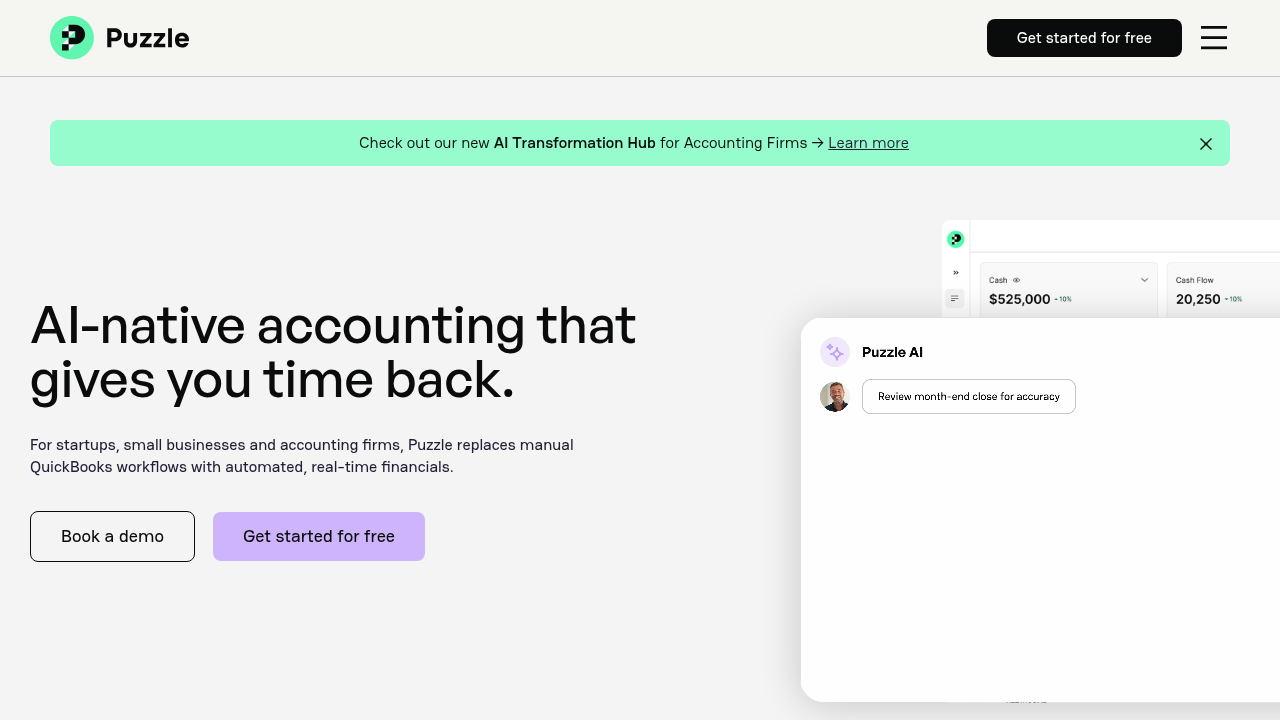
82% of small businesses that fail cite cash flow problems as a primary cause. Waiting weeks for month-end close means you see warning signs too late. Puzzle surfaces the metrics you need to make critical decisions right now, while automating the painful bookkeeping work.
For accounting firms: our partner-only model means we never compete for your clients. No bookkeeping services, no direct-to-business sales. We grow when you grow.
The right startup accounting software shows you burn rate and runway in real-time, not weeks after decisions have already been made. Xero leaves you patching together integrations and paying for apps that should work natively. See what accounting built for venture-backed companies actually looks like.
At seed stage, you need bank transaction matching that runs itself, not a monthly manual exercise. Puzzle connects natively to your bank accounts (Mercury, Brex, and others) and uses AI to categorize 85–90% of transactions automatically, so your books stay current without a bookkeeper touching every line. Xero and QuickBooks both offer bank transaction matching, but they rely on rules-based matching and third-party sync apps that require ongoing maintenance. For a seed-stage startup with no dedicated finance team, the difference is whether transaction matching happens daily in the background or piles up until someone has time to do it manually.
Puzzle is built on a partner-only model: we sell exclusively through accounting and bookkeeping firms, never directly to their clients. The AI-native architecture handles categorization and transaction-matching automatically, so your team spends time on advisory and review instead of data entry. Firms managing 50+ startup clients gain a unified view across portfolios without proportional headcount growth: the same workflows that serve 10 clients scale to 50 because the software handles the volume, not your staff. QuickBooks Online Accountant and Xero HQ offer multi-client management tools, but their underlying automation still surfaces more manual work per client than an AI-native platform built for this scale.
Consider switching if you're a US-based startup that needs real-time burn rate and runway tracking, automated revenue recognition for SaaS subscriptions, or native integrations with tools like Stripe, Mercury, and Ramp. If you're building spreadsheets to track metrics Xero doesn't provide natively, you're likely outgrowing it.
Real-time cash flow visibility requires two things most legacy tools don't provide together: native bank sync and automated categorization. Without both, you're waiting for a bookkeeper to match and clear transactions before you can trust the numbers. Puzzle connects directly to Mercury, Brex, Ramp, and your other financial accounts, categorizes transactions automatically with AI, and surfaces burn rate, runway, and cash position in your dashboard every day, not at month-end. Founders without a CFO or controller use this to make hiring, spend, and fundraising decisions based on current data instead of last month's close. Tools like Xero or QuickBooks require manual transaction-matching steps or third-party apps before the same visibility is available.
Puzzle integrates natively with Stripe, Mercury, Ramp, Brex, and Gusto: the core fintech stack most US startups are already running. Native means direct API connections maintained by Puzzle, not third-party sync bridges that break on API updates or require separate subscriptions. Stripe revenue flows directly into automated revenue recognition schedules. Mercury and Brex transactions sync and categorize without manual imports. Ramp card spend maps to your chart of accounts automatically. Xero and QuickBooks connect to some of these tools through their app marketplaces, but those are third-party integrations with their own setup, maintenance, and failure points. For a startup that lives inside this fintech stack, native matters.
Focus on real-time startup metrics (burn rate, runway, ARR/MRR), native integrations with your fintech stack, and automated revenue recognition if you sell subscriptions. For venture-backed companies, cash vs. accrual accounting for startups matters: running both simultaneously saves time and keeps you compliant without managing separate systems.
For a SaaS startup, the choice comes down to what you need natively versus what you'll bolt on. Xero handles multi-currency and general invoicing well, but SaaS-specific needs (subscription revenue recognition, ARR/MRR tracking, burn rate dashboards) require third-party apps. QuickBooks Online is the most widely supported platform with the broadest accountant network, but its AI is retrofitted onto legacy architecture built for general SMBs, not venture-backed companies. Newer AI-native platforms split into two categories: Rillet and Campfire are ERP-class tools designed for Series B+ companies with $50M+ ARR and dedicated finance teams; Puzzle is built for pre-seed through Series B, with automated revenue recognition, real-time startup metrics, and native fintech integrations sized for the stage where founders are still doing most of the financial work themselves. If you're a SaaS startup that hasn't yet hired a controller, Puzzle is the right fit. If you're preparing for IPO with a full finance org, an ERP is the right answer.
Xero was built for general small businesses, not venture-backed tech companies. Startups need burn rate visibility to avoid running out of cash, but Xero requires separate spreadsheets or third-party apps to track these survival metrics. The integration gaps with US fintech tools and manual revenue recognition create extra work that slows you down.
Yes, but only if it's built for it. AI-native tools like Puzzle deliver daily updates on cash position, burn rate, and runway because they connect natively to your bank accounts and financial tools. Legacy software requires manual reconciliation and categorization first, creating delays that push insights to month-end.