The close at
agent speed
AI Close agents execute the close process your accountants design. You control the system. Your team approves every outcome.
10 → 30
50%
Trusted by forward-thinking accounting firms.











What CPAs are saying
We closed all of our accounts by the fourth business day.

Every client is different. AI Close adapts to each one – not a one-size-fits-all checklist.

90% of a new client close done in 30 minutes. It used to take 3 hours.

How Debit & Co. Closed 15 Clients by the 4th Business Day with Puzzle




Accountants are the architects. AI is the engine.
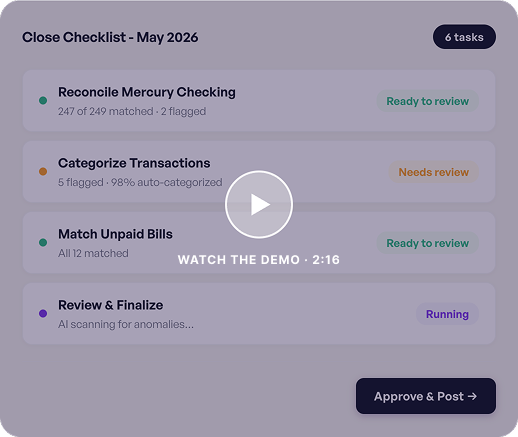
Four steps. Every action logged, sourced, and accountant-approved. Nothing posts to the GL without your sign-off.
Write the workflow in plain language, the way you'd explain it to your team.
The agent is in learning mode: iterating, reasoning, finding the optimal solution. You don't write code. You write instructions. The agent handles the rest.
AI converts your description into explicit, runnable steps. The logic locks.
This is where probabilistic AI becomes deterministic. The solution is found, locked, and saved. Same inputs, same outputs. Every single run. Your reconciliations and categorizations are not being re-imagined each time. They are executed with the consistency you expect.
You approve. The agent executes. Full audit trail attached.
Nothing posts to the GL without your explicit sign-off. The agent surfaces its findings in a review panel: every proposed entry, every reasoning step, every source transaction. You review, ask follow-up questions in plain English, and approve. Control never leaves the room.
AI runs a final review of the month-end close for accuracy.
After running all your tasks, kick off the Review & Finalize analysis to scan every record across the platform. AI surfaces discrepancies in a review panel: each anomaly flagged, each affected account, each source transaction. You review the findings, ask the agents to continue working on them, and take actions. Nothing slips past you.
Every action logged.
Every entry traces back.
Nothing posts without your approval. Every agent action has a complete audit trail: date, time, action, source transaction, reasoning, and who approved it. When a partner reviews the work, or an auditor asks, every entry traces back to its source.
100%
Full
Zero
Built on three principles.
Designed for the way accountants work.
Customizable
You design every workflow. The agent runs exactly what you built. No code. No consultants. Just plain-English instructions.
Permissioned
Nothing posts to the GL without your explicit approval. Full control at every step. Every action requires a human sign-off.
Aligned
AI executes your judgment at scale. It does not replace it. The accountant is always the architect. The agent is always the engine.
Production-ready prompts. Copy, paste, run.
Every prompt is pre-connected to your client's data inside Puzzle AI Close. No setup. No configuration. Just describe what you need and let the agent work.
Bank Statement Transaction Extraction & Reconciliation
Extract the transaction table from this bank statement PDF with the highest possible accuracy. Match each row against the existing ledger entries and flag any…
Match Unpaid Bills to Payments
Identify unpaid bills over the last 3 months and propose the most likely payment matches based on amount, date proximity, and memo. Flag any bills that…
Identify & Draft Unbilled Accruals
Using expense patterns from the last 3 full months, identify likely unbilled costs to accrue this month: subscriptions, recurring services, and vendor…
Journal Entry Review & Anomaly Detection
Review all journal entries posted this period and flag any that appear unusual: round numbers, unusual accounts, entries posted outside business hours…
Prepaids Review
Review the current prepaid and accrual schedules alongside this month's GL activity. Identify any prepaids that should have amortized but haven't, and…
Transaction Audit
Review last month's transactions for the following risk patterns: duplicate payments, split transactions below approval thresholds, and vendors with…
Prepare for a Client Call
Give me a summary of this client's business health and 3–5 talking points for our call. Use plain English for the titles and flag anything that needs…
Variance (Flux) Analysis
Given the trial balance for the current month and the prior month, perform a flux analysis. For each account with a variance over $X, explain the likely…
Cash Runway Estimate
Estimate runway in months based on current cash and last month's burn rate. Produce a summary table showing projected cash over the next 6 months and…
Forecasting & Narrative
Using the client's last 6 months of general ledger activity, build a rolling 13-week cash flow forecast. Highlight the 3 biggest drivers of cash movement…
Find a Key Business Insight
Analyze this client's full GL history and find the single most valuable insight, something actionable that the client likely doesn't already know about…
Profit Margin Analysis
Using the client's revenue and cost data from the general ledger, perform a margin analysis at the product or service line level. Flag any lines where…
How much capacity is your firm leaving on the table?
Adjust the inputs to see your firm's potential capacity recovery.
The numbers firms are seeing.
3 hrs → 30 min
New client close time, down from 3 hours
"You can't unsee it as a CPA. 90% of a new client close done in 30 minutes. It used to take 3 hours."
- Arlo Financial
10x
Time saved per close task across clients
"Saves our team so much time, we're reducing client fees."
- Accountalent
50%
Faster month-end close
"Trivium cut their close time in half in the first month."
- Trivium
10 → 30
Clients managed. Same team. Same headcount.
"Firms using AI Close report tripling client capacity without adding a single new hire."
- Across firms
Scale without headcount.
Stay in control.
Speed is the hook. Control is what closes the deal. AI Close delivers both, without asking you to give up either.
Go deeper.
AI Playbook for Firms
The Next Generation Firm Playbook: How to Adopt AI in Accounting Without Losing Judgment, Margin, or Client Trust
What are AI Agents
What is an AI agent in accounting, and what does it mean for the way your firm works? Learn more here.
Case Study: Debit & Co.
How Debit & Co. Closed 15 Clients by the 4th Business Day with Puzzle
AI Isn’t Taking Accounting Jobs. It’s Exposing How Firms Use Time.
The risk isn’t replacement.
It’s misallocation.
When repetition compresses, judgment expands.
The question is whether your workflow is built for that shift.
How AI Ready Is Your Firm?
Are you compressing repetition
or defending it?
Seven questions.
Instant clarity.
Questions we hear a lot.

Nothing posts to the GL without your approval. Every agent drafts the work for review and approval, citing the finding, reasoning and recommended next steps before you click approve. If something looks off, you edit it, delete it or override it. You're not trusting the AI blindly. You're reviewing its work the same way you'd review a junior bookkeeper's output. The AI has already done the heavy lifting.
Puzzle's categorization is a custom learning model. It trains on your firm's industry mix and your accountants' preferences, not a generic ruleset. Most clients see up to 98% auto-categorization by month 2 to 3 without writing a single manual rule. The remaining transactions can be auto-routed to the client, who responds in natural language by email. By the time you log in, everything is ready for review.
Two differences that matter for your firm. The technology. QuickBooks AI is probabilistic intelligence. Same input, different output. It drafts, guesses, and asks you to check its work. Puzzle is deterministic execution. Same input, same output, every run. Your firm sets the rules. The AI runs them. The business model. Intuit is using AI to compete for your clients. Puzzle is using AI to help your firm serve more clients, more profitably. One is built to replace you. One is built for you.
That's exactly what the Add Custom Agent flow is for. Beyond the standard templates, you can create custom agents with plain-English instructions. Multi-entity real estate, agencies with class tracking, SaaS companies with complicated revenue recognition: all of these run as custom agents on top of the standard close. Build once, reuse across clients. No code required.




The accounting firm of the agent era starts here.
See AI Close in action with a live demo tailored to your firm's workflow.