Few events shake the tech industry to its core like the sudden collapse of a major player. In 2023, Silicon Valley Bank (SVB) crashed, sending shockwaves through the financial ecosystem. As the FDIC took control, Mercury’s CEO Immad Akhund faced a decisive moment.
This is how they navigated the chaos and made decisions that would shape their future in a suddenly unstable landscape.
TLDR:
SVB's instability started as whispers, but by mid-week, it was a full-blown exodus. Suddenly, Mercury was flooded with SVB refugees seeking financial shelter.
"Everyone needed a bank account, fast." Immad remembers.
Mercury experienced a shocking surge in demand. This wasn't a time for business as usual. As the CEO, Immad mobilized Mercury’s 400-strong workforce into action. The goal was clear: provide a smooth onboarding experience for the influx of new customers.
They onboarded a tidal wave of new customers without drowning. This wasn't about growth—it was about being the lifeboat in a perfect storm.
As the chaos unfolded, one question echoed: "Is Mercury safe?"
Immad knew that simply asserting their stability wouldn’t be enough. Customers needed tangible proof.
Here's how they quickly inspired confidence:
These efforts weren't just about reassurance, but radical transparency in a time of uncertainty. Potential customers were assured their cash is safe with Mercury.
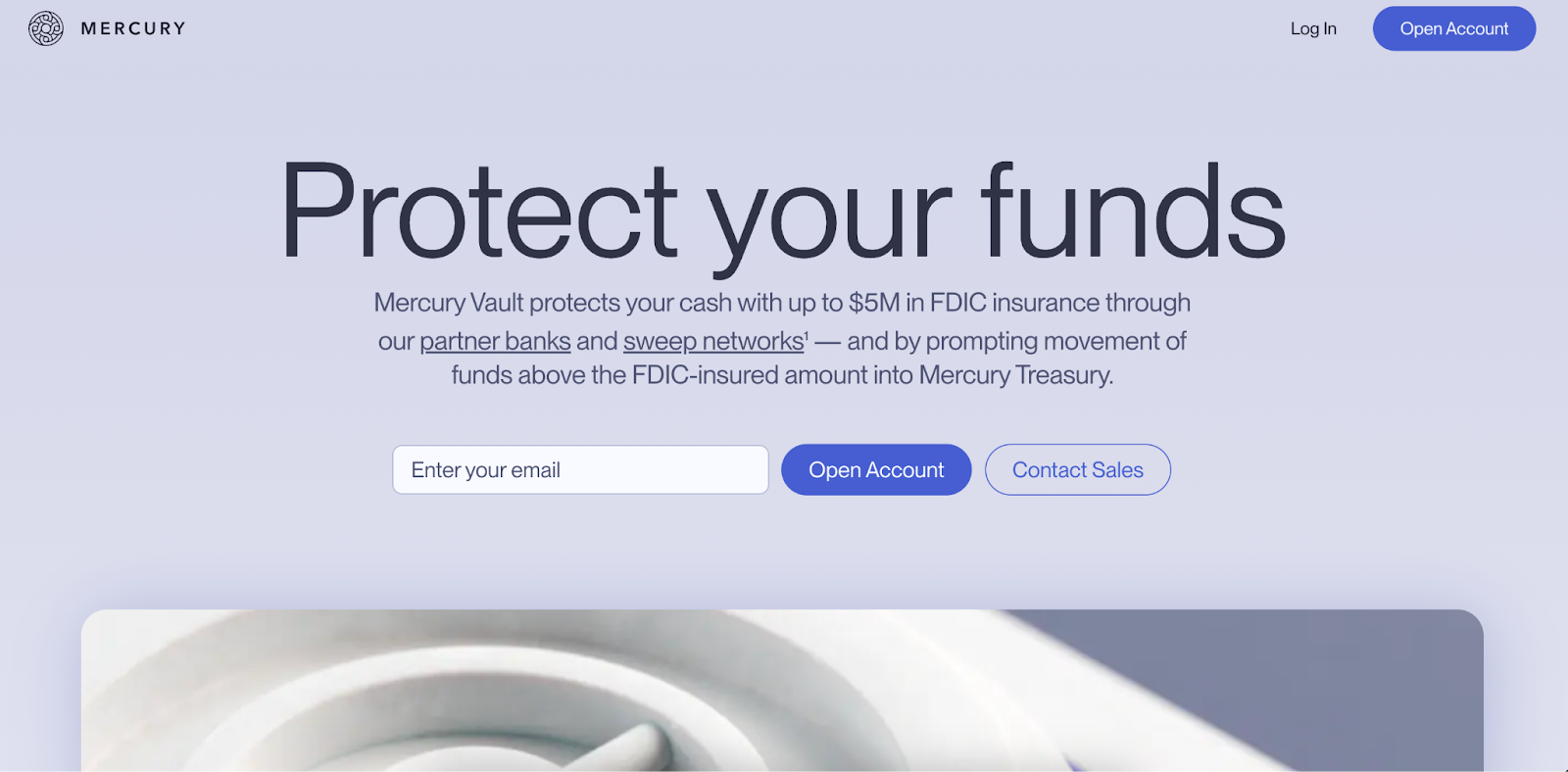
When you're a startup founder, every problem looks like a product waiting to happen. The Mercury Vault wasn't a knee-jerk reaction—it was their battle-tested approach in action. Their team has been listening to customers' fears and had already built the core components of the product, the crisis just accelerated the release timeline.

"We didn't invent new solutions," Immad explains. "We repackaged existing ones to directly address the panic. That's the power of having a flexible product mindset."
They used their Treasury by Mercury Advisory product, which gave customers access to U.S. government T-bills through a money market fund, providing additional security and confidence.
Looking back, Immad doesn't sugarcoat it: "Startups are a rollercoaster."
He ticks off Mercury’s highlights: Launched in 2019, Covid obliterated 60% of their revenue in 2020, then they doubled it a month later. After that, the 2023 banking apocalypse arrived, full steam ahead. By that time, the team was comfortable responding quickly to extreme situations.
Immad's mantra on crisis leadership? "Underplay the good times, stay calm in the bad."
It's not about avoiding crises—they're inevitable. It's about building an organization that thrives on chaos. Each storm makes you stronger, faster, more adaptable. By the time SVB collapsed, Mercury wasn't just ready, they were in their element.
Mercury’s response to the SVB crisis was about reinforcing their long-term vision. They were building for sustainability and growth. As Immad puts it, "We're not here for a quick exit. We're building something that lasts."
There are three lessons that ambitious founders can take away from Mercury's response to the SVB failure in 2023:
In startups, change is the only constant. The collapse of SVB exemplified Mercury’s resilience and highlighted the importance of swift, decisive action and transparent communication.
The SVB crisis turned out to be a defining chapter, not just a close call. By May 2026, Mercury hit a $5.2 billion valuation after closing a $200 million Series D — a 49% jump in just 14 months — and now counts more than 300,000 customers, including one in three early-stage U.S. startups. The company has been profitable for four consecutive years and hit $650 million in annualized revenue as of Q3 2025.
| Milestone | Detail |
|---|---|
| Valuation (May 2026) | $5.2 billion — a 49% jump in 14 months |
| Series D raise | $200 million |
| Customer count | 300,000+, including 1 in 3 early-stage U.S. startups |
| Consecutive profitable years | 4 years |
| Annualized revenue (Q3 2025) | $650 million |
| Application growth (Q1 2026 vs. prior year) | 2.5× — driven largely by AI-native founders |
| Transaction volume (2025) | $248B — up 59% year-over-year |
| Regulatory win | Conditional OCC approval (April 2026) to become a federally regulated bank |
More recently, Mercury received conditional OCC approval to become a federally regulated bank — a move that will reduce its reliance on partner banks, expand its lending capabilities, and join the Zelle network. It's a direct consequence of the credibility Mercury built during the SVB chaos: customers who trusted them in the worst moment are still there, and they've brought thousands more with them.
The macro tailwind helping Mercury now? AI is accelerating startup formation at a pace few predicted. Mercury's applications grew 2.5x in Q1 2026 versus the prior year — driven largely by a new generation of AI-native founders opening accounts at day zero. As Immad put it: "We're going to see more founders in the next five years than in the last twenty." The lifeboat became the flagship.
The lesson for founders: how you respond to a crisis compounds over time. Mercury's transparency, speed, and product instinct in March 2023 didn't just win customers — it won trust that has proven extraordinarily durable.
As of April 2026, Mercury entered what regulators call the "bank organization phase" — the final stretch before full authorization to launch Mercury Bank, National Association. The OCC's conditional approval requires Mercury to capitalize the new bank at no less than $300 million, satisfy remaining supervisory conditions, and receive final authorization from the OCC — along with pending approvals from the FDIC and the Federal Reserve — before opening its doors as a federally chartered institution.
For founders, the practical upside is significant: once Mercury Bank, N.A. launches, Mercury will control its own payments infrastructure, expand lending products for businesses and individuals, and join the Zelle network — all without routing through partner banks. That means faster money movement, more direct control over how payments are processed, and a banking partner that was purpose-built for founders from day one. The lifeboat that showed up in March 2023 is becoming a full-fledged bank.
Mercury isn't alone in this move. On September 10, 2026, Block filed its own OCC charter application — a signal that the era of fintechs depending entirely on partner banks is ending across the industry. For founders, this matters: the banking infrastructure underpinning your financial stack is consolidating around a small group of players who are betting on full regulatory accountability rather than the BaaS model. Knowing which platforms are building toward that kind of structural permanence — and which aren't — is exactly the signal worth tracking before the next crisis hits.
Mercury isn't alone in this move. As of September 10, 2026, Block submitted its own national trust bank charter application to the OCC — a signal that the era of fintechs depending entirely on partner banks is ending across the industry. For founders, this matters: the banking infrastructure underpinning your financial stack is consolidating around a small group of players who are betting on full regulatory accountability rather than the BaaS model. Knowing which platforms are building toward that kind of structural permanence — and which aren't — is exactly the kind of signal worth tracking before the next crisis hits.
As of September 2026, Mercury isn't coasting on its SVB-era momentum — it's accelerating. The company recently launched AI agent tools that let founders interact with their accounts in plain language: approving payments, sending invoices, and managing finances conversationally, without digging through dashboards. A broader AI interface is expected before year-end. For founders who lived through the SVB chaos refreshing browser tabs at 2 a.m., that kind of real-time, natural-language control over their financial stack is a meaningful leap forward.
There's also a strategic signal worth noting: Immad has ruled out selling to a bank — a pointed contrast to Brex, which was acquired by Capital One in April 2026 for $5.15 billion. His stated goal is an IPO: "I really want to build a strong independent brand. I would like it to be a public company." For the 300,000+ founders banking with Mercury, that independence matters — it means the platform they chose during the worst banking crisis in a decade is still building toward something, not winding down into a legacy acquirer's roadmap.
The SVB crisis underscored a critical truth: in the startup world, speed is everything. But speed without direction? That's just a fast way to crash and burn.
During the chaos, Mercury had to quickly restructure their team to handle an influx of new customers and revamp product development plans to address new market demands. Access to real-time financial statements, awareness of your cash vs. accrual position, net burn, and runway are crucial in these key moments. A burn rate post-mortem can reveal how quickly your cash position shifted — and whether you’d have seen it coming.
With daily updated insights, your team can move fast while maintaining confidence in their financial understanding and decisions. For every opportunity, every partnership, every pivot—make sure you have the right numbers to inform your decisions. In a world where hesitation kills, staying ahead of your financials is crucial.
That matters more now than ever. On September 16, 2026 — the day before this post was updated — Mercury launched Mercury Books, an integrated bookkeeping product built directly into its banking platform. For founders already banking with Mercury, it's a convenient baseline. But convenience and depth aren't the same thing: Puzzle's accrual-aware engine, burn and runway calculations, and Stripe-native revenue recognition are built for the financial complexity that emerges as you scale — not just for keeping transactions categorized. For a full comparison of options across your startup banking stack, see our breakdown of the top accounting tools. Puzzle turns raw data into actionable insights, instantly. No more guesswork, no more lag between decision and data. Try Puzzle today.
At the seed stage — typically pre-revenue or early-revenue, one entity, no dedicated finance hire — the fastest path to real-time burn and runway is connecting your bank account (Mercury, SVB, or any major business bank) directly to Mercury bookkeeping software for startups that updates daily rather than waiting for a monthly close. The formula is straightforward: net burn = cash out − cash in over a period; runway = current cash balance ÷ net monthly burn. The hard part isn't the math — it's having numbers you can trust today, not three weeks after month-end.
Here's how to get there:
Puzzle pulls live transaction data from Mercury and Stripe, updates your burn and runway daily, and keeps both cash and accrual books accurate in real time — so your runway number is never more than 24 hours stale. No spreadsheet required, no waiting for month-end. For a broader look at how these integrations work, see our guide to Mercury Bank accounting integration.
For a small SaaS team (say, 5–15 people) banking with Mercury and processing payments through Stripe, the right accounting software for Mercury users is one that connects natively to both — so your cash position and revenue data stay current without manual exports. Puzzle was built for exactly this stack: it pulls live transaction data from Mercury and recognizes Stripe revenue in line with ASC 606, keeping both your cash and accrual books accurate in real time.
Tools like QuickBooks or Xero can connect to Stripe and Mercury via third-party integrations, but they were designed for traditional businesses — which means you'll spend time forcing them to handle subscription revenue, deferred income, and multi-currency correctly. NetSuite offers that sophistication but is typically overkill (and overpriced) until you have a dedicated finance team and multi-entity complexity. If you're weighing a move away from QuickBooks, see our breakdown of AI accounting alternatives to QuickBooks. For a SaaS startup that wants clean books, daily burn and runway visibility, and a direct line from Stripe and Mercury accounting tools to your financial statements, an AI-native tool sized for your stage is the better fit — and the right Mercury Bank accounting integrations make that connection straightforward.