Startup Accounting
October 2026 Guide: Brex and Puzzle for Startups
Learn why funded startups love Brex and Puzzle in January 2026 for real-time burn tracking, automated accounting, and financial visibility that matches business pace.

2.17.26
Learn why funded startups love Brex and Puzzle in January 2026 for real-time burn tracking, automated accounting, and financial visibility that matches business pace.
Your investors expect you to maintain 24 to 30 months of runway, but your accounting system tells you where you stood six weeks ago. Brex and Puzzle fix this disconnect by working as a single system instead of disconnected tools. Brex extends credit based on startup metrics that matter, your team captures expenses at the transaction level, and Puzzle's AI categorizes everything automatically while updating your burn rate in real time. The result is financial visibility that matches the pace of your business, where you see the impact of hiring decisions and marketing spend this week instead of next month.
TLDR:
Venture capital changes everything about how you run your startup. The moment you close your seed or Series A round, you're playing a different game with different rules. Investors expect you to maintain 24 to 30 months of runway and hit growth rates between 20% and 30% annually. Miss those benchmarks and your next fundraising conversation gets harder.
The problem is that most founders find they're off track weeks after it matters. Traditional accounting operates on a monthly cycle. You complete the month-end close for startups, get your financials, and by then you're looking at decisions you made 30 to 45 days ago. That delay can be fatal for a company burning, say, $200K per month.
Funded startups need to know their burn rate daily, understand which expenses are trending up, and see how new hires or marketing spend impacts runway. This isn't about better spreadsheets or faster bookkeepers. You need financial infrastructure that updates as money moves.
Traditional banks won't extend credit to early-stage startups. They want personal guarantees, three years of revenue history, and collateral most founders don't have. Even if you just raised $5 million, getting a $50K credit line from Chase requires your personal credit score and often your home as collateral.
Brex built its underwriting model around the metrics that matter for venture-backed companies. They look at your cash balance, burn rate, and runway instead of your personal FICO score. If you have $2 million in the bank and reasonable burn, Brex can extend six-figure credit limits within days. According to Brex's own marketing materials, 1 in 3 venture-backed US startups uses Brex because it's one of the few financial products designed for how startups work.
The value goes beyond the card itself. Brex combines cards, expenses, and bill pay in a single system. Your team submits receipts directly in Brex, approvals route automatically, and transactions sync to your accounting software the same day.
Most startups handle expenses the same painful way. Someone on your team buys something, screenshots a receipt, texts it to Slack, forgets about it for two weeks, then submits an expense report with half the details missing. Your finance person chases them down, matches receipts to card transactions manually, and spends hours each week sorting it all out.
The expense management software market is growing from $9.09 billion in 2026 to a projected $17.26 billion by 2034, according to Fortune Business Insights, because every company faces this bottleneck. Startups feel it harder because you can't hire someone just to manage expense reports, and you can't afford the time your team wastes on reimbursement paperwork.
Brex removes the bottleneck by capturing everything at the transaction level. Your team takes a photo of the receipt in the Brex app the moment they make a purchase. The system matches it to the card transaction automatically, enforces your spending policies in real time, and syncs the categorized expense to your books without manual data entry.
The hours you save add up fast. Instead of spending Friday afternoons chasing down expense records, your team focuses on shipping features and talking to customers.
You can have the best corporate card and the best accounting software, but if they don't talk to each other properly, you're still doing manual work. Most startups start with disconnected tools because they adopt what works at each stage. You get Mercury for banking, Brex for cards, Gusto for payroll, and QuickBooks because everyone said you needed it. Choosing the right accounting tools for your banking stack from the start prevents most of this.
Then you start to see the integration tax. Brex transactions take days to sync to QuickBooks. When they finally arrive, categories are wrong or missing. Your bookkeeper spends hours each month fixing what should have been automatic. You're running reports in three different systems and building spreadsheets to see the full picture.
When you need to understand your burn rate for a board meeting, you're exporting CSVs from Brex, pulling a separate report from QuickBooks, and matching the two in a spreadsheet before you can trust the number. That's the gap the table below shows: sync delays, manual categorization, and month-old burn data, each a product of tools that work fine in isolation but don't share state.
| Disconnected Stack | Brex + Puzzle | |
|---|---|---|
| Transaction sync | Days to sync; often manual CSV imports | Real-time, automatic |
| Categorization | Manual: bookkeeper clicks through dropdowns | AI-automated, 85–90% of transactions categorized automatically |
| Burn rate visibility | 30 to 45 days after month-end | Updated daily |
| Expense capture | Screenshot → Slack → expense report → manual match | Receipt photo in Brex app, auto-matched at transaction level |
| Credit underwriting | Personal guarantee + 3 years of revenue history | Based on cash balance, burn rate, and runway |
| Book types maintained | Separate spreadsheets for cash vs. accrual | Both maintained simultaneously from one transaction stream |
Funded startups need their financial stack to function as a single system. When Brex syncs to Puzzle in real time with accurate categorization, your runway calculation reflects what actually happened this week, not what a bookkeeper finished entering last month. That's the difference between reacting to last month's problems and preventing next month's mistakes.
Getting transactions into your accounting system is only half the battle. Someone still needs to categorize every Brex transaction, match it against your bank statements, apply the right accounting treatment, and generate reports that actually tell you what's happening.
Most startups solve this by paying someone to do it manually. Your bookkeeper logs into QuickBooks, reviews hundreds of transactions, clicks through dropdown menus to assign categories, and fixes errors one by one. This process takes days each month, and by the time you get clean financials, the data is already stale. Founders leaving QuickBooks often find that AI-native QuickBooks alternatives cut that lag entirely.
AI changes the economics completely. Puzzle categorizes 85–90% of transactions automatically by learning from your patterns. When a Brex transaction for Google Ads hits your account, Puzzle recognizes it, categorizes it correctly, and clears it against your bank feed without human intervention.
The time savings matter, but the real value is continuous visibility. Your P&L updates as transactions happen instead of weeks later. You see how yesterday's spending affected your burn rate this morning, not next month.
Running out of money kills more startups than bad products or weak markets. You can recover from a failed launch or a competitor entering your space. You can't recover from zero dollars in the bank.

Burn rate is the metric that matters. Every hiring decision, every marketing campaign, and every software subscription either extends or shortens the time you have to hit your next milestone. Founders who track burn monthly make decisions on outdated information. By the time you realize you're burning $50K more per month than planned, you've already spent $150K you didn't have.
Real-time burn tracking changes how you operate. When Brex transactions sync to Puzzle daily, you see the impact of decisions immediately. A $180K engineering hire adds roughly $15K to your monthly burn the moment their first paycheck clears, and that shift shows up in your runway calculation the same day. Your AWS bill spiked 40% this week because of that product launch, and you know it now instead of at month-end.
The combination of Brex's spending controls and Puzzle's real-time accounting creates a feedback loop that keeps you alive longer. You set budgets in Brex, track actual spend against targets in Puzzle, and adjust before small problems become fatal ones.
Brex gives you spending control and transaction data. Puzzle turns that data into the financial intelligence you need to run your startup.
The integration works in real time. Every Brex transaction flows into Puzzle automatically, gets categorized by AI (85–90% of transactions categorized automatically), and updates your financials immediately. No manual imports, no waiting for bank feeds to refresh, no bookkeeper spending hours matching transactions to receipts.
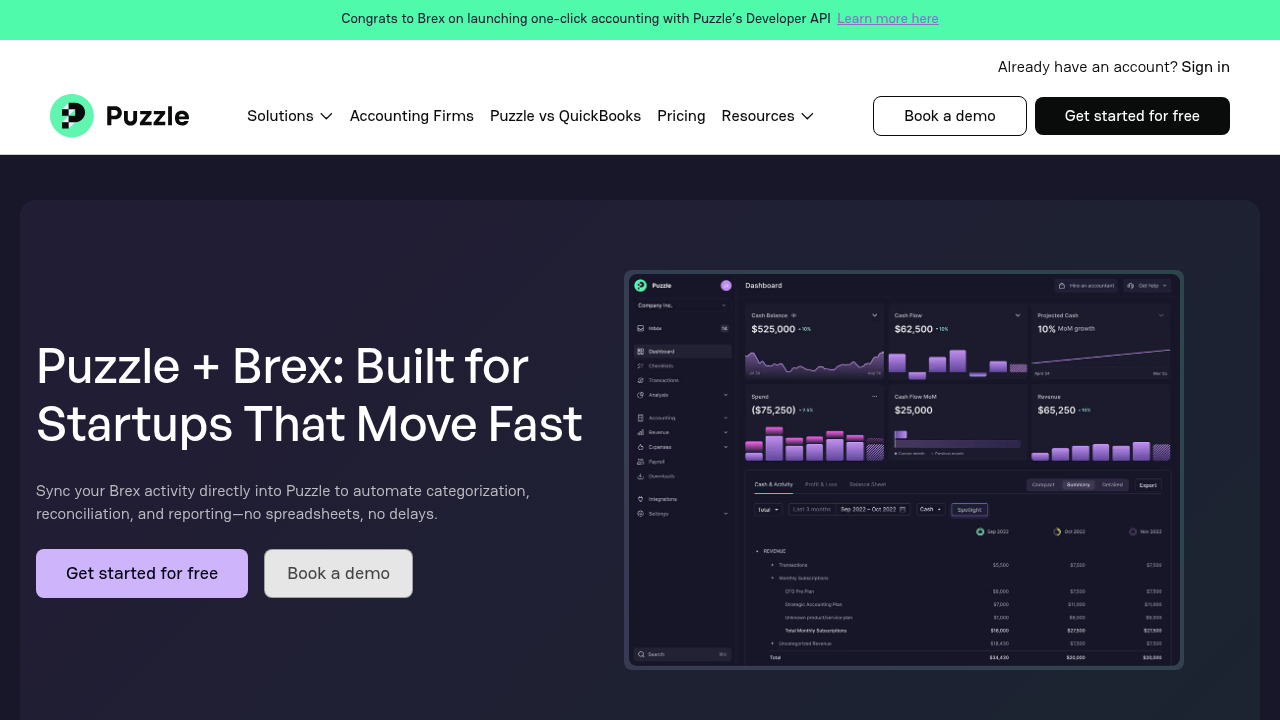
Puzzle maintains both cash and accrual books simultaneously from the same transaction stream. You see your actual cash position for daily decisions while keeping accrual financials ready for investors and tax filing. Most startups manage this with separate spreadsheets that break the moment your business gets complex.
The dashboard shows you what funded startups actually need to monitor: current burn rate, remaining runway, and cash on hand. These numbers update daily as Brex transactions sync, so you're making decisions based on today's reality instead of last month's history.
Puzzle is built to integrate with your full fintech stack. If you're running on Brex, you can review the best accounting software for Brex users to get the full value of both without the integration tax.
The stakes around burn rate visibility have risen sharply. Fundraising cycles have stretched considerably between rounds, with time between seed and Series A now running well over 18 months according to Crunchbase data. The era of grow-at-all-costs is over, and doing more with less capital has become the baseline expectation.
The burn multiple, net burn divided by net new ARR, has become the dominant capital performance metric investors use at the Series A stage. Burkland's July 2026 Series A evaluation guide puts the threshold at under 2x to be viewed as lean, with under 1x considered strong. That has tightened meaningfully from the 2020 to 2021 window when burn multiples above 2x were routinely accepted. Meanwhile, Crunchbase data shows the median Series A round in 2026 sits around $20 million, with investors expecting that capital to carry a company credibly to Series B milestones.
That compression leaves almost no room for delayed financial reporting. Burkland's diligence checklist now requires 12 to 24 months of GAAP-aligned historical financials, a driver-based forecast model founders can defend assumption by assumption, and a clear use-of-funds plan tied to Series B milestones.
If you're catching a burn spike six weeks after it happened, you've already lost the time needed to produce those artifacts before your next fundraise conversation. Real-time visibility isn't a nice-to-have in this environment: it's what investors will ask for in the first diligence call.
Running out of cash kills more startups than bad products, and monthly financial reporting shows you problems too late to fix them. Brex and Puzzle together give you the real-time burn tracking and automated accounting that funded companies need to stay alive longer. Your transactions sync automatically, categorize with AI, and update your runway calculation daily. You make better decisions because you're working with today's data, not last month's history.
Brex underwrites based on startup-specific metrics like cash balance, burn rate, and runway instead of personal credit scores or collateral. If you have $2 million in the bank with reasonable burn, they can extend six-figure credit limits within days.
When your corporate card, bank, and accounting software don't sync properly, someone spends hours each month manually matching transactions, fixing incorrect categories, and building spreadsheets to see the full picture. Brex transactions can take days to sync to QuickBooks, and categories often arrive wrong or missing.
When you see burn rate and runway daily instead of weeks after month-end, you catch problems early enough to fix them. That new engineering hire's impact on your burn shows up within days, not 30-45 days later when you've already overspent.
85–90% automated categorization means your bookkeeper stops spending days clicking through dropdown menus and can focus on strategic work instead. More importantly, your financials update as transactions happen, not weeks later, so you're making decisions on current data.
Yes, Puzzle maintains both simultaneously from the same Brex transaction stream. You see actual cash position for daily decisions while keeping accrual financials ready for investors and taxes, without managing separate systems that break as you scale.
This is one of the most common sources of double counting in Puzzle.
When you issue an invoice in Stripe, Puzzle records the revenue at that point. When the customer pays via bank transfer outside Stripe, Puzzle sees a new deposit hit your bank feed and may record it as a second revenue event, because there's no automatic signal connecting that bank transfer to the original Stripe invoice.
The fix is to apply the bank transfer against the open accounts receivable balance created by the invoice, not categorize it as new income. On first occurrence, you or your accountant needs to match the bank transfer to the outstanding receivable; Puzzle's AI will learn the pattern over time. If you're regularly collecting outside Stripe, setting up a categorization rule for those incoming transfers prevents the double count from recurring.
Puzzle's AI categorization accuracy depends on how much transaction history it has to learn from. On a new account, accuracy will be lower because the AI hasn't yet built enough patterns to recognize your specific vendors and spending categories. As you finalize transactions, the AI creates categorization rules automatically and improves over time, eventually reaching 85–90% automated categorization on a mature account.
When the AI's confidence is low, it intentionally leaves a transaction uncategorized, avoiding a wrong guess. Those transactions appear in your review queue for you to categorize manually. Once you do, Puzzle creates or updates a rule so the same vendor or transaction type is handled correctly going forward. You can also create rules manually for recurring vendors, split transactions by percentage or dollar amount across multiple categories, and bulk-edit transactions across any field. If you're in the early weeks of a new account and accuracy feels low, that's expected: the system is still building its pattern library from your real data.
On an accrual basis, cash activity and the balance sheet are measuring two different things, so a gap between them is expected, not a bug. The cash activity report tracks actual cash moving in and out of your bank accounts. The balance sheet includes non-cash items: accrued expenses, accounts receivable, prepaid assets, and deferred revenue. If your beginning and ending cash balances don't match between the two reports, the most common culprits are bank transfers recorded as expenses instead of balance sheet movements, transactions categorized to income or expense accounts instead of asset or liability accounts, or a clearing account (like bank transfers in transit) that hasn't been fully cleared. Puzzle's bank transfers and transit clearing account exists to prevent one category of these mismatches: see the next question.
When money moves between two accounts you own (say, from your Brex account to your Mercury savings), Puzzle needs to record both the outgoing and incoming transaction without double-counting cash. The transit clearing account sits in the middle: the outgoing transfer reduces your Brex balance and parks in clearing, then the incoming transfer clears it out against the same entry. Without this, a $100K sweep would show up as $100K in expenses and $100K in income simultaneously. You can't turn the clearing account off, because it's doing real accounting work. What you can do is make sure both sides of every transfer are matched promptly: transfers left sitting in clearing are the most common reason the cash activity report doesn't tie to your balance sheet. If clearing balances are building up, it usually means one leg of a transfer wasn't categorized correctly or synced yet.
Most startups run on cash-basis accounting early on: it's simpler and mirrors your bank balance. The trigger to switch to accrual is typically one of four things: you raise institutional capital and investors expect GAAP financials, you're approaching a Series A audit, you start recognizing revenue over time (subscriptions, contracts), or your burn rate exceeds $50K per month and timing differences between cash and accrual start distorting decisions. Puzzle makes the transition easier because it maintains both cash and accrual books simultaneously from the same transaction stream. You don't have to migrate off one system and rebuild in another; the dual-basis view is built in from day one.
The real answer depends on complexity, but for most funded startups (single entity, Brex or a similar fintech stack, no dedicated controller), Puzzle is built for exactly this situation. It syncs your Brex transactions in real time, categorizes them automatically, and maintains clean financials without someone manually clicking through QuickBooks dropdowns every month, so a founder or part-time CFO can stay on top of burn and runway without a full-time accounting hire. QuickBooks and Xero are capable tools, but they were built for businesses with bookkeepers to operate them. Puzzle is built to run lean, so a founder or a part-time CFO gets accurate burn, runway, and cash position without a full-time accounting hire.
Puzzle integrates natively with Brex, Mercury, Ramp, Gusto, Rippling, Deel, Stripe, Carta, and BILL, among others. Each connection takes about two minutes to set up and pulls in transactions automatically once connected.
For bank accounts, automatic daily reconciliation works natively with Mercury and Ramp. Brex also syncs in real time through the direct integration. Other banks and financial institutions require manual CSV uploads to import transactions. For bill pay, BILL connects natively so vendor payments flow into your books without manual entry. If you're running a standard fintech stack (Brex for cards, Mercury for banking, Gusto or Rippling for payroll, Stripe for revenue), Puzzle connects to all of it without CSV imports or third-party sync tools.
Puzzle was built for exactly this profile: venture-backed, high-growth, technically sophisticated founders who need real-time financial visibility but don't want to manage accounting infrastructure. YC and accelerator-backed startups typically run Brex or Mercury for banking, Stripe for payments, and Gusto for payroll; Puzzle integrates natively with all of them. You get the burn rate, runway, and GAAP-ready financials that investors expect from your first institutional round, without the overhead of a legacy system or a full accounting team. Other tools like Pilot and Rillet also target this segment; Puzzle stands apart on its AI-native architecture and the depth of real-time Brex integration.
Manual bank reconciliation (downloading statements, matching transactions line by line, chasing down discrepancies) is one of the biggest time sinks at a seed-stage company. Puzzle automates this by syncing directly with Brex and your other connected accounts in real time. Transactions flow in as they happen, get categorized by AI, and clear against your bank feed automatically. At seed stage, where your transaction volume is manageable but your team's time isn't, reconciliation that used to take hours each month now runs continuously in the background. You close the books faster and see accurate cash position without waiting for a manual process to complete.
The combination of Brex and Puzzle is built for this. Brex captures every transaction at the moment it happens (card spend, bill pay, expense reimbursements) and syncs to Puzzle automatically. Puzzle's AI categorizes the transactions, updates your burn rate, and refreshes your runway calculation daily. You see current cash position, this week's spend by category, and how new hires or campaigns are affecting your runway, all without a controller or finance analyst running monthly reports. The dashboard is designed for founders: burn, runway, and cash on hand, updated every day, without requiring any manual work from your team.