Fiscal Year vs Calendar Year: Which One Should Your Startup Use? (June 2026)
Fundraising Tips
Fiscal Year vs Calendar Year: Which One Should Your Startup Use? (June 2026)
Learn whether your startup should use fiscal year or calendar year. Compare tax deadlines, entity restrictions, and planning options. June 2026 guide.
The Puzzle Team
6.11.26
In article:
Accounting. Simplified
A bad product lacks competitive advantage. Successful businesses have something unique that's hard to copy. It could be cost efficiency, brand power, or proprietary tech. Without this, you're just waiting to get outperformed. Think of physical retailers being outperformed by e-commerce.
Thank you for being part of our Puzzle community. Stay tuned!
Oops! Something went wrong while submitting the form.
When you file your first tax return, the IRS is going to ask whether you're using a fiscal year or calendar year, and depending on your entity type, you might not actually get to choose. S-Corps are generally locked into the calendar year, while C-Corps have flexibility, and partnerships need to match their majority partners. Before you pick, you need to know what your corporate structure allows and how that timing affects when you can claim deductions and when your tax bill comes due.
TLDR:
Pick your fiscal year based on when your revenue peaks—ending after your busy season keeps complete business cycles in one reporting period instead of splitting them across two years.
Your entity type restricts your options: S corps and sole proprietors must use calendar year (January 1 to December 31), while C corps can start their fiscal year on any date.
Fiscal year choice affects when you file taxes (calendar year: April 15; fiscal year: 15th of third month after year-end) and when you can claim deductions for major purchases.
Switching fiscal years later requires IRS approval via Form 1128, so get your initial choice right by consulting a CPA familiar with startup structures before filing your first return.
Modern accounting software like Puzzle tracks burn rate and runway in real-time on whatever fiscal year structure you choose, without extra manual work at close.
What Is a Fiscal Year and How Does It Differ From a Calendar Year?
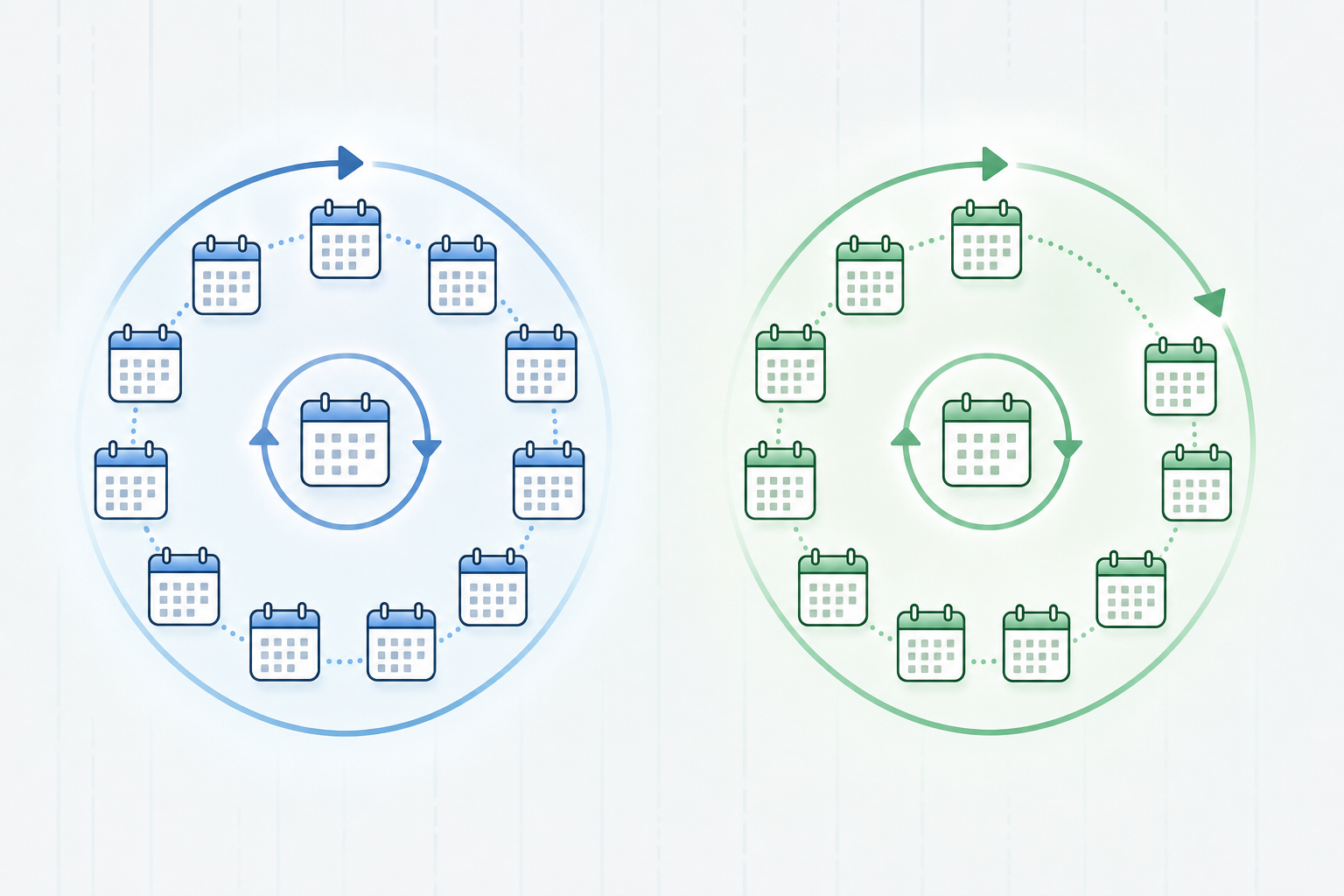
A fiscal year (FY) is any 12-month period a business or government uses for accounting and financial reporting purposes. Unlike a calendar year, which runs from January 1 to December 31, a fiscal year can start on any date and end exactly 12 months later.
The U.S. federal government, for example, runs its fiscal year from October 1 to September 30. Many retailers align their fiscal year to end after the holiday shopping season, often in late January or early February, so their biggest revenue period falls cleanly within one reporting cycle.
Here is a quick comparison:
Calendar Year
Fiscal Year
Start date
January 1
Any date
End date
December 31
12 months after start
Who uses it
Most individuals, many startups
Governments, seasonal businesses
Common example
Jan 1 Dec 31
Oct 1 Sep 30 (U.S. federal)
For startups, the distinction matters more than it might initially seem. Your choice affects how you report taxes, how investors read your financials, and whether your quarterly reports actually reflect how your business performs throughout the year.
Understanding Fiscal Year Dates, Quarters, and Abbreviations
Once you've picked a fiscal year start date, the structural details follow a predictable pattern. Here's what to know.
Quarters
A fiscal year divides into four quarters of roughly three months each. If your fiscal year starts January 1, your quarters look like this:
Q1: January through March
Q2: April through June
Q3: July through September
Q4: October through December
If your fiscal year starts July 1 (common for government entities and some universities), the quarters shift accordingly, with Q1 running July through September and Q4 covering April through June.
Abbreviations
Fiscal years are typically abbreviated as "FY" followed by the year in which the fiscal year ends. A company with a fiscal year running July 1, 2025 through June 30, 2026 would label it FY2026. This is worth knowing when reading government budgets, investor reports, or public filings, where FY and calendar year references can easily be confused.
Key Dates to Know
The U.S. federal government runs on a fiscal year starting October 1 and ending September 30. State governments vary; California, for instance, runs July 1 through June 30. For startups, these distinctions matter mostly when working with government grants or contracts.
Calendar Year vs Fiscal Year: IRS Requirements and Entity Type Restrictions
Not every startup gets to freely pick between a calendar year and a fiscal year. The IRS has specific rules about tax years and which entities can use each, and your corporate structure may already narrow the decision for you.
S Corporations and Personal Service Corporations
S corps and personal service corporations (PSCs) are generally required to use the calendar year. There are exceptions, but they require IRS approval and a clear business purpose, which is a high bar to meet.
Partnerships and multi-member LLCs must generally match the tax year of their majority partners or members. If there's no majority, the IRS default is the calendar year.
Sole Proprietors
Sole proprietors file on Schedule C and must use the calendar year, full stop.
Before settling on a fiscal year, confirm your entity type is eligible. If you're unsure, consult a CPA before filing your first return.
Why Seasonal Businesses Choose Fiscal Years Over Calendar Years
For a ski resort, a retailer, or a summer camp, the calendar year creates a real reporting problem. If your busiest month is December, a December 31 year-end splits your peak season across two separate books. Revenue lands in one year, but the returns, refunds, and post-season costs follow in the next.
Ending your fiscal year after your busy season closes means your financials reflect a complete business cycle. You can see total seasonal revenue against total seasonal costs in one place, which makes year-over-year comparisons far more accurate.
There are a few common fiscal year choices for seasonal businesses:
Retailers often close their fiscal year on January 31, capturing the full holiday season and post-holiday returns before the books close.
Agricultural businesses frequently end their fiscal year after harvest, when inventory levels are at their lowest and easiest to count.
Summer tourism operators may choose a September or October year-end, once the season has fully wound down and receivables have cleared.
For a startup with a seasonal product or revenue model, this same logic applies. If your growth is tied to a predictable annual cycle, your fiscal year should wrap around that cycle, not cut through the middle of it.
Calendar Year Benefits: Why
The calendar year runs January 1 through December 31, and for most early-stage startups, that simplicity is genuinely useful.
A few reasons founders gravitate toward it:
Personal tax returns follow the calendar year, so keeping your business on the same cycle reduces the mental overhead of tracking two separate year-end timelines at once.
Most contractors, payroll providers, and financial institutions already operate on a calendar year basis, making W-2s, 1099s, and year-end reconciliations straightforward to coordinate.
Investor benchmarking is easier when your annual metrics align with how most other startups report, since calendar year comparisons are the default in most seed and Series A conversations.
Accounting software defaults to the calendar year, which means less configuration work when you are just getting started.
For a pre-seed or seed-stage startup with no seasonal revenue patterns and no compelling reason to do otherwise, the calendar year is often the right default. It keeps things simple when your team is small and your accounting resources are thin.
How Choosing Your Fiscal Year Impacts Tax Strategy and Deductions
Your fiscal year choice shapes more than your reporting calendar — it directly affects when you can claim deductions, how you time major purchases, and when your tax obligations come due.
For startups, this timing can matter. If your business has predictable seasonal expenses, a fiscal year that ends shortly after your biggest spending period lets you capture those deductions sooner. A calendar year startup buying equipment in December gets the deduction that year. A fiscal year company with a June 30 year-end buying the same equipment in July captures it in the very next reporting period.
There are a few practical tax considerations worth knowing:
Your chosen fiscal year locks in your tax filing deadline. Calendar year filers typically have an April 15 deadline for federal returns, while fiscal year filers file by the 15th of the third month after their year-end.
Changing your fiscal year requires approval, so the initial choice carries real weight.
Consult a tax advisor before locking in your fiscal year. The right choice depends on your entity structure, revenue timing, and how your major expenses fall across the calendar.
Real-World Examples: How Major Companies Structure Their Fiscal Years
A few well-known examples show the logic in practice:
Walmart ends its fiscal year on January 31, keeping its full holiday season in one reporting cycle instead of splitting it across two years.
Apple closes on the last Saturday of September, aligned with its annual product launch cadence so new iPhone revenue lands cleanly within a single period.
Microsoft uses June 30, which keeps enterprise software renewal cycles within one fiscal year.
Government contractors commonly mirror the federal October 1 through September 30 cycle to sync with client budget approvals.
The pattern holds across industries: companies pick fiscal years that keep their most important revenue moments intact within one reporting period.
For a startup, the same logic applies. If you sell into enterprise clients who budget annually in Q4, a December 31 close may cut straight through your most active sales period. If you build for government, aligning to their fiscal calendar can simplify contract and revenue timing. The question worth asking is which fiscal year matches how money actually moves through your business.
How Your Accounting Software Handles Fiscal Year vs Calendar Year Reporting
Whatever fiscal year you choose, your accounting software needs to keep up. That means generating financials on your chosen 12-month cycle, maintaining both cash and accrual books simultaneously, and surfacing the right metrics without manual work at each close.
Puzzle was built around how startups actually operate. Whether your fiscal year runs January through December or July through June, the system pulls transactions from Stripe, Mercury, Gusto, and Ramp automatically, categorizes up to 98% without manual effort, and tracks burn rate and runway in real-time. The fiscal year structure does not change any of that.
Because Puzzle runs continuous accounting, investor-ready financials do not require a year-end scramble. Your numbers are current every day, in whatever period structure your business runs on.
Final Thoughts on Fiscal Year Structure
Your choice between calendar year and fiscal year affects more than just when you file taxes. It changes how readable your financials are, how you time major expenses, and whether your quarterly metrics actually tell the story of how your business performed. If you're not sure which structure fits your business model, talk to your accountant before you lock it in, because switching later requires IRS approval and creates unnecessary friction. The good news is that modern accounting software should work on whatever fiscal year you choose, keeping your burn rate and runway current without extra manual work. Book a demo to see how Puzzle handles both structures in real time.
FAQ
What's the main difference between fiscal year vs calendar year for tax filing?
A calendar year runs January 1 to December 31, while a fiscal year can start on any date and end 12 months later. Calendar year filers typically have an April 15 tax deadline, while fiscal year filers file by the 15th of the third month after their year-end. Your entity type may restrict which option you can use—S corps and sole proprietors generally must use the calendar year, while C corps have more flexibility.
Can I switch my startup's fiscal year after I've already chosen one?
Switching requires IRS approval via Form 1128, and you'll need to show a valid business purpose. The IRS sets a high bar for approval, so your initial fiscal year choice carries real weight. Before locking in your decision, confirm your entity type is eligible and consult a CPA familiar with startup structures.
How do fiscal year quarters work if my year doesn't start in January?
Fiscal year quarters follow the same three-month pattern as calendar quarters, just shifted to match your start date. If your fiscal year starts July 1, Q1 runs July through September, Q2 covers October through December, Q3 spans January through March, and Q4 ends April through June. The quarter structure stays consistent—only the dates change.
When does it make sense for a startup to use a fiscal year instead of a calendar year?
Seasonal businesses benefit most from fiscal years. If your busiest revenue period is December, a calendar year-end splits your peak season across two separate books—revenue lands in one year, but returns and costs follow in the next. Ending your fiscal year after your busy season closes means your financial statements reflect a complete business cycle, making year-over-year comparisons more accurate.
Fiscal year vs calendar year for C corps—which gives better tax planning flexibility?
C corps can adopt any fiscal year they choose, giving them more tax planning options than S corps or sole proprietors (which must use calendar year). The right choice depends on when your major expenses fall across the year. A fiscal year that ends shortly after your biggest spending period lets you capture those deductions sooner, but you'll need to weigh that against investor benchmarking and payroll coordination, which default to the calendar year.
Let us help you solve your financial puzzles.
Thank you for being part of our Puzzle community. Stay tuned!
Oops! Something went wrong while submitting the form.