Best AI-Powered Accounting Software for Startups (October 2026)
Startup Accounting
Best AI-Powered Accounting Software for Startups (October 2026)
Compare the best AI accounting software for startups in January 2026. Learn how Puzzle, Campfire, and others automate categorization, burn rate tracking, and revenue recognition.
Sasha Orloff
1.29.26
In article:
Accounting. Simplified
A bad product lacks competitive advantage. Successful businesses have something unique that's hard to copy. It could be cost efficiency, brand power, or proprietary tech. Without this, you're just waiting to get outperformed. Think of physical retailers being outperformed by e-commerce.
Thank you for being part of our Puzzle community. Stay tuned!
Oops! Something went wrong while submitting the form.
When you're choosing accounting software, you're really choosing between speed and accuracy. Traditional tools force you to pick one. Manual entry gives you control but takes forever. Automated rules save time but miss context and create cleanup work later. AI-native accounting solves this by learning your specific patterns to handle categorization automatically while maintaining the accuracy your books need for fundraising and taxes, and by automating SaaS revenue recognition so deferred revenue schedules stay ASC 606-compliant without manual spreadsheets. You get both speed and precision without the tradeoff.
TLDR:
AI accounting software automates categorization and reconciliation to give startups real-time burn rate and runway visibility.
Puzzle processes 85–90% of transactions automatically and connects your fintech stack in minutes.
Puzzle automates SaaS revenue recognition by connecting to Stripe and maintaining deferred revenue schedules under ASC 606 without manual journal entries.
Legacy tools like QuickBooks require manual work and delay insights until weeks after month-end.
Startups need dual-basis accounting to track daily cash flow while staying compliant for investors.
Puzzle is modern accounting software that integrates with Stripe, Mercury, and Ramp to deliver instant financial insights.
What is AI-native accounting software?
AI-native accounting software uses machine learning to automate the repetitive bookkeeping tasks that drain founder time. Instead of relying on manual entry or static rules, these tools analyze bank feeds to handle categorization, reconciliation, and reporting automatically.
The difference lies in speed and visibility. Legacy systems act like digital file cabinets that only store what you manually input. AI accounting is proactive. It processes financial data as it occurs, giving you real-time access to critical metrics like burn rate and runway. You get immediate insights instead of waiting weeks after month-end to understand your cash position.
How we ranked AI-native accounting software for startups
To find the best AI accounting software, we filtered out legacy tools that merely bolted on chatbots. We prioritized systems offering a true financial intelligence layer based on specific startup needs:
Native revenue recognition that automates deferred revenue schedules and ASC 606 compliance without manual journal entries
Support for complex SaaS contract structures including bundled performance obligations, usage-based pricing, and mid-contract modifications
Partnership models that empower accounting firms without competing against them
As process predictions for 2026 suggest, intelligent automation is now the standard for accurate financial data.
Best overall AI-powered accounting software for startups: Puzzle
Puzzle is AI-native accounting software designed specifically for startups and their accounting firms, with an architecture built around automated transaction processing and real-time startup metrics. It connects directly to modern fintech stacks and maintains cash and accrual books simultaneously so founders and investors see what they need without duplicate work.
Key features
AI-native categorization and reconciliation that can automatically process about 85–90% of transactions after learning from your activity.
Automated SaaS revenue recognition that connects to Stripe to track deferred revenue schedules, allocate transaction price across performance obligations (e.g., seat licenses bundled with onboarding), and recognize revenue in the correct period under ASC 606, without manual spreadsheets or journal entries.
Native integrations with Stripe, Mercury, Ramp, Brex, Gusto, and similar tools, plus dashboards for real-time burn rate, runway, and ARR/MRR, and dual-basis accounting baked in.
Good for: US-based pre-seed through growth-stage startups that care about burn/runway, SaaS revenue recognition, and investor-ready reporting (including companies with annual subscription plans, usage-based pricing, or bundled contracts needing compliant deferred revenue tracking) and that work with an external or in-house accounting firm.
Limitation: Overkill for very small, non-funded businesses that don’t need dual-basis accounting, sophisticated rev rec, or specialized startup metrics.
Bottom line: Puzzle gives startups enterprise-grade visibility without ERP complexity, pairing high automation (85–90% categorization) with startup-native metrics and a partner-only model that supports accountants instead of competing with them.
Campfire
Campfire is an AI-native ERP and financial system aimed at mid-market tech companies looking to replace NetSuite, not early-stage bookkeeping tools. It focuses on multi-entity consolidation, advanced revenue recognition, and a full GL plus billing and treasury stack.
Key features
Multi-entity consolidation, advanced revenue recognition (including multi-element arrangements, contract modifications, and variable consideration at scale), and a full ERP feature set (GL, invoicing, billing, treasury).
AI-native automation for complex workflows suitable for companies with established finance teams.
Good for: Series B+ and mid-market tech companies (50-500+ employees) with controllers and finance teams ready for ERP-level implementation.
Limitation: Implementation takes weeks and the system is generally overpowered for pre-seed and Series A startups that mainly need quick setup and founder-friendly dashboards.
Bottom line: Campfire is a strong NetSuite alternative for larger firms, and its rev rec module is better suited to complex enterprise contracts across multiple entities, while Puzzle is a better fit for earlier-stage startups needing speed, simplicity, and startup-specific metrics.
Digits
Digits brands itself as an “Autonomous General Ledger,” using AI agents to automate bookkeeping and offering both software and in-house accounting services. Its models are trained on broad small-business data, targeting general SMB use cases.
Key features
AI agents to manage categorization and workflows, with claimed accuracy around the high-90s.
Self-serve software plans plus full-service bookkeeping using Digits’ own CPAs.
Good for: General small businesses (retail, healthcare, local services) seeking mostly hands-off bookkeeping and comfortable using the vendor’s own accountants.
Limitation: Competes directly with independent accounting firms, and models are optimized for generic SMBs rather than startups; it lacks native startup metrics like burn and runway.
Bottom line: Digits automates bookkeeping for Main Street and replaces external firms; Puzzle focuses on startups and partners with accounting firms instead of displacing them.
Zoho Books
Zoho Books fits into the wider Zoho ecosystem, using its AI assistant, Zia, to support accounting tasks alongside other business tools.
Key features
Cloud features for standard invoicing, expense tracking, and reporting.
Zia AI detects anomalies and pre-fills transaction data.
Free pricing tier for businesses with under $50K in annual revenue.
Native integration with Zoho CRM.
Good for: Small, non-venture-backed businesses already invested in the Zoho ecosystem that need standard accounting and CRM linkage.
Limitation: Lacks startup-specific features like native burn/runway tracking and robust SaaS revenue recognition, often pushing founders back to spreadsheets.
Bottom line: Zoho Books is strong value for general SMBs on Zoho; Puzzle is better for startups needing automated rev rec and investor-grade metrics out of the box.
Intuit QuickBooks
QuickBooks dominates the general small business market. To keep pace with AI accounting software, they added Intuit Assist to their legacy architecture. However, they now compete directly with accounting firms through their QuickBooks Live bookkeeping service.
Key features
Broad brand recognition, wide accountant familiarity, and a large third-party app marketplace.
Intuit Assist AI features in premium tiers and optional in-house bookkeeping services.
Good for: Traditional small businesses needing a widely supported system and working with accountants who already know QuickBooks inside out.
Limitation: Fintech integrations relevant to startups (Stripe, Mercury, Ramp) can be brittle, many startup metrics (burn, runway) are missing natively, and recent price increases have raised total cost, especially for firms.
Bottom line: QuickBooks works well for Main Street, but startups often face broken feeds, manual fixes, and missing real-time insights that AI-native tools like Puzzle solve by design.
Xero
Xero is a cloud accounting leader outside the US, with strong global compliance and a large app ecosystem, plus a conversational AI companion (like JAX) for natural-language tasks. It is often favored by companies with entities in the UK, Australia, and New Zealand.
Key features
Global compliance support and 1,000+ app integrations for varied workflows.
Conversational AI features to help with repetitive tasks such as drafting invoices or retrieving data.
Good for: International businesses or companies relying heavily on the Xero app marketplace and operating in multiple jurisdictions.
Limitation: Relies on third-party or aggregator integrations for modern US fintech like Mercury and Ramp, leading to feed stability issues, and lacks native burn/runway tracking, forcing founders back to spreadsheets.
Bottom line: Xero is often the right fit for global entities; Puzzle is better suited to US startups that need reliable fintech connections and built-in startup metrics without manual modeling.
SaaS revenue recognition: what startups need to know
The ASC 606 five-step framework
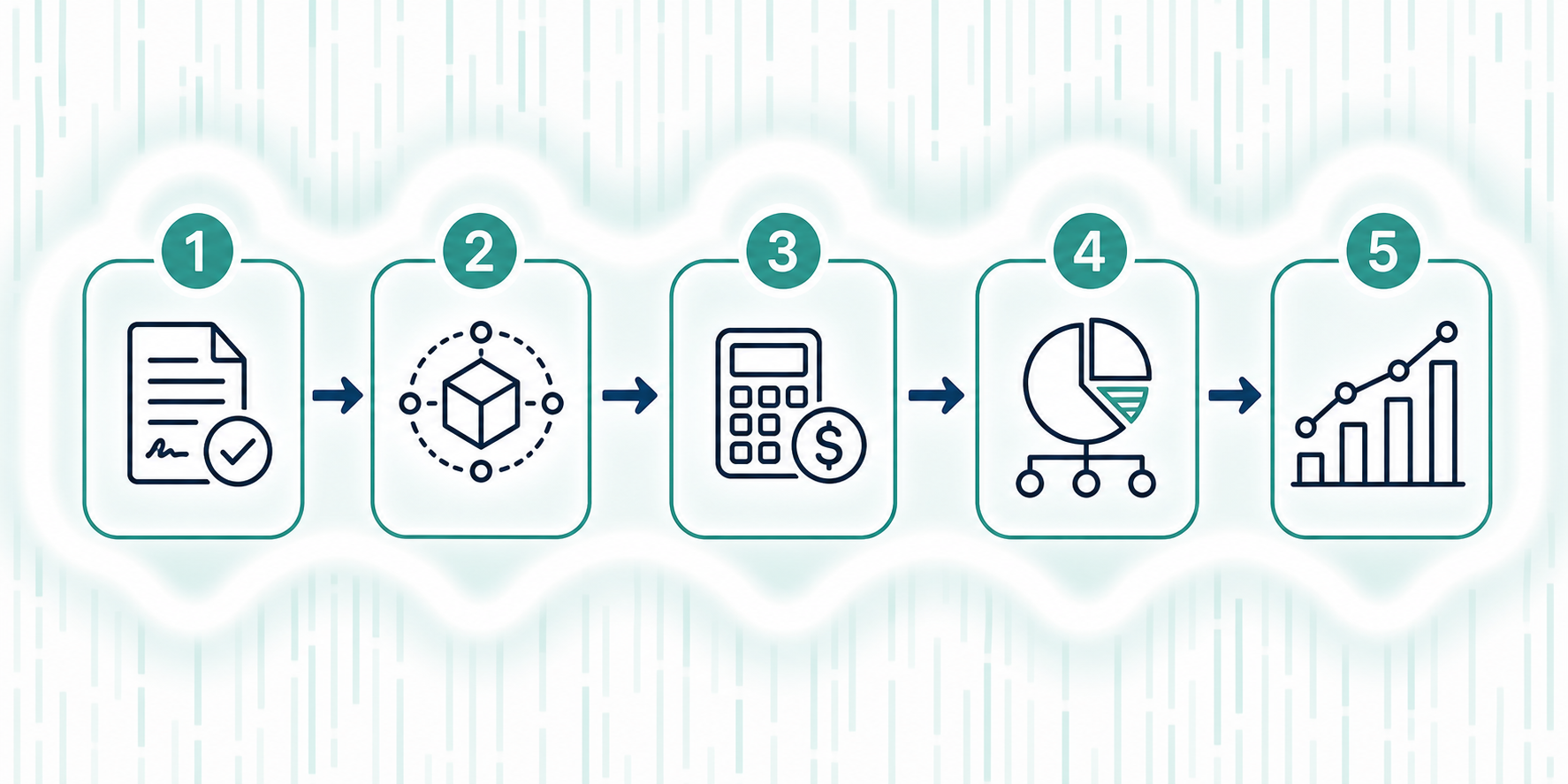
ASC 606 is the accounting standard that governs when you can actually record revenue. For a SaaS startup, the five steps are: identify the contract with your customer, identify the performance obligations (what you've promised to deliver), determine the transaction price, allocate that price to each obligation, and recognize revenue only as you satisfy each one. A $12,000 annual subscription is not $12,000 in revenue on day one; it's $1,000 per month as you deliver the service. Investors and auditors check how you've applied this standard, so getting it right early matters.
Deferred revenue and why it creates accounting complexity
When a SaaS customer pays upfront for an annual plan, that cash hits your bank account immediately, but it's a liability on your books, not revenue. You've taken money for a service you haven't fully delivered yet, so it sits in a deferred revenue account and gets released month by month as you earn it. Tracking that release schedule across dozens or hundreds of customers manually means spreadsheets, custom formulas, and month-end errors. That's the exact problem AI accounting software is designed to solve.
How Puzzle automates this
Puzzle ingests Stripe data natively, so every subscription payment flows directly into your books without CSV exports or manual imports. It maps each payment to its performance obligation and automatically releases deferred revenue on the correct schedule, posting the right journal entries without anyone touching a spreadsheet. Your accrual books stay accurate in real time, and when an auditor or investor asks for your revenue schedule, it's already there.
Feature comparison table of AI-native accounting software
Most legacy software relies on rules-based categorization wrapped in AI marketing. To find the best fit for your startup, compare the underlying feature set and specific automations instead of general feature lists.
Feature
Puzzle
Campfire
Digits
Zoho Books
QuickBooks
Xero
AI-Native Architecture
Yes
Yes
Yes
No
No
No
Automated Categorization
85–90%
Yes
Claimed high-90s
Basic
Rules-based
Basic
Real-Time Burn Rate
Yes
Available
No
No
No
No
Real-Time Runway
Yes
Available
No
No
No
No
Native Stripe Integration
Yes
Yes
Via Plaid
Basic
Third-party
Third-party
Native Mercury Integration
Yes
No
Via Plaid
Limited
Third-party
Third-party
Automated Rev Rec
Yes
Advanced
No
Basic
Manual
Basic
Dual-Basis Accounting
Simultaneous
Advanced
No
Manual
Choose one
Manual
Partner-Only Model
Yes
No
No
No
No
No
Competes with Firms
No
No
Yes ($350/mo)
No
Yes (QB Live)
No
Why Puzzle is the right AI-native accounting software for startups
As a 2025 industry report on accounting trends found, the industry is moving away from generic tools toward specialized tech that understands specific business models. We provide the automation early-stage companies need without the implementation fatigue of an ERP.
Our AI-native design automates 85–90% of categorization, learning your patterns to improve accuracy over time. While legacy incumbents struggle to retrofit their code, we use agentic AI capabilities to proactively manage workflows. This keeps your data audit-ready and allows you to close the books much faster than manual methods.
In practice, accounting firms use Puzzle to cut their month-end close time and deliver real-time dashboards to their startup clients. The software handles categorization and reconciliation automatically, freeing the firm to focus on cash flow strategy, fundraising prep, and tax planning. You get a finance stack that scales with your headcount without adding manual overhead on either side.
Final thoughts on modern accounting software
Switching to AI bookkeeping built for startups means you finally see your financial health in real time. You stop wrestling with broken integrations and manual reconciliation. Your accountant gets better data to work with, and you make faster decisions. The gap between legacy tools and AI-native software keeps growing.
FAQs
How much time per month should a founder expect to spend on bookkeeping with AI accounting software?
With AI-native software like Puzzle, most founders spend under an hour per month on bookkeeping once the system has learned their transaction patterns. The AI handles categorization and reconciliation automatically, so your monthly review is mostly spot-checking flagged items, not entering data. Legacy tools like QuickBooks typically require several hours of manual work each month because rules-based categorization misses context and fintech integrations break frequently.
How does AI accounting software connect to bank accounts and pull in transaction data?
AI accounting software connects to your bank, credit card, and fintech accounts through direct API integrations or bank feeds. Puzzle connects natively to Mercury, Ramp, Brex, and Stripe, meaning transactions flow into your books automatically without CSV exports or third-party aggregators. Once connected, the AI processes each transaction, applies the correct category based on your history, and flags anything that needs review. Most startups are fully connected and processing transactions within minutes of setup.
Which AI accounting software is best for pre-seed startups with limited budgets?
Puzzle and Zoho Books both offer value for early-stage companies, but they serve different needs. Zoho Books provides a free tier for businesses under $50K in annual revenue but lacks burn rate and runway tracking. Puzzle is purpose-built for startups and automatically tracks the metrics investors require, making it worth the investment if you're raising capital or need real-time financial visibility.
How do I choose between AI accounting software if I already use QuickBooks?
Consider your fintech stack and reporting needs. If you rely on Stripe, Mercury, or Ramp and need real-time burn rate visibility, Puzzle's native integrations will save hours of manual work. If you operate internationally with entities in the UK or Australia, Xero's global compliance makes more sense. QuickBooks works for traditional businesses but creates friction for startups through unreliable fintech connections and missing startup metrics.
Can AI accounting software handle revenue recognition for SaaS companies automatically?
Yes, but capabilities vary widely. For example, if a startup sells a $12,000 annual SaaS contract, Puzzle automatically creates a deferred revenue liability of $12,000 at payment, then recognizes $1,000 per month as the service is delivered, with no manual journal entries. For hybrid contracts that bundle a SaaS subscription with a one-time onboarding fee, Puzzle allocates the transaction price across the two performance obligations using standalone selling price (SSP) estimates, recognizing onboarding revenue upon delivery and subscription revenue ratably. Puzzle and Campfire both automate revenue recognition end-to-end; QuickBooks and Xero require manual tracking, and Zoho Books offers only basic support.
What's the difference between AI-native and AI-powered accounting software?
AI-native software like Puzzle and Campfire was built from the ground up with AI at the core, meaning the system learns from your patterns and improves over time. AI-powered tools like QuickBooks and Xero retrofitted AI features onto legacy architecture, typically offering rules-based categorization with limited learning capability. The architecture difference impacts accuracy rates and how well the system adapts to your specific business.
Should accounting firms avoid software that competes with their services?
Yes. QuickBooks now offers QuickBooks Live bookkeeping, and Digits provides in-house CPA services at $350/month, making them direct competitors to independent firms. Puzzle maintains a partner-only model and guarantees we never compete for clients, while Campfire, Zoho Books, and Xero don't offer competing services. If you're an accounting firm, choose software that treats you as a partner, not as a competitor.
Does AI accounting software replace my accountant?
No. AI accounting software automates the repetitive bookkeeping work (categorization, reconciliation, and reporting) so your accountant spends less time on data entry and more time on strategic advice. Tools like Puzzle use a partner-only model, meaning the software works alongside your accounting firm instead of displacing it. The best outcomes come from pairing smart software with a skilled accountant who understands your startup's specific situation.
Let us help you solve your financial puzzles.
Thank you for being part of our Puzzle community. Stay tuned!
Oops! Something went wrong while submitting the form.