Startup Accounting
Stop Manual Bank Reconciliations: Save Time Sept 2026
Learn how Mercury and Puzzle work together to help startup founders save time and automate their bookkeeping with features automations in bank reconciliations.

9.13.23
Learn how Mercury and Puzzle work together to help startup founders save time and automate their bookkeeping with features automations in bank reconciliations.
Say goodbye to the days of struggling with time-consuming manual accounting tasks, especially if you're a founder or an accountant of an early-stage startup like Flike. Flike (YC S22), a company focused on AI solutions for modern go-to-market teams, has taken a big step towards automating their accounting processes.
How did they do it? In accounting, the first step involves making sure the matching process of all the financial data between systems is accurate, a process known as bank reconciliation. But what if we told you this can now be done automatically without manual data entry?
TLDR:
All thanks to Mercury's new statement API integration with Puzzle, Tobias Mueller, co-founder of Flike, no longer needs to rely on a bookkeeper to manually reconcile bank statements and stress about understanding the bank reconciliation process.
“With Puzzle's automation, I can trust that our financial operations are set up correctly, giving me the time steer Flike toward growth. Puzzle has empowered founders like me to work smarter, not harder.”
Today, we’re diving deep into Mercury’s API as a part of our Fintech for Founders series.
Flike's journey towards using AI-native accounting has been possible with Puzzle’s integration of Mercury’s API, part of the Mercury banking platform.
Mercury's API benefits not only founders and CFOs but also accountants by syncing every bank account transaction with Puzzle in real-time.
This unique integration fully leverages Mercury's API, delivering a wealth of automation giving founders and accountants the most precious gift of all—time. The direct connection ensures reliable data, including metadata not typically found in a traditional bank feed, and access to historical balances through the statements API.
For founders, time is a precious resource that should be used wisely. Traditional bank reconciliations are notorious for being a drain on time and energy.
To put it simply, performing a bank reconciliation is a month-end close process that ensures your company's cash records match your bank statements and bank transactions.
Before this integration, manually cross-referencing transaction matching between your bank and accounting software was a painstaking task. Founders like Tobias spent an eternity matching transactions between their accounting records and bank statements.
Puzzle effortlessly compares the balances in your accounting system with Mercury statement balances for a specific month.

Puzzle uses Mercury's API to perform automated pre-reconciliation validation checks.
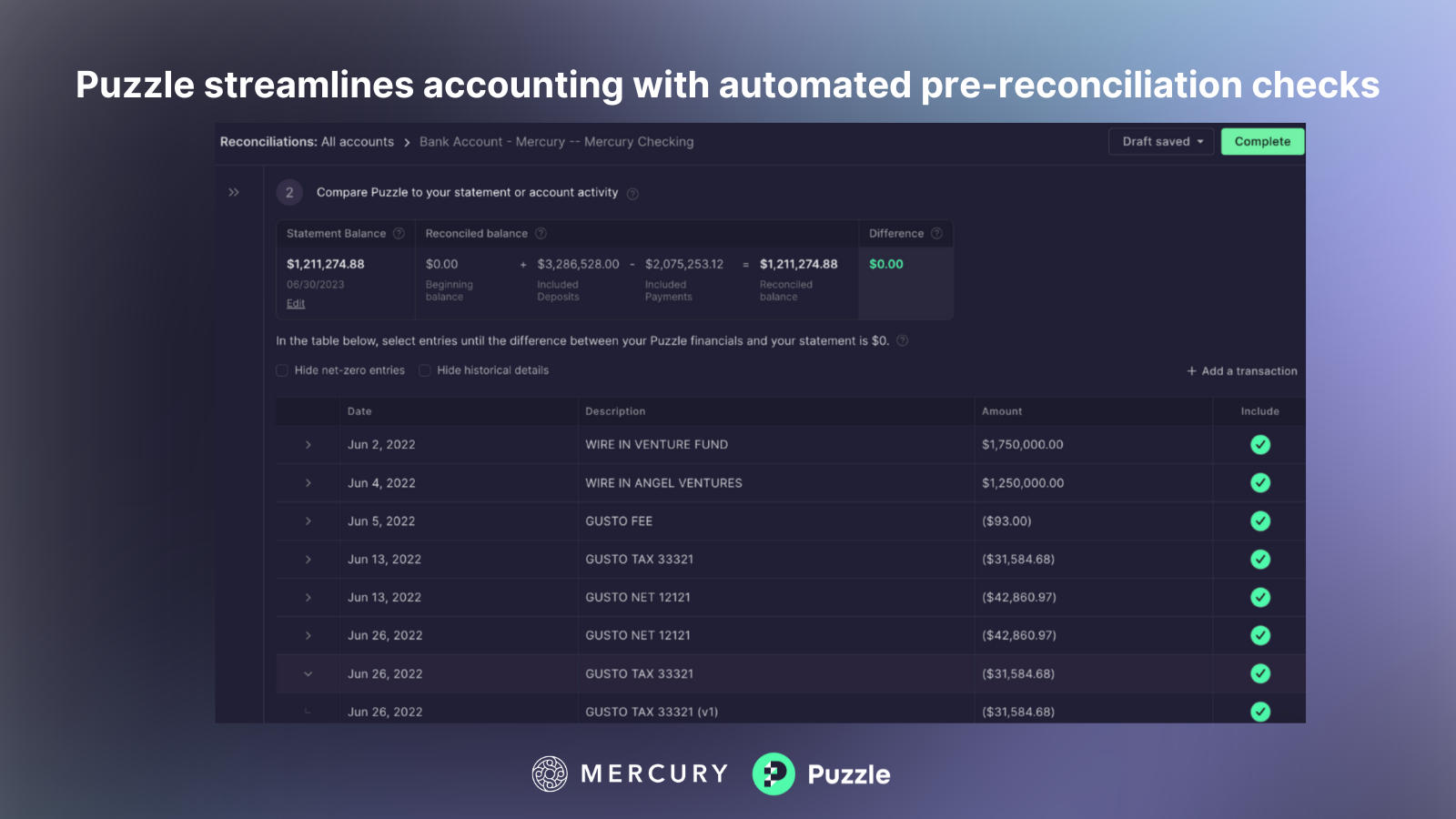
Puzzle's automated reconciliation screen effortlessly populates the "Statement Balance”.
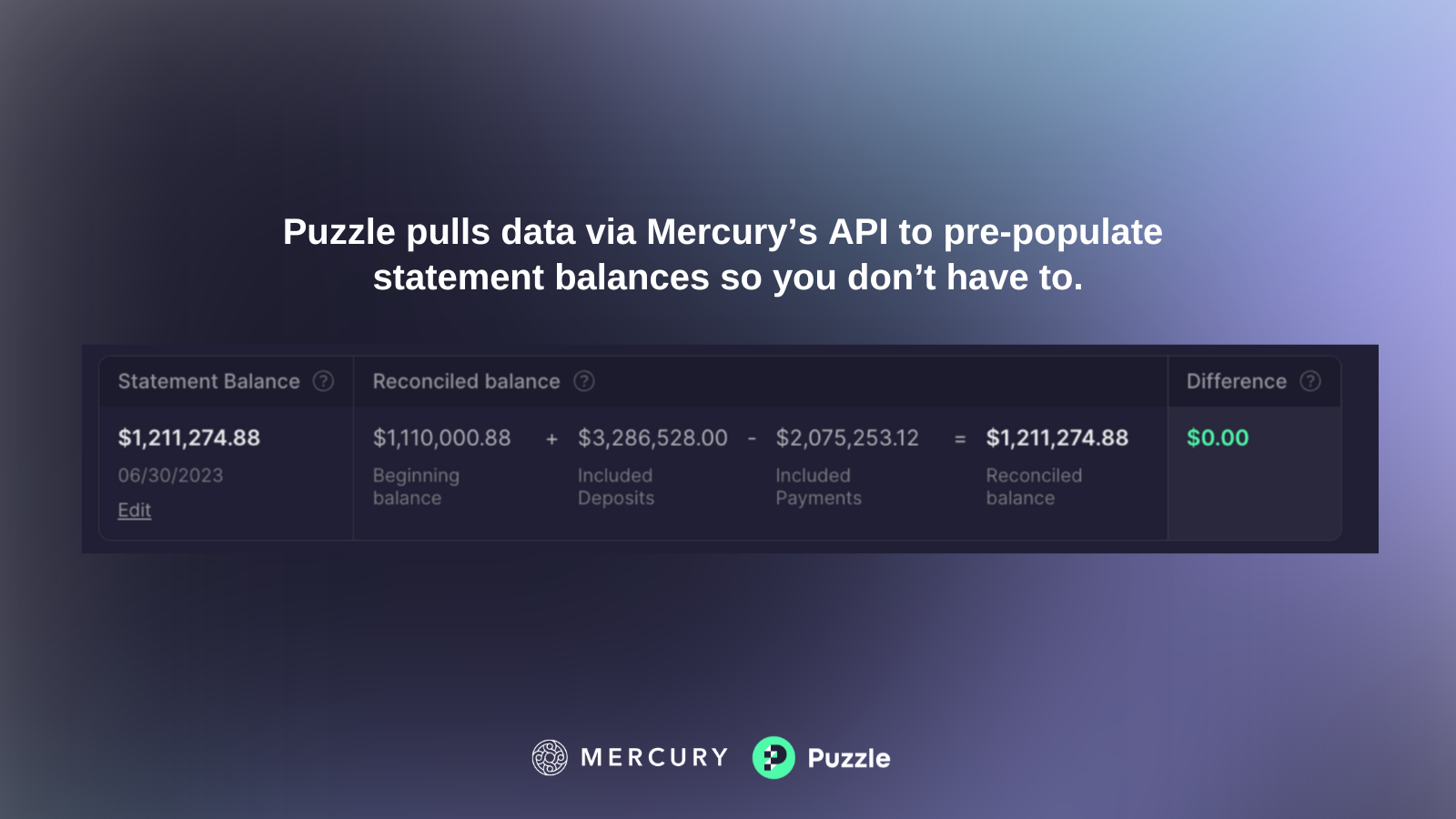
Automated Statement and Memo Imports: A Double Boost to Efficiency
Beyond reconciliations, here’s how Puzzle, thanks to its direct Mercury integration, changes the game for founders and finance teams:
Mercury's API simplifies bank statement imports into Puzzle. This integration streamlines and eliminates manual tasks and the reliance on separate systems, ensuring financial accuracy and bolstering traceability, thus rendering businesses audit-ready.
The integration extends to syncing meta-data from Mercury, including transaction details like descriptions, memos, and notes. This automated process guarantees meticulous record-keeping without the need for manual journal entries, relying on spreadsheets, saving time and minimizing errors.
Tobias isn't just saving time; he's gaining peace of mind. As a first-time founder, Tobias can now focus his time and energy on the strategic aspects of growing Flike.
Want the same efficiencies as Tobias? Check out the Mercury and Puzzle integration.
A lot has happened on Mercury's end since this post was first published — and it makes the Puzzle integration more valuable, not less.
In April 2026, Mercury received conditional OCC approval for Mercury Bank, N.A. — a move that gives Mercury direct control over deposits, compliance, and data rather than routing everything through partner banks. For founders using Mercury, that means more stability and tighter data ownership at the infrastructure level. For the Puzzle integration, it means the API connection you're relying on is backed by an institution building toward a full national bank charter.
Then on August 11, 2026, Mercury launched Mercury Spend — a spend management platform built directly into the Mercury banking dashboard that lets founders issue cards to employees and AI agents, set intelligent budgets, enforce expense policies, and auto-code expenses to the right budget at the point of purchase. Mercury Spend connects to QuickBooks, Xero, and NetSuite, so more transactions arrive pre-coded with less manual review before anything hits your books. For founders already running Puzzle alongside Mercury, the two tools are increasingly designed to work together — live API data from Mercury feeds Puzzle's AI categorization, and Spend tightens the controls upstream.
The broader trend tracks, too: across the category, AI-native reconciliation tools now report auto-match rates between 90% and 99%. The Puzzle + Mercury API connection — pulling full transaction metadata in real time — keeps founders at the front of that curve without switching tools or adding complexity.
One thing worth noting as of September 2026: the audit trail question is getting sharper. COSO's February 2026 guidance on AI-driven internal controls, combined with the PCAOB's amended AS 2201 (effective December 15, 2026), now requires reconciliation decisions to be reproducible and attributable — not just accurate. Gartner separately forecasts embedded AI in cloud accounting will drive a 30% faster financial close by 2028. A direct API connection like Puzzle's Mercury integration matters here not just for speed, but because every matched transaction carries the source metadata that makes your records defensible. That's a different kind of value than a headline auto-match rate.
The fastest path to real-time cash flow visibility — without hiring a controller or CFO — is pairing a bank account that exposes a live API with accounting software that reads from it continuously. The Puzzle + Mercury combination is built for exactly this: Mercury syncs every transaction and balance to Puzzle in real time, so your burn rate, runway, and daily cash position update without anyone logging in to export a file. Founders like Tobias Mueller of Flike (YC S22) replaced manual bookkeeper reconciliation with this stack and got their close time down to near-zero manual effort. Spreadsheets and standalone forecasting tools (Float, LivePlan) can layer on top, but they're only as current as whatever you feed them — Puzzle starts with live data.
The highest-leverage move is automating bank reconciliation — it's the task that blocks everything else at month-end. For clients banking with Mercury, Puzzle's native API integration runs automated pre-reconciliation validation checks, compares accounting system balances against Mercury statement balances, and auto-populates the statement balance field before a human touches the file. That removes the first and most time-consuming step of close entirely. From there, automated transaction categorization (Puzzle handles up to 98% of transactions automatically) and metadata imports — memos, descriptions, notes — flow through without manual journal entries. Startups without a full-time accountant can evaluate month-end close automation tools to find the right fit for their stage. For an accounting firm, this means client books are materially complete before the month-end close call, not during it.
For pre-seed through Series B startups without a dedicated accountant, the right fit depends on your banking stack and complexity. If you bank with Mercury, Puzzle is purpose-built for your situation: AI-native architecture, direct Mercury API integration, automated reconciliation, and daily cash and accrual visibility without manual data entry. For a deeper look at how the options stack up, see our comparison of the best accounting software for Mercury users. QuickBooks Online and Xero work for simpler setups but are built around manual imports and periodic bookkeeper involvement — you'll end up re-creating automation Puzzle ships by default. Wave is free but lacks the accrual-basis infrastructure and integrations early investors expect to see at Series A. The core question isn't which software has the longest feature list; it's which one requires the least manual intervention between your bank and your books. For a Mercury-based startup with no finance team, that answer is Puzzle.
| Puzzle | QuickBooks Online / Xero | Wave | |
|---|---|---|---|
| Best fit | Pre-seed → Series B, Mercury-based, no finance team | Simple setups with a part-time bookkeeper | Bootstrapped / very early, minimal complexity |
| Mercury API integration | Direct, real-time API | Manual imports or aggregator-based | No native integration |
| Automated reconciliation | Yes — pre-reconciliation validation + auto-populated statement balance | Partial — still requires manual review steps | No |
| Transaction auto-categorization | Up to 98% automated | Rule-based; requires manual setup | Limited |
| Cash & accrual basis | Both, simultaneously (see cash vs. accrual accounting for startups) | One basis at a time | Cash only |
| Series A investor-ready books | Yes | Yes, with bookkeeper involvement | No — lacks accrual infrastructure |
For seed-stage startups, the right reconciliation software comes down to one question: does it connect directly to your bank's API, or does it rely on manual CSV exports and periodic imports? The answer determines whether reconciliation is something that happens automatically or something you schedule time for every month.
If you bank with Mercury, Puzzle is purpose-built for your situation. The direct Mercury API connection syncs every transaction in real time, runs automated pre-reconciliation validation checks, compares your accounting system balances against Mercury statement balances, and auto-populates the statement balance field — all before a human touches the file. The outcome: month-end reconciliation that previously took hours runs with near-zero manual effort. Ramp also has a native Puzzle integration with similar automation for card transactions.
For startups banking elsewhere, QuickBooks Online and Xero offer bank feeds but route most connections through third-party aggregators (Plaid, Finicity) — which introduces re-authentication friction and delays. Brex and Rillet have added reconciliation automation features, but neither has the same depth of direct API integration for early-stage accounting workflows. At the seed stage, where you have no controller and need clean books for your next fundraise, the least-manual path wins — and that path runs through a direct API connection, not an aggregator relay.
Puzzle connects directly to Mercury's API to pull full transaction metadata in real time, then compares your accounting system balances against Mercury statement balances, runs pre-reconciliation validation checks, and auto-populates the statement balance field. Reconciliation that previously took hours runs without manual data entry or CSV uploads — and the connection carries over metadata like memos, descriptions, and notes automatically, so your records are complete before a human reviews them.
Most founders find out their runway is dangerously short weeks after the fact — because their accounting data is only as current as the last manual export. The fix isn't a better spreadsheet; it's eliminating the gap between your bank and your books.
At the seed stage, real-time burn rate and runway visibility requires three things: a bank that exposes a live API, accounting software that reads from it continuously, and AI categorization fast enough to keep up with the feed. The Puzzle + Mercury combination delivers all three. Mercury syncs every transaction and balance to Puzzle in real time; Puzzle's AI categorizes up to 98% of those transactions automatically; and your burn rate, runway, and daily cash position update without anyone logging in to trigger a sync. You see a number you can trust — not a number that was accurate three days ago.
Founders like Tobias Mueller of Flike (YC S22) replaced manual bookkeeper reconciliation with this stack and eliminated the monthly reconciliation bottleneck entirely. For seed-stage founders without a finance team, that's the practical path: pair a live API bank (Mercury) with AI-native accounting software (Puzzle), and your key metrics update themselves.
Automated reconciliation works natively with Mercury and Ramp without any manual steps. For most other banks, reconciliation requires manual CSV uploads instead of a live API connection. If Mercury is your primary bank, you get the full automation. If it isn't, expect a more manual workflow until Puzzle expands its native bank integrations.
The constraint for most fractional CFOs isn't analytical skill — it's data latency. If your client's books are updated once a month by a bookkeeper, your "real-time insights" are actually last-month insights with a fresh timestamp. The tools that change that equation are the ones that eliminate the lag between the bank and the general ledger.
For clients banking with Mercury, Puzzle is the highest-leverage addition to a fractional CFO's stack. The direct Mercury API integration means every transaction flows into the general ledger in real time, AI categorization handles up to 98% of transactions automatically, and bank reconciliation runs without manual intervention. As a fractional CFO, you arrive at the monthly strategy call with books that are materially complete — not halfway through a close. That changes what the conversation is about.
For reporting and dashboards on top of clean books, tools like Mosaic, Jirav, or Cube layer FP&A and scenario modeling onto the data Puzzle maintains. Power BI and Looker Studio work for custom reporting but require a data pipeline to be useful — they don't replace the underlying accounting layer. The sequencing matters: get the transaction data clean and current first (Puzzle + Mercury), then build dashboards on top of a source you trust. Fractional CFOs who lead with dashboards before fixing the underlying data pipeline end up presenting numbers their clients can't verify.
Mercury Spend auto-categorizes transactions to the right budget and GL category at the point of purchase inside Mercury. When that data flows through the API into Puzzle, more transactions arrive pre-categorized and require less review before hitting your general ledger. The two tools are increasingly designed to complement each other — founders using both get higher straight-through processing rates with fewer manual touchpoints between the bank feed and finalized books.
Puzzle's AI categorizes up to 98% of transactions automatically using a combination of merchant signals, memo text, and your company's historical patterns. When you correct a categorization, Puzzle captures that signal and builds automated rules that apply the same logic to future transactions — so the system gets more accurate the longer you use it. You don't need to set up rules manually from scratch; the AI generates them from your behavior and surfaces them for your review. For founders on Mercury, the live API feed means Puzzle is learning from real-time transaction metadata — not a periodic import — which accelerates the feedback loop.
If your personal and business accounts are held at the same bank and accessed through a single login, Puzzle will surface all accounts available through that connection during setup — you choose which ones to sync. Only the accounts you explicitly select are imported into your books. If a personal account gets connected by mistake and transactions flow in, you can remove those transactions directly in Puzzle and disconnect the account from your settings. The underlying rule: Puzzle pulls from whatever the bank's API exposes, but you control which accounts are active. If you're unsure whether a connection pulled in the wrong account, check your connected accounts list in Puzzle settings before transactions accumulate.
Stripe payouts and similar bulk deposits are a common friction point: one deposit hits your Mercury account, but it represents dozens of individual customer payments. Puzzle handles this through its payment matching and revenue recognition workflows. When a Stripe payout lands, Puzzle can split the deposit and match each portion to the corresponding open invoice — so your accounts receivable clears correctly and each customer's payment is recorded individually, not as a single lump sum. For check batches, the same logic applies: you can apply one deposit to multiple invoices manually, or set rules that automate the match for recurring patterns. If you're running Stripe through Mercury, the metadata Puzzle pulls from Mercury's API — including Stripe payout breakdowns — makes this matching more accurate than a bank feed that only shows the net deposit amount.
When a live API connection isn't available, Puzzle's AI Close feature can ingest PDF bank statements directly — no manually prepared CSV template required. Puzzle extracts transactions from the PDF, runs them through the same AI categorization engine, and applies your existing rules and historical patterns to assign GL categories. You review what the AI flagged rather than entering data from scratch. For banks with a native API integration like Mercury, you don't need PDF imports at all — transactions flow in automatically. PDF import is most useful for legacy banks, credit cards, or one-time imports of historical statements.
Puzzle's AI Close agent is designed to work across both live feeds and manual imports. When transactions are imported via PDF or CSV rather than a real-time API, the AI Close agent applies the same pre-reconciliation validation checks, compares your accounting system balances against the imported statement data, and flags discrepancies for your review — the workflow is structurally the same. For a broader look at how to structure AI agent workflows for month-end close, that guide covers the full sequencing. The difference is cadence: with a live Mercury integration, reconciliation can happen continuously; with manual imports, it runs when you upload. Bottom line — manual import doesn't break the automated close workflow, it just means you trigger it rather than the connection triggering it for you.
A financial dashboard shows you where things stand — cash balance, burn rate, runway. It's read-only and only as current as your last sync or manual update. An automated close workflow with AI agents actually does the work: it pulls in transactions, categorizes them, runs validation checks, flags anomalies, and produces a reconciled close — without you logging in to kick anything off. For a founder without a full-time bookkeeper, the practical difference is this: a dashboard tells you your runway is 8 months; an AI close workflow makes sure the number is accurate before you see it. The Puzzle + Mercury API integration puts you in the second category — your books update in real time and the month-end close is largely automated before you touch it.
Most accounting tools connect to banks through third-party aggregators like Plaid or Finicity, which introduces a layer of dependency outside the software vendor's control — connection drops and re-authentication prompts are a known friction point. Puzzle's Mercury integration is a direct API connection, not an aggregator relay, which removes that intermediary layer and gives the connection more stability. Mercury's API infrastructure is built for fintech-grade reliability, and with Mercury's conditional OCC approval to establish a national bank charter (April 2026), the underlying infrastructure is moving toward tighter institutional control. If uptime metrics matter to your firm, ask vendors whether their connections go through an aggregator or a direct API — the answer tells you most of what you need to know.
Migrating your chart of accounts to Puzzle involves three steps: importing your existing COA structure, connecting your bank accounts, and resolving any duplicate or overlapping accounts through the account-merging step. When you import from QuickBooks or another system, Puzzle maps your existing accounts to its default COA and flags accounts that look like duplicates or near-matches — you review and confirm merges before anything is finalized. Bank account connections happen in the same setup flow: you authorize Mercury (or another supported bank) via the API, and Puzzle links the connected account to the corresponding balance sheet account in your COA. The merging step matters most if you're migrating mid-year with historical balances — Puzzle walks you through reconciling opening balances so your books are clean from day one, not just from the migration date forward. If you're migrating from a system with a heavily customized COA, it's worth doing a dry run before your target go-live date to catch any mapping gaps.
Stay tuned for more guides from our Fintech for Founders series!