Your close process runs the same way every month: pull the data, match the transactions, flag the variances, draft the entries, post after review. If that sequence is repeatable, an autonomous close agent can run it without waiting for you to click through each step. That's the core promise of agentic AI for accountants. The agent does the execution. You do the approval. Month-end becomes a review cycle instead of a data-entry marathon, and your capacity suddenly stops being the bottleneck.
TLDR:
Agentic AI refers to AI systems that can plan, reason, and execute multi-step tasks on their own, without waiting for a human to approve each action. In accounting, that means an agent can identify what needs reconciling, pull the relevant transaction data, and flag anomalies, all in sequence, before a human ever opens a spreadsheet.
This is a meaningful departure from earlier AI tools in accounting, which were mostly reactive: you asked a question, the AI answered it. Agentic systems set their own sub-goals to complete a broader task.
Earlier accounting automation handled discrete, rule-based steps. An agentic close agent handles the whole chain.
The accountant's role doesn't disappear here. It shifts: less time moving data between systems, more time reviewing AI-generated work before it touches the books.
Generative AI answers questions. Traditional automation follows fixed rules. Agentic AI does something different: it plans, acts, checks its own work, and adjusts based on what it finds.
In accounting, that distinction matters. A rule-based bot can match transactions against a predefined list. A generative AI can explain a variance. An agentic AI can find the variance, trace it to its source, flag it for review, and wait for your sign-off before updating the ledger.
The gap comes down to how each approach handles uncertainty and multi-step work:
| Traditional Automation | Generative AI | Agentic AI | |
|---|---|---|---|
| What it does | Follows fixed rules you write in advance | Answers questions and drafts explanations | Plans, acts, checks its work, and adjusts based on findings |
| How it handles exceptions | Breaks when conditions fall outside its script | Can explain a variance but takes no action | Flags the exception with reasoning and requests human approval |
| Multi-step work | Requires human to trigger each step | Produces outputs but doesn't execute | Breaks goals into steps and executes across systems |
| Impact on your books | Matches transactions against predefined lists | Drafts memos but won't touch the ledger | Finds variances, traces sources, flags for review, waits for sign-off before updating |
That last point is what makes agentic AI viable for month-end close. The agent does the work; the accountant approves before anything is written to the general ledger. That human-in-the-loop structure is the difference between a useful tool and an unauditable black box.
Accounting firms are under real pressure in 2026. Clients expect faster turnarounds, tighter reporting, and fewer surprises at month-end, but headcount hasn't kept pace with that demand. Agentic AI helps firms close that gap without hiring into it. Industry research shows agentic AI adoption is reaching a tipping point across accounting firms in 2026.
The core appeal is speed without sacrificing control. A close agent can work through a checklist of reconciliations, flag anomalies, and prep journal entries overnight. The accountant arrives to a queue of reviewed, approval-ready items—not a blank slate and a pile of transactions.
There are a few specific pressures driving adoption right now:
The firms moving fastest are those treating agentic AI as infrastructure for their practice, not a one-off automation experiment. They're building repeatable close workflows where agents handle the data-heavy work and accountants stay in the decision seat.
Autonomous close agents work by breaking month-end into discrete, repeatable tasks and executing each one without waiting for a human to open a queue. When the calendar flips, the agent pulls transaction data from connected sources (Stripe, Mercury, Ramp, Brex, Gusto), matches entries against expected patterns, flags anomalies for review, and updates the general ledger in sequence.

The workflow runs in layers, not as a single pass:
The result is a close where the accountant arrives to a mostly finished set of books instead of a blank slate. Their job moves from execution to verification, which is where professional judgment actually matters.
The agent does not approve its own work. Every flagged item, every journal entry touching a material balance, and every period-end adjustment requires sign-off before it posts. This keeps the accountant in the loop at the points that carry the most risk, and it keeps the books auditable.
Agentic AI handles four distinct jobs during the month-end close that previously required hours of manual accountant time.
None of these capabilities remove judgment from the equation. The accountant decides whether a flagged variance is a real error or an expected business event. They approve journal entries before anything posts. They set the rules that define what "normal" looks like. Agentic AI handles the pattern recognition and repetitive execution; the accountant handles interpretation and sign-off.
Teams that have moved to agentic close workflows report measurable time reductions at every stage of month-end. The pattern is consistent: work that once required days of back-and-forth across spreadsheets, inboxes, and accounting software now runs in hours. Only 53% of companies close within six business days using traditional methods, which underscores the need for automation.
The biggest gains tend to cluster in three areas:
Across these gains, teams report month-end close time dropping 50%. That compression matters beyond productivity: a faster close means leadership sees accurate financials sooner, which affects burn rate conversations, hiring decisions, and fundraising timing in ways that a two-week-late close simply cannot support.
Traditional month-end close runs on checklists: a controller opens a spreadsheet, works down a list of tasks, hands off to a preparer, waits for review, and repeats until everything ties out. Agentic AI for accountants changes that sequence by replacing the checklist with an agent that monitors, acts, and escalates on its own schedule.
Where a static checklist tells a human what to do next, an autonomous close agent watches the books in real time and does it. When a transaction needs categorization, the agent categorizes it. When a reconciliation is off, the agent flags the discrepancy with context already attached.
The result is a close that runs continuously instead of in a compressed sprint at month-end.
Three workflows eat the most time during month-end close, and they're where agentic AI is making the clearest difference.
Agentic AI reviews every transaction against your chart of accounts, historical patterns, and vendor context, then codes it automatically. If something falls outside expected parameters, it flags the exception for human review without guessing.
Bank feeds, credit cards, and sub-ledgers get matched against the general ledger continuously. Discrepancies surface immediately, not three weeks into the next month when they're harder to trace.
AI agents scan period-over-period changes, identify which line items moved materially, and generate explanations grounded in the underlying transaction data. Accountants get a drafted commentary to review instead of a blank page to fill.
Every close agent action sits behind an approval gate before it touches the books.
When the agent flags a transaction, posts a journal entry, or reconciles an account, it surfaces the work for a human reviewer first. The accountant sees what the agent did, why it did it, and what it proposes to change. Nothing is final until a person signs off.
This keeps the accountant in the decision seat. The agent handles the volume; the accountant handles the judgment.
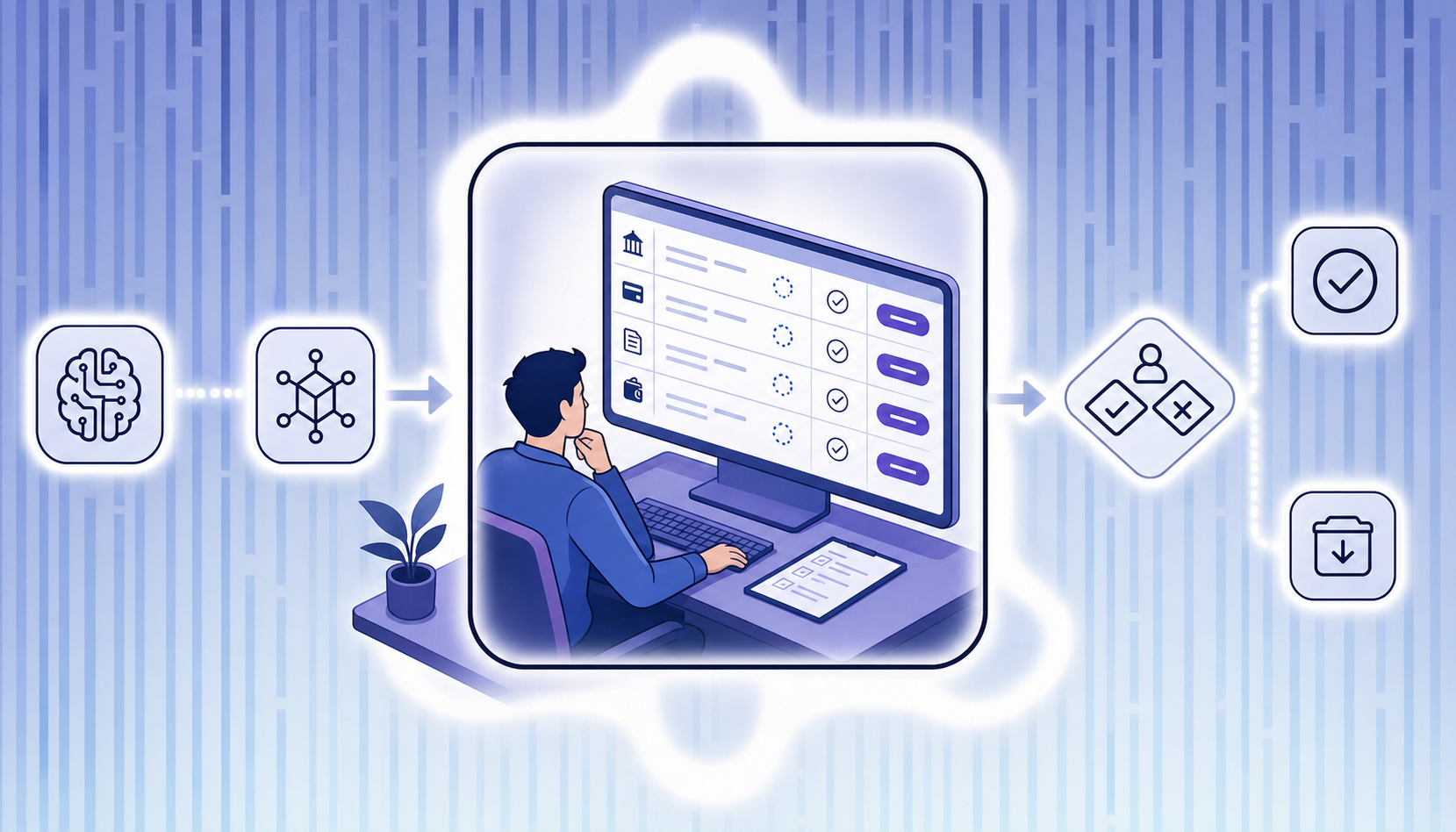
The result is a close process where the accountant's time goes toward review and judgment instead of data entry and formatting. That's a meaningful shift in how firm capacity gets spent, especially during peak close weeks when hours are scarce.
Agentic AI offers real advantages for month-end close, but accountants adopting it in 2026 should go in with clear eyes about where it falls short.
The hype around autonomous close agents tends to outpace the reality of what they can reliably handle today. A few friction points come up repeatedly in practice:
None of these are reasons to avoid agentic AI. They are reasons to choose tools that keep accountants in the approval loop, where human expertise and AI speed work together rather than in opposition.
Before committing to any agentic close tool, accounting firms need to ask harder questions than "can it automate journal entries?"
The approval workflow matters as much as the automation itself. Look for tools that surface AI-generated entries for human review before anything posts to the general ledger. If a tool makes decisions autonomously and shows you the output after the fact, you've lost the ability to catch errors before they reach your client's books.
Agentic tools need broad read/write access to function. Firms should verify SOC 2 Type II compliance, understand exactly what data the agent can touch, and confirm whether client data is used to train shared models.
Regulators and clients expect a clear record of who (or what) made each accounting decision. Before adopting any tool, confirm it produces a timestamped log of every automated action, including the reasoning behind each entry.
A close agent that can't connect to the tools your clients already use creates more manual work, not less. Check native integrations with the fintech stack your clients run (Stripe, Gusto, Ramp, Mercury, Brex) before choosing anything else.
Puzzle's approach inverts the typical agentic AI setup. Instead of an AI agent deciding what to do and executing it autonomously, Puzzle gives accountants the controls: you define the rules, and the agent runs them.
When you set up a close agent in Puzzle, you build the workflow yourself. The agent then executes that workflow on a schedule, pulling in transactions, running categorization logic, flagging anomalies, and checking items off the close checklist before you've even opened your laptop.
The agent runs inside boundaries the accountant sets, which means the expertise stays with the human:
The result is a close process where AI handles the repeatable execution and accountants stay focused on judgment, review, and client advisory work. The agent runs; you think.
Your close doesn't need to take five days anymore. Agentic AI compresses the timeline by handling transaction matching, reconciliation, and variance detection while you sleep. You arrive to a review queue, not a blank slate. If you want to see how a close agent works with your fintech stack, book a demo and we'll walk you through it.
Yes. Agentic close agents work by connecting to your existing data sources and executing workflows you define, not by replacing your general ledger. The agent pulls transaction data from your bank feeds, payment processors, and payroll systems, then categorizes, reconciles, and flags anomalies according to rules you set. You stay in control of approvals before anything posts to your books.
Generative AI answers questions and drafts explanations, but it doesn't act on your books. Agentic AI plans multi-step tasks, executes them autonomously across your accounting systems, and surfaces decisions for approval before posting. For month-end close, that means an agentic system can run your entire reconciliation checklist overnight and present you with approval-ready work, while a generative AI tool would only help you understand variances after you've already done the manual work.
Teams using agentic close workflows report reconciliation dropping from two hours to under five minutes, and overall month-end close time compressing by up to 50%. The time savings come from three areas: continuous transaction matching throughout the month instead of a manual sprint at close, automated journal entry drafting with context already attached, and instant variance flagging the moment anomalies appear rather than after-the-fact investigation.
Autonomous close agents handle transaction categorization, bank reconciliation, accrual calculations, journal entry drafting, and variance detection without manual intervention. However, every action sits behind an approval gate—nothing posts to the general ledger until a human accountant reviews and signs off. The agent executes the repetitive work; the accountant makes the judgment calls.
If your firm is spending more than 10 hours per client per month on reconciliation and categorization, or if clients are demanding faster closes than your current headcount can deliver, agentic AI becomes the viable path forward. Traditional automation still requires you to trigger each step manually; agentic systems run the entire close checklist on a schedule and surface only the exceptions that need human review.