Running a paid community startup means your revenue model doesn't fit neatly into traditional accounting frameworks. Membership fees, recurring billing cycles, content access tiers, and community perks all create financial complexity that most generic bookkeeping guides ignore entirely. Whether you're bootstrapping a Discord-based mastermind group or scaling a platform with thousands of paying members, your accounting needs are uniquely yours.
This guide to accounting for paid community startups breaks down the specific financial practices, tax considerations, and software criteria you need to get right from day one. Think of it as the resource we wish existed when we first started advising founders in this space. If your revenue comes from people paying to belong, keep reading.
Accounting for paid community startups is the practice of tracking, categorizing, and reporting financial activity generated by membership-based revenue models. It matters because misclassifying subscription income, ignoring deferred revenue, or botching sales tax compliance can sink an otherwise healthy business.
Here are the three most important things to know:
Even if you stop reading here, get those three things right. They'll save you from the most common financial mistakes in this space.
Most startup accounting advice assumes you're selling a product or a one-time service. Paid communities operate differently. Your clients in this space generate recurring revenue tied to ongoing access, not discrete deliverables. That distinction changes how revenue gets recognized, how expenses get categorized, and how financial statements tell the company's story.
The first major difference is the relationship between cash received and revenue earned. A member who pays $1,200 upfront for a year of access has given you cash, but you've only earned $100 of that in month one. Your balance sheet needs to reflect the remaining $1,100 as a liability (deferred revenue) until you deliver each month of service. Many early-stage founders skip this entirely, which inflates their income statements and creates problems during due diligence.
The second nuance involves cost allocation. Community startups spend heavily on platform hosting, moderator compensation, content creation, and event production. These costs don't map cleanly to traditional COGS categories. Your clients need a chart of accounts that reflects where their money actually goes, not a generic template pulled from accounting software defaults.
Deferred Revenue Across Multiple Tiers: Most communities offer monthly, quarterly, and annual plans. Each billing cycle creates different deferred revenue schedules that must be tracked separately. Mixing them up distorts monthly income reporting and makes forecasting unreliable.
Handling Refunds and Prorated Cancellations: Members cancel mid-cycle constantly. Each cancellation requires reversing the appropriate portion of recognized and deferred revenue. Without a systematic process, your books will drift further from reality every month.
Multi-Jurisdiction Tax Compliance: Your members live everywhere. Each jurisdiction has its own rules about whether digital memberships are taxable. Tracking nexus thresholds and filing obligations across states or countries is a genuine operational burden.
Distinguishing Community Revenue from Ancillary Income: Many communities sell courses, merchandise, or event tickets alongside memberships. Blending these revenue streams into a single account makes it impossible to understand which part of your business is actually profitable.
Your chart of accounts is the backbone of your financial reporting. For paid community businesses, the default chart that ships with most accounting platforms won't cut it. You need accounts that reflect the realities of membership revenue, content delivery costs, and community operations. The goal is clarity: when you pull a profit and loss statement, you should immediately see how much you're earning from memberships versus courses versus events, and what it costs to deliver each one. Naming conventions matter too. Use descriptive names like "Monthly Membership Revenue" instead of vague labels like "Service Income." This saves hours during tax prep and makes investor reporting far more straightforward.
Here are example accounts to consider adding:
Paid community startups face a tax environment that's grown more complex every year. Digital services taxation has expanded significantly across U.S. states and international markets. If you have members in multiple jurisdictions, you likely owe sales tax or VAT in places you haven't considered.
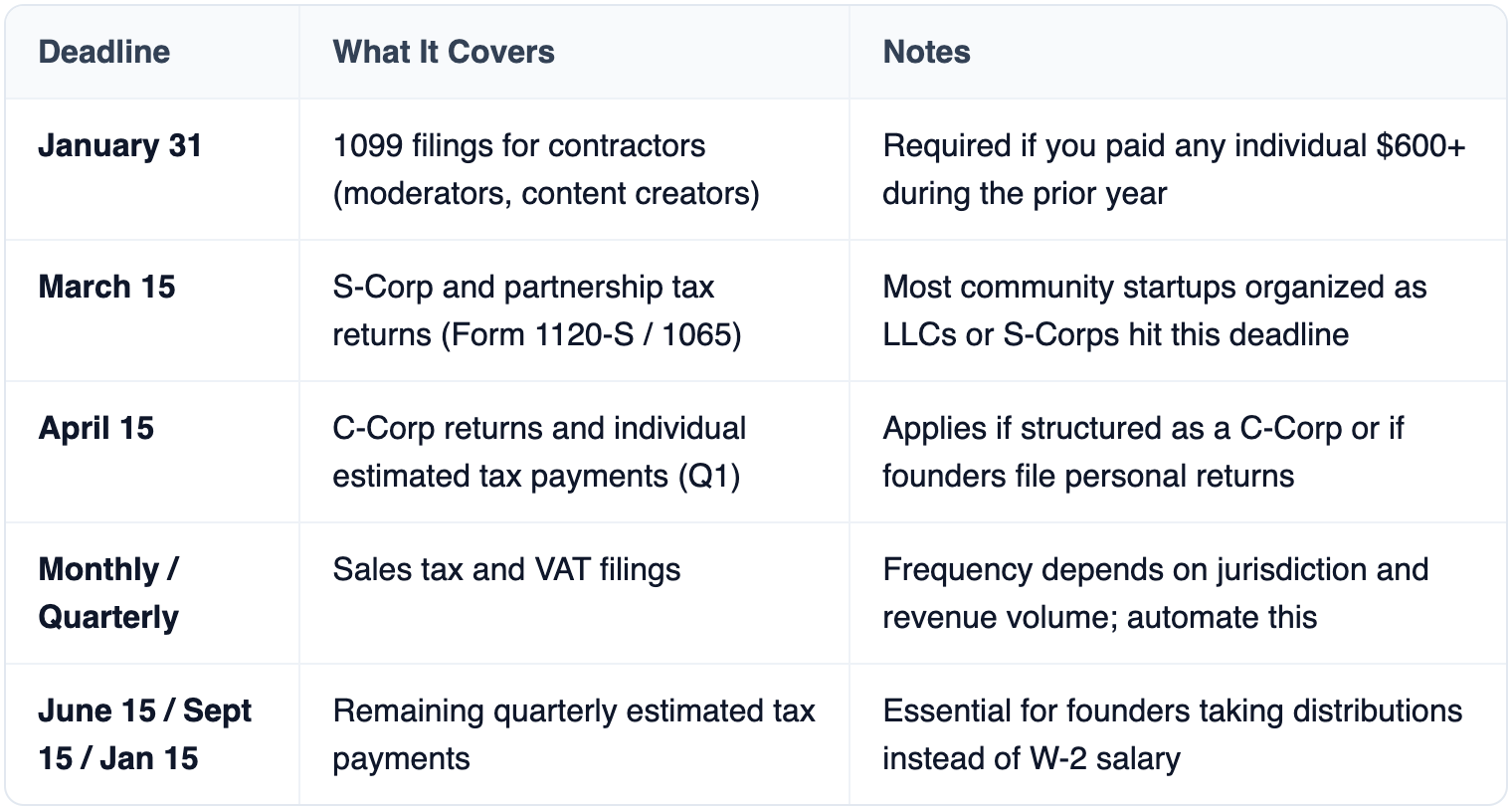
Missing any of these deadlines triggers penalties that eat into your margins. Set calendar reminders or, better yet, work with an accountant who tracks them for you.
Not every accounting platform handles membership-based businesses well. Here's what to prioritize:
Recurring Revenue Tracking Built In: Look for software that automatically creates deferred revenue schedules from recurring invoices. Manual spreadsheet tracking breaks down once you pass 50 members. You need a system that handles monthly, quarterly, and annual billing cycles without custom workarounds.
Direct Integration with Your Membership Platform: Your accounting software should sync with whatever tool manages your member billing, whether that's a community platform, payment processor, or subscription management system. Manual data entry introduces errors and wastes time you don't have.
Multi-Currency and Tax Jurisdiction Support: If you serve an international community, you need software that handles currency conversion and tracks tax obligations by region. This isn't optional for communities with global reach. It's a compliance requirement.
Clear Revenue Segmentation Reporting: Choose a tool that lets you tag and filter revenue by type: memberships, courses, events, merchandise. You should be able to generate a report showing gross and net revenue per stream in under a minute.
Do I need to recognize membership revenue differently from one-time sales?
Yes. Membership revenue must be recognized over the period of service, not at the point of sale. If a member pays $600 for six months, you recognize $100 per month. One-time sales like a course purchase can typically be recognized immediately upon delivery. Getting this wrong overstates your income and creates tax liability issues.
Should I hire an accounting firm that specializes in subscription businesses?
Strongly recommended. A generalist accountant can handle your basic bookkeeping, but they often miss deferred revenue nuances, SaaS metrics integration, and multi-jurisdiction tax filings. Firms that specialize in subscription or membership models understand the revenue recognition rules and can set up your systems correctly from the start.
What accounting structure makes sense at the seed stage?
At seed stage, keep it simple but correct. Use cash-basis accounting if you're pre-revenue or very early, then switch to accrual basis once you're generating consistent membership income. Most investors expect accrual-basis financials by the time you're raising a Series A. Set up your chart of accounts properly now so the transition isn't painful later.
How do I handle failed payments and dunning in my books?
Failed payments should not be recorded as revenue. If your billing system retries a charge and it eventually succeeds, record the revenue at that point. If recovery fails and the membership lapses, no revenue entry is needed. Track failed payment rates as a metric, but don't let them clutter your financial statements.
Are community membership fees subject to sales tax?
It depends on the jurisdiction and what your membership includes. Many U.S. states now tax digital goods and services, including access to online communities. Some states exempt educational content. The rules vary widely, so you'll need to evaluate your nexus obligations state by state, or country by country if you have international members.
The difference between paid community startups that scale smoothly and those that hit financial walls often comes down to accounting fundamentals. Deferred revenue, proper chart of accounts setup, tax compliance, and the right software aren't glamorous topics. But they're the infrastructure that lets you make confident decisions about hiring, pricing, and growth.
If you're running a paid community, treat your accounting system as seriously as you treat your member experience. Both determine whether your business survives its first few years. Start with the basics outlined here, bring in a specialist when complexity grows, and review your financials monthly, not just at tax time.
Your members are investing in your community. Make sure your financial systems are worthy of that trust.