The drone industry has exploded over the past few years. From agricultural surveying to last-mile delivery, drone startups are reshaping how entire sectors operate. But rapid growth brings financial complexity. Revenue models vary wildly. Hardware depreciates fast. Regulatory costs pile up. And most general accounting advice simply doesn't fit.
If you're running a drone startup or advising one, you already know the finances look nothing like a typical SaaS or e-commerce company. Physical assets, FAA compliance costs, R&D tax credits, and inventory management create a unique financial puzzle. Getting the accounting right from day one isn't optional: it's the difference between a startup that scales and one that stalls out. This guide to accounting for drone startups breaks down the specific challenges, tax considerations, and software criteria you need to know. Whether you're a founder bootstrapping your first prototype or a Series A company hiring your first CFO, the principles here will keep your books clean and your cash flow visible.
Accounting for drone startups means tracking finances across hardware, software, regulatory compliance, and often multiple revenue streams simultaneously. It matters because drone companies burn cash on R&D and physical inventory long before they see consistent revenue. Misclassifying expenses or ignoring depreciation schedules can distort your financial picture and scare off investors.
Here are the three most important things to know:
Get these three right, and you've handled 80% of what makes drone accounting distinct.
Your clients in the drone space sit at an unusual intersection of manufacturing, technology, and regulated aviation. That blend creates accounting nuances you won't find in a standard tech startup playbook.
First, there's the hardware-software entanglement. A drone startup might sell a physical product bundled with a SaaS subscription for flight planning or data analytics. Allocating revenue between the hardware and software components requires careful judgment under ASC 606. Get it wrong, and your revenue figures won't survive due diligence.
Second, FAA compliance costs are ongoing and significant. Part 107 certifications, Remote ID compliance, waiver applications for beyond-visual-line-of-sight operations: these aren't one-time expenses. They recur and they grow as the fleet scales. Classifying them correctly, whether as operating expenses or capitalized costs tied to specific contracts, changes how profitability looks on paper.
Third, inventory accounting is unusually volatile. Drone components have short shelf lives. New sensor models replace old ones every 12 to 18 months. Your clients need inventory valuation methods that reflect rapid obsolescence, not the slow-moving assumptions that work for traditional manufacturers.
A standard chart of accounts won't capture the financial activity unique to drone operations. You'll need dedicated accounts for drone fleet assets, separated from general equipment, because their depreciation schedules and insurance requirements differ. R&D expenses should be broken into sub-accounts: flight software development, airframe prototyping, and sensor integration testing each carry different tax credit eligibility. Regulatory compliance deserves its own expense category rather than being lumped into "professional services" or "legal." If your startup sells hardware alongside services, you'll want distinct revenue accounts for each stream to simplify ASC 606 compliance. Naming conventions matter too: use prefixes like "DRN-" for drone-specific accounts so your team can filter and report on them quickly.
Here are five example accounts you'll likely need:
Drone startups face a tax environment shaped by R&D-heavy spending, equipment purchases, and evolving federal incentives for unmanned aircraft systems. Missing a deadline or failing to claim eligible credits can cost tens of thousands of dollars, especially during early growth stages when every dollar counts. Planning around these dates is essential for drone startups at every stage.
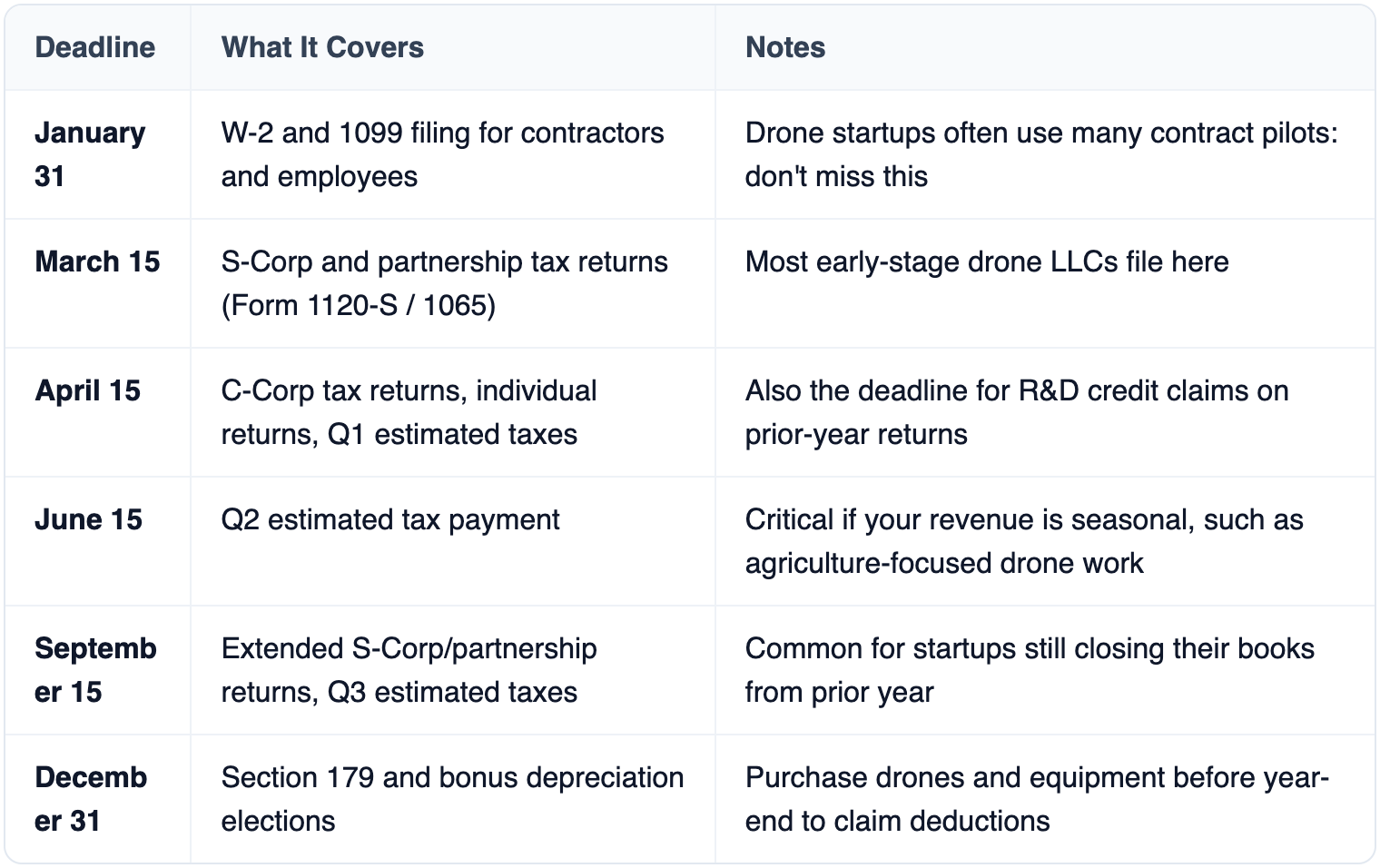
One thing many founders overlook: the R&D tax credit can offset payroll taxes for qualifying small businesses. If your startup has under $5 million in gross receipts, you can apply up to $500,000 in R&D credits against payroll tax each year. That's real cash back during the pre-revenue phase.
Not all accounting platforms handle the complexity of a drone business. Look for software that meets these criteria:
Do drone startups need a specialized accountant? Yes, in most cases. A generalist CPA can handle payroll and basic tax filing, but drone-specific issues like R&D credit eligibility, FAA cost classification, and hardware-software revenue allocation require industry knowledge. Look for accounting firms with experience in aerospace, manufacturing, or hardware-tech hybrids.
What's the best accounting method for a pre-revenue drone startup? Cash basis works fine during the earliest stages, especially if you're a sole founder or small team. Once you take on investors or start generating recurring revenue, switch to accrual basis. Most Series A investors and lenders expect accrual-based financials, and the transition is easier to do early.
Can I deduct crashed or destroyed drones? Yes. If a drone is destroyed or damaged beyond repair, you can write off the remaining undepreciated value as a casualty loss. Document the incident thoroughly: include flight logs, photos, and insurance correspondence. Your accountant will need this for the deduction.
How should seed-stage drone startups handle R&D expenses? At the seed stage, most of your spending likely qualifies as R&D. Track it meticulously from day one, even before you have formal accounting software. Separate your R&D costs into categories: wages, supplies, contract research, and cloud computing. This granularity makes claiming the R&D tax credit straightforward later.
When should a drone startup hire a fractional CFO? Consider it once you're approaching $1 million in annual revenue or preparing for a Series A raise. A fractional CFO can build financial models, manage investor reporting, and ensure your books are audit-ready: all without the $200K-plus cost of a full-time hire.
Getting your accounting right isn't glamorous, but it's the backbone of every funding round, every tax season, and every strategic decision you'll make. Drone startups that treat accounting as an afterthought end up scrambling during due diligence or leaving money on the table at tax time.
Start with a chart of accounts built for your industry. Claim every R&D credit you're entitled to. Pick software that handles your actual complexity, not just your invoice volume. And find an accountant who understands the difference between a Part 107 waiver and a Part 135 certificate.
Your financial foundation determines how fast and how far you can scale. Build it right, and the rest of the business has room to fly.