SAFEs (Simple Agreements for Future Equity) are one of the most popular fundraising instruments for early-stage startups. Y Combinator introduced them in 2013, and they've since become a standard way to raise capital without setting a valuation upfront. But here's the catch: while SAFEs are simple to sign, they're not simple to record on your books. The accounting treatment sits in an awkward gray area that trips up founders and even some accountants. Getting it wrong can create headaches during your next raise, your annual audit, or a potential acquisition.
If you're a startup founder or an early-stage finance lead, you need to understand how to account for a SAFE note correctly. The classification matters more than you think. It affects your balance sheet, your cap table, and how investors perceive your financial health. A misclassified SAFE can distort your equity picture and raise red flags with sophisticated investors or acquirers doing due diligence. This guide breaks down the proper treatment, the most common mistakes, and what happens when a SAFE converts. We'll also cover what to look for in accounting software that handles these instruments properly. Whether you've just closed your first SAFE round or you're cleaning up the books from a prior one, this is the resource you need.
A SAFE is a contractual agreement where an investor gives a startup cash now in exchange for the right to receive equity later, typically at a future priced round. The tricky part? It's neither traditional debt nor straightforward equity. It has no maturity date, no interest rate, and no repayment obligation, yet it doesn't grant shares until a triggering event occurs.
Most startups encounter SAFEs during pre-seed or seed fundraising when they want to raise money quickly without negotiating a full valuation. The investor wires funds, and the startup issues a SAFE instead of shares.
Here's the high-level process for recording it:
The details matter, though. Read on for the full treatment, journal entries, and pitfalls to avoid.
The correct accounting treatment for a SAFE depends on its specific terms, but under U.S. GAAP, most SAFEs are classified as liabilities rather than equity. This surprises many founders who think of SAFEs as "future equity." The relevant standard is ASC 480, which deals with instruments that can be settled in a variable number of shares. Because a typical SAFE converts at a discount or valuation cap, the number of shares the investor receives isn't fixed. That variable settlement feature pushes the instrument into liability territory.
Some SAFEs may qualify for equity classification under ASC 815 if they meet specific conditions, such as being indexed to the company's own stock and meeting equity classification criteria. In practice, though, the standard post-money SAFE from Y Combinator typically lands as a liability.
Here's a sample journal entry at issuance, assuming a $500,000 SAFE:
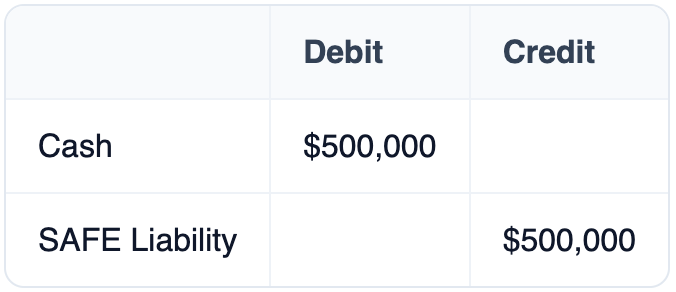
This entry reflects the cash received and the corresponding obligation. You're recording the SAFE at its initial fair value, which is typically the amount of cash received. No equity accounts are touched at this stage because no shares have been issued.
At each reporting date, you may need to remeasure the SAFE at fair value if it's classified as a liability measured under fair value option. Changes in fair value flow through your income statement, which can create volatility in your reported earnings. For early-stage startups with limited revenue, this can look alarming on paper but is standard treatment.
The bottom line: classify it as a liability, record it at fair value, and remeasure as needed until conversion.
Even experienced bookkeepers get SAFEs wrong. Here are the most frequent errors we see:
Classifying the SAFE as equity at issuance. This is the number-one mistake. Founders assume that because a SAFE represents future equity, it belongs in the equity section of the balance sheet. Under ASC 480, most SAFEs fail the fixed-for-fixed test and must be recorded as liabilities. Misclassifying it inflates your equity and understates your liabilities.
Ignoring fair value remeasurement. If your SAFE is classified as a liability, you likely need to remeasure it at fair value each reporting period. Many startups record the initial entry and never revisit it. This creates a stale balance that doesn't reflect the instrument's true economic value, especially as your company's valuation changes between funding rounds.
Failing to disclose SAFEs in financial statement notes. Even if the journal entry is correct, inadequate disclosure is a problem. Auditors and investors expect to see the terms of each SAFE, including valuation caps, discount rates, and conversion triggers, clearly documented in your footnotes. Skipping this step can delay audits and erode investor confidence.
The critical trigger for a SAFE is conversion into equity, which typically happens at a priced financing round (like a Series A). When the startup issues preferred stock at a set price per share, the SAFE converts based on its cap or discount terms.
At conversion, you reclassify the SAFE from a liability to equity. The journal entry debits the SAFE liability account and credits preferred stock and additional paid-in capital (APIC) for the fair value of shares issued. If there's a difference between the SAFE's carrying value and the fair value of the equity issued, that difference hits your income statement or equity, depending on the specifics.
Other triggering events can include a change of control (acquisition), an IPO, or dissolution of the company. Each of these has different accounting implications, so review your SAFE agreement carefully for the specific conversion mechanics.
Not all accounting platforms treat complex instruments like SAFEs correctly out of the box. Here's what to look for:
Automatic liability classification. Good software recognizes SAFEs as liabilities by default and places them in the correct balance sheet category. You shouldn't have to manually override the system to get the right classification. The platform should understand that SAFEs aren't simple equity.
Fair value remeasurement support. Your software should prompt or allow for periodic remeasurement of SAFE liabilities. This means tracking the instrument's fair value over time and recording adjustments through the income statement, not burying them in a manual spreadsheet.
Conversion event handling. When a priced round closes, the software should support reclassification from liability to equity with a clean journal entry. It should generate the proper debits and credits for the conversion, including any gain or loss on settlement, and maintain a clear audit trail for each step.
Is a SAFE a debit or a credit?
The cash you receive from a SAFE is a debit to your cash account. The SAFE itself is recorded as a credit to a liability account on your balance sheet. Think of it this way: you've received money (asset goes up, so debit) and taken on an obligation to issue future equity (liability goes up, so credit). The SAFE stays as a credit balance until it converts or is otherwise settled.
Is a SAFE an asset or a liability?
From the startup's perspective, a SAFE is a liability. You owe the investor something: future equity. It's not an asset because you're the one with the obligation. From the investor's side, the SAFE is an asset on their books. The classification depends on which side of the transaction you're on, but for the issuing company, it's almost always a liability under current GAAP guidance.
What happens to the SAFE on my books when it converts?
At conversion, you debit the SAFE liability to remove it from your balance sheet. Then you credit equity accounts, specifically preferred stock at par value and APIC for the remainder. If the fair value of shares issued differs from the SAFE's carrying amount, you record that difference. The conversion entry effectively moves the obligation from liabilities to stockholders' equity, reflecting that shares have now been issued.
Do I need to remeasure my SAFE each quarter?
If your SAFE is classified as a liability and you're using fair value measurement, yes. You should remeasure at each reporting date. For startups that only prepare annual financials, you'd remeasure at year-end at minimum. The fair value changes flow through your income statement. If you've elected the practical expedient and your SAFE hasn't changed in terms, the remeasurement may be straightforward, but you still need to document it.
Can a SAFE ever be classified as equity?
Yes, but it's uncommon with standard SAFE agreements. If the SAFE settles in a fixed number of shares for a fixed amount of cash (the "fixed-for-fixed" test under ASC 815-40), it could qualify for equity classification. Some custom SAFEs are drafted to meet this threshold. However, the typical Y Combinator post-money SAFE with a valuation cap or discount doesn't pass this test, so liability classification is the norm.
Puzzle is the AI-native accounting platform built for startups and the firms that serve them. From SAFEs to stock comp, Puzzle categorizes complex transactions correctly the first time, with a clean audit trail your accountant will actually trust. Spend less time second-guessing journal entries and more time on the work that matters.