Your investors expect accrual financials within days of the month-end, but your accounting software was built for cash-basis service businesses. You're manually tracking burn rate, building ARR reports in spreadsheets, and spending hours on reconciliation because Zoho Books connects to your fintech stack in name only. When survival metrics live outside your accounting system, you're paying twice: once for software that misses what you need, and again in founder time building workarounds. If this matches where you are right now, these Zoho Books alternatives were built for venture-backed companies that need real-time financial visibility instead of basic bookkeeping.
TLDR:
Zoho Books is cloud-based accounting software designed for small businesses and freelancers who want basic bookkeeping at a lower price point than QuickBooks. Part of the broader Zoho ecosystem, it connects with Zoho's CRM, project management, and other business apps.
The software covers standard accounting functions: invoicing, expense tracking, bank reconciliation, and financial reporting. You link your bank accounts, create invoices, log expenses, and Zoho Books generates your financial statements. It supports multi-currency transactions and automated bank feeds, pulling transactions directly into the system.
Zoho Books includes Zia, an AI assistant that pre-fills transaction fields based on your historical data. For businesses with repetitive transactions, this can reduce manual entry time. The software also offers customizable reports you can tailor to your specific needs.
The pricing appeals to early-stage businesses: Zoho Books offers a free plan for companies earning under $50,000 annually. While other accounting solutions offer free tiers for founders as well, it's worth comparing what's included. Paid plans start at $15/month, making it one of the more affordable options for businesses outgrowing spreadsheets.
Where Zoho Books falls short is for startups that need real-time burn-rate visibility, complex revenue recognition for SaaS models, or native integrations with tools like Stripe, Brex, or Mercury. For founders tracking Runway daily and accountants managing multiple startup clients, these gaps become dealbreakers.
Zoho Books serves general small businesses well, especially those already in the Zoho ecosystem. The low price and straightforward features work fine if you're running a consulting practice or local service business.
But for venture-backed startups, the gaps become expensive:
Zoho Books doesn't track burn rate, runway, ARR, or MRR natively. You're forced back into spreadsheets for the metrics that matter when you're planning your next fundraise or trying to understand if you'll make it to profitability. These aren't nice-to-haves for startups; they're survival metrics.
The fintech integrations are surface-level. If you're using Stripe for subscriptions, Mercury for banking, or Ramp for spend management, Zoho Books connects in name only. You'll spend hours each month on reconciliation and manual categorization that purpose-built tools automate completely.
Revenue recognition gets messy fast. SaaS companies with deferred revenue, multi-year contracts, or usage-based billing quickly hit the ceiling. The built-in features can't handle subscription complexity without reverting to external spreadsheets, which defeats the purpose of accounting software.
For accounting firms serving startup clients, Zoho Books lacks the multi-client workflows, firm management capabilities, and real-time client dashboards needed to operate at scale. You're managing multiple logins and patching together tools that should work together natively.
When your burn rate determines your survival and investors expect accrual-basis financials within days of month-end, these aren't minor inconveniences.
Puzzle is AI-native accounting software built for startups and the accounting firms that serve them. Unlike Zoho Books' small business approach, we're designed for venture-backed companies that need real-time financial visibility.
Up to 98% of transaction categorization is automated by AI that learns from your patterns. Your burn rate, runway, ARR/MRR, and cash position update daily, not weeks after month-end. Native integrations with modern banking platforms like Stripe, Mercury, Ramp, Brex, and Gusto work without manual journal entries or reconciliation headaches.
We handle simultaneous cash and accrual accounting with automated revenue recognition schedules. For accounting firms, Puzzle operates on a partner-only model: we never compete for your clients. You get white-glove support and revenue share for referrals.
Best for venture-backed startups from pre-seed to Series B, SaaS companies needing revenue recognition, and accounting firms serving startup clients who need automation beyond what Zoho Books offers.
QuickBooks Online covers basic accounting needs with automated bank feeds, transaction categorization, invoicing, and financial reporting. Extensive third-party app integrations mean most bookkeepers already know how to use it.
The problem: QuickBooks requires manual setup for startup metrics. No native burn rate, runway, or ARR/MRR tracking forces you back into spreadsheets. Many startups look for alternatives that better meet their needs. Manual categorization and reconciliation consume hours each week. QuickBooks Live also competes directly with accounting firms for bookkeeping clients.
Xero offers unlimited users on all plans, bank reconciliation, and automated transaction imports. It handles 160+ currencies with automatic exchange rate updates.
The gap: Xero lacks startup metrics like burn rate, runway, or ARR tracking. Choosing the right accounting software requires understanding these differences. Accounts payable requires manual data entry without PO matching automation. No native revenue recognition or investor-ready reporting tools.
Wave provides free accounting for freelancers and micro-businesses. Core features include invoicing, expense tracking, automated bank imports, and mobile receipt capture.
The tradeoff: Wave skips inventory management, deep integrations, dual-basis accounting, revenue recognition, and startup financial metrics. Free user support is chatbot-only.
Here's where the differences matter for startups tracking their survival metrics and accounting firms managing multiple clients.
| Feature | Zoho Books | Puzzle | QuickBooks Online | Xero | Wave |
|---|---|---|---|---|---|
| Burn Rate Tracking | No | Yes, automated daily | No | No | No |
| Runway Calculation | No | Yes, real-time | No | No | No |
| ARR/MRR Tracking | No | Yes, automated for SaaS | No | No | No |
| AI Automation | Zia across suite | Yes, 98% categorization | Limited | Limited | No |
| Dual-Basis Accounting | Manual setup | Simultaneous automated | Manual | Manual | No |
| Revenue Recognition | Basic | Automated schedules | Manual | Manual | No |
| Stripe Integration | Available | Native, automated | Available | Available | Limited |
| Partner-Only Model | No | Yes | No | No | No |
| Starting Price | Free plan | Premium | $30/month | $15/month | Free core |
Zoho Books wins on initial cost. Free for businesses under $50,000 in annual revenue makes it accessible for bootstrappers.
But for venture-backed startups, the gap in financial visibility becomes expensive. Building spreadsheets to track burn rate while your accounting software handles invoicing means you're paying twice: once for software that misses what you need, and again in founder time building workarounds.
Integration depth beats integration existence. Every option here connects to Stripe. Puzzle handles subscription revenue recognition and deferred revenue automatically. The rest require manual journal entries and custom schedules your accountant builds from scratch each month.
Zoho Books works for general small businesses, especially those already using Zoho's CRM or project management tools. The pricing makes sense if you're a consulting firm or service business without venture funding.
For venture-backed startups, Puzzle addresses what Zoho Books can't:
You get automated burn rate and runway tracking that updates daily. No spreadsheets tracking your survival metrics separately from your books. Your financial position is visible in real-time, not reconstructed manually after month-end.
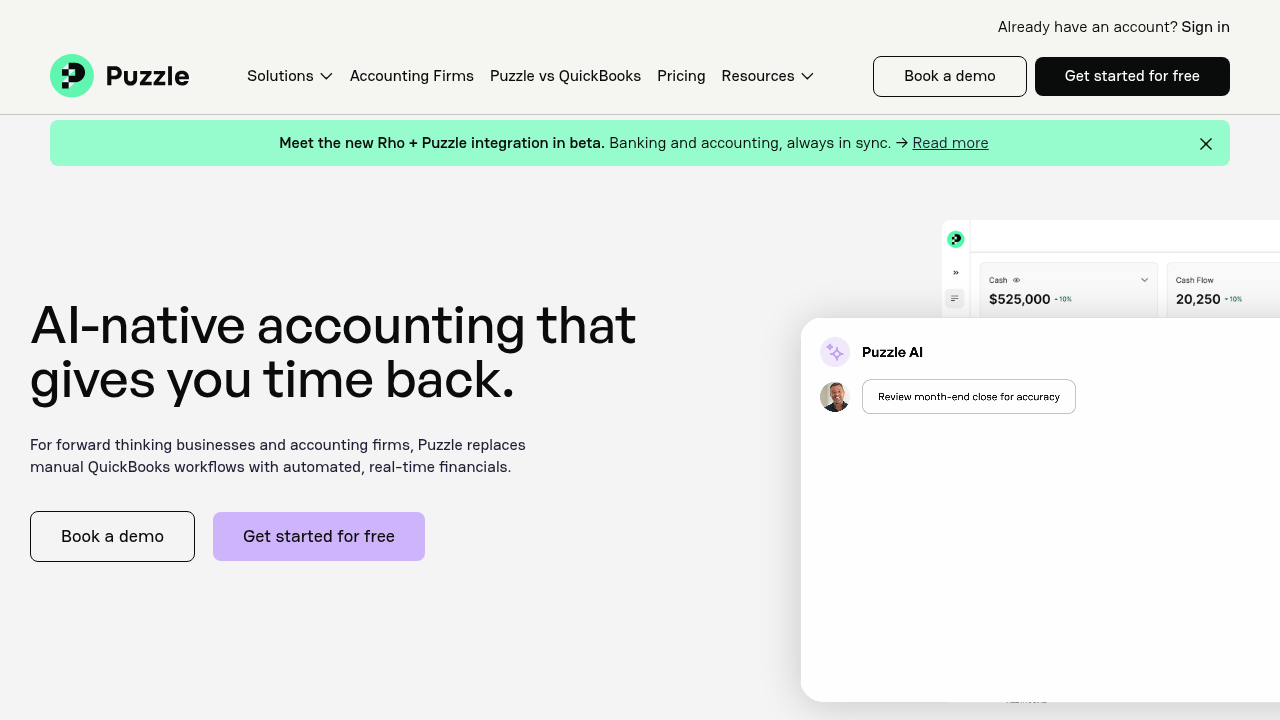
The AI difference matters here. Puzzle's AI-native architecture categorizes up to 98% of transactions accurately and learns from your patterns. Zoho's Zia pre-fills fields, but you're still reviewing and correcting most entries. That's the difference between automation and assistance.
Native integrations work without workarounds. Connect Stripe, Mercury, or Ramp and subscription revenue, deferred revenue, and spend categorization happen automatically. Zoho Books connects to these tools but requires manual journal entries for complex transactions. You're back to the reconciliation work you wanted to escape.
Dual-basis accounting runs simultaneously in Puzzle. Cash and accrual books stay in sync with automated revenue recognition schedules. Zoho Books handles basic revenue recognition but requires manual setup for SaaS models. When investors need accrual financials and you need daily cash visibility, managing both manually gets expensive fast.
For accounting firms, our partner-only model means we never compete for your clients. See how the product works for both founders and their accounting partners. Zoho Books has no firm-specific workflows or multi-client management capabilities built for practices serving multiple startups.
When you compare Zoho Books alternatives, the decision centers on whether your accounting software gives you startup metrics or forces you back into spreadsheets. Zoho Books handles basic bookkeeping well, but venture-backed companies need burn rate visibility and automated revenue recognition from day one. If you're building a SaaS company or working with an accounting firm that serves startups, book a demo to see how Puzzle handles what Zoho Books leaves on the table.
If you're a venture-backed startup tracking burn rate and runway daily, or if you need automated revenue recognition for SaaS subscriptions, Zoho Books can't deliver those metrics natively; you'll end up building spreadsheets alongside your accounting software.
Look for native integrations with your fintech stack (Stripe, Mercury, Ramp), automated burn rate and runway tracking, and dual-basis accounting that runs cash and accrual simultaneously without manual setup.
Zoho Books includes basic revenue recognition features, but SaaS models with deferred revenue, multi-year contracts, or usage-based billing require external spreadsheets. It can't automate subscription accounting the way purpose-built tools can.
Accounting firms using AI-native alternatives report up to 50% reduction in month-end close time and 96% faster reconciliations, but savings depend on your client mix and whether you're serving startups with complex fintech stacks.
Startups need survival metrics like burn rate, runway, and ARR available daily, not reconstructed manually after month-end, and Zoho Books doesn't track these natively, forcing founders back into the spreadsheets they wanted to escape.