In the News
Top Financial Reporting Tools for Startup Founders October 2026
Compare the top real-time financial reporting tools for founders in February 2026. See which tools track burn rate, runway, and cash position automatically.

3.10.26

Compare the top real-time financial reporting tools for founders in February 2026. See which tools track burn rate, runway, and cash position automatically.
Waiting two weeks after month-end for accurate financials made sense when transactions moved through physical ledgers. It makes zero sense now when Stripe processes your revenue instantly and Ramp posts expenses the same day. Live financial statements close that gap by updating your books continuously as money moves, showing your actual burn rate and runway today instead of last month. We compared seven tools built for this new reality to see which ones actually automate the busy work, integrate natively with modern fintech tools, and give you the startup-specific metrics you need to manage cash without a finance team.
TLDR:
Real-time financial reporting means your financial data updates continuously as transactions occur. Your cash position, P&L, and balance sheet refresh daily or hourly as payments process and revenue comes in, showing what's happening now instead of weeks ago.
Traditional accounting requires waiting 5 to 15 days after month-end for accurate financials while your accountant categorizes transactions and closes out accounts. For startups, that delay creates risk. If your burn rate spikes in early February, waiting until mid-April for March financials could be fatal. Real-time reporting lets you check runway today and spot problems when you can still fix them.
We ranked each tool based on what matters most to startup founders who need immediate visibility into their financial health:
We focused on tools built for startups between pre-seed and Series B, where real-time insights matter more than enterprise-grade complexity.
Puzzle delivers real-time financial reporting with setup in minutes, giving founders continuously updated financial statements without waiting for month-end close.
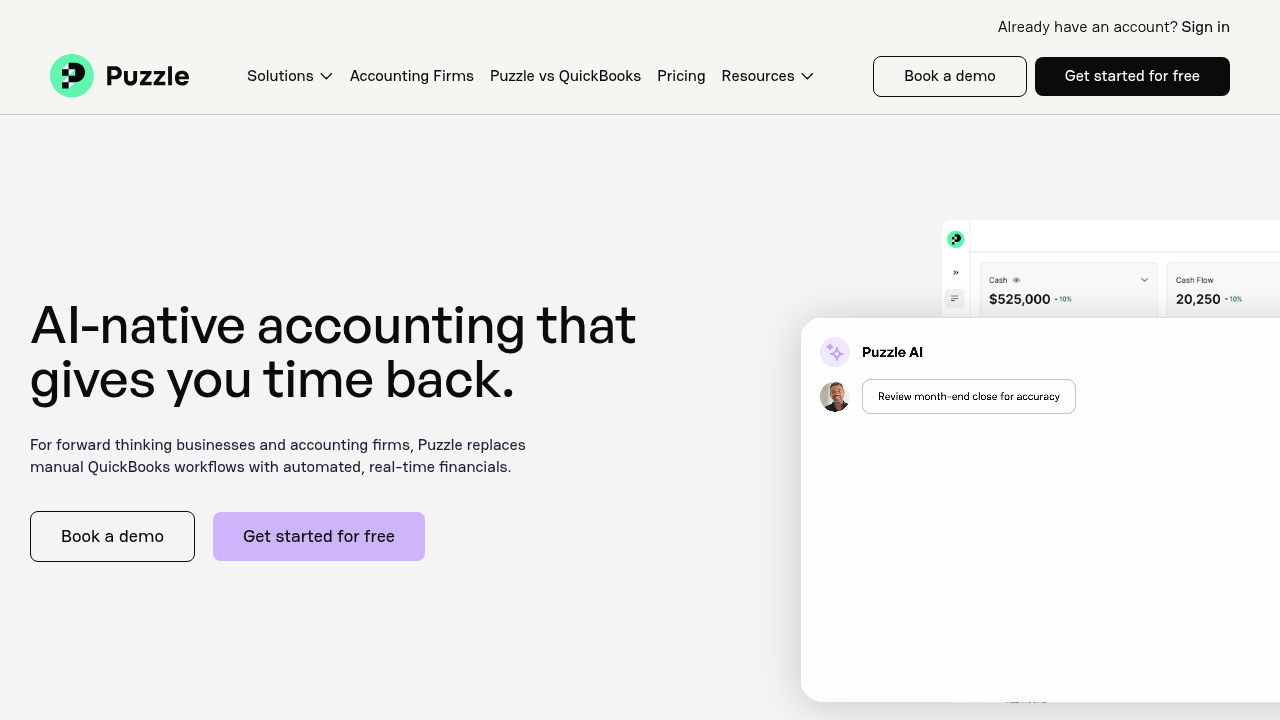
Puzzle was architected AI-native from day one for startup workflows, automatically tracking burn rate, runway, and ARR/MRR without manual spreadsheet maintenance. Month-end close automation cuts close time by up to 50%. Native connections to your startup banking stack mean data flows in automatically without manual imports.
Rillet is an AI-native ERP built by accountants for high-growth SaaS companies with complex revenue models. The company has raised $200M+ in total funding, including a $100M Series C in August 2026 that valued it at $1B, and reports 93% automation.
Their focus includes ASC 606 revenue recognition with complex allocations, multi-entity consolidation and intercompany accounting, zero-day close capabilities for enterprise-scale operations, and usage-based billing support.
Best for Series B+ companies with $50M+ ARR scaling toward IPO with multiple entities and dedicated finance teams.
The trade-off: Rillet targets enterprise-scale operations. Startups at earlier stages without controllers or CFOs will find the ERP complexity unnecessary, with implementation taking days to weeks instead of hours.
Campfire is an AI-native ERP that raised $100M+ in 2025 as a NetSuite alternative for mid-market tech companies with 50 to 500+ employees.
The tool offers multi-entity consolidation, enterprise revenue recognition, multi-currency support, and finance-team workflows built for dedicated controllers or CFOs managing multiple legal entities.
The trade-off: Campfire requires sophisticated accounting operators and days to weeks for implementation. It lacks the founder-first design and startup-specific metrics early-stage companies need, and doesn't operate through an accounting firm partnership model. Early-stage founders considering Campfire alternatives for startups will find lighter-weight options better suited to their stage.
Digits offers an "Autonomous General Ledger" targeting SMBs, with AI agents that handle workflows end to end. The company has raised nearly $100M and reports 97.8% accuracy. Self-serve plans start at $65/month (Essentials) up to $250/month (Pro), with outcome-based pricing available for accounting firms.
They trained AI agents on $825B+ in transactions and offer bookkeeping through in-house CPAs, which means they compete with accounting firms instead of partnering with them. The tool works well for general small businesses in retail, healthcare, or consulting that want AI to replace their bookkeeper entirely.
The tradeoff: Digits focuses on broad SMB workflows, not startup-specific needs like burn rate or runway tracking.
QuickBooks holds the largest market share but retrofits AI onto decades-old architecture. Founders looking at AI-native QuickBooks alternatives will find the gap in real-time capabilities is substantial. The company now operates QuickBooks Live bookkeeping services that compete directly with accounting firms who used to be their primary distribution channel.
QuickBooks Online for small to medium businesses, Intuit Assist AI features (mostly restricted to higher-priced tiers), third-party app marketplace for integrations, and QuickBooks Live bookkeeping services.
Good for small businesses with traditional banking who already know QuickBooks and don't need startup-specific metrics.
The limitation: founders wait weeks for month-end financials instead of seeing real-time data. Integrations with Stripe, Mercury, and Ramp frequently break or require manual journal entries, and there's no native burn rate, runway, or ARR tracking.
Xero is cloud accounting software with strong international reach and a JAX AI assistant. The tool is popular with accountants globally, especially in UK, Australia, and New Zealand markets.
Cloud-based accounting with 1,000+ app integrations, JAX conversational AI assistant, multi-currency support, and a mature ecosystem for international accounting needs.
Good for international businesses or those with accountants already using Xero who need global multi-currency capabilities.
The limitation: Xero's strength is global breadth, not US startup depth. It lacks native burn rate, runway, and ARR/MRR tracking. Integrations with US fintech tools like Stripe, Mercury, and Ramp rely on third-party apps instead of native connections. Xero sells directly to businesses instead of through a partner-only model.
Zoho Books provides affordable accounting within the broader Zoho business suite, with Zia AI assistant across 55+ apps covering CRM, marketing, and HR. The service includes a free tier for businesses under $50K revenue and strong value when using multiple Zoho apps.
Good for general small businesses already using Zoho CRM or Projects who put low cost ahead of startup-specific features.
The limitation: Zoho Books lacks native burn rate, runway, or ARR/MRR tracking because it wasn't built for startups. Zia AI serves dozens of apps as a generalist, with no focus on accounting automation. The tool doesn't offer automated revenue recognition or deep native integrations with Stripe, Mercury, and Ramp.
Here's a side-by-side comparison of how each tool handles the features founders need most when tracking their financial health:

| Feature | Puzzle | Rillet | Campfire | Digits | QuickBooks | Xero | Zoho Books |
|---|---|---|---|---|---|---|---|
| Real-Time Financial Visibility | Yes | Yes | Yes | Yes | No | Yes | Yes |
| Burn Rate Tracking | Yes | No | No | No | No | No | No |
| Runway Calculation | Yes | No | No | No | No | No | No |
| ARR/MRR Tracking | Yes | Yes | Yes | No | No | No | No |
| Automated Revenue Recognition | Yes | Yes | Yes | No | No | No | No |
| Dual-Basis Accounting | Yes | Yes | Yes | No | No | No | No |
| Native Stripe Integration | Yes | Yes | Yes | No | No | No | No |
| Native Mercury Integration | Yes | No | No | No | No | No | No |
| AI-Native Architecture | Yes | Yes | Yes | Yes | No | No | No |
| Partner-Only Model | Yes | No | No | No | No | No | No |
| Setup Time | Minutes | Days to weeks | Days to weeks | Hours | Hours | Hours | Hours |
| Target Stage | Pre-seed to Series B | Series B+ | Series A+ | General SMB | General SMB | General SMB | General SMB |
The gap between legacy accounting and real-time visibility has closed fast. AI adoption among finance teams jumped from 22% to 40% between the 2025 and 2026 Thomson Reuters surveys, and 64% of accounting firms now plan to invest in or upgrade AI systems this year. By mid-2026, 85% of mid-size and large accounting firms report using some form of AI in their workflows, up from 58% in 2024. Industry analysts now categorize real-time financial reporting as the new standard, not a differentiator. The monthly close cycle is becoming obsolete for any team with modern infrastructure.
For startups, this shift has a sharp edge. The same Stripe and Mercury integrations that used to feel optional are now the baseline expectation from investors and board members who want to see burn and runway on demand. Funding activity in the space reflects the momentum: Rillet closed a $100M Series C at a $1B valuation in August 2026, a signal that enterprise-scale real-time finance is attracting serious capital. Agentic AI (systems that act autonomously on financial data instead of merely surfacing it) is no longer a roadmap item. As of September 2026, leading platforms are actively deploying agents that monitor cash positions, flag anomalies, and trigger reconciliation workflows around the clock without human prompts. The tools in this comparison sit at different points on that curve, which is why architectural choices and setup time matter more than they did even a year ago.
Puzzle gives founders what they need most: instant data access to react quickly to market changes and financial challenges. We're the only accounting software that automatically tracks burn rate, calculates runway, and maintains dual-basis books from day one, without requiring a controller or CFO.
Setup takes minutes. Connect Stripe, Mercury, Ramp, and Gusto once, and our AI handles 85–90% of categorization while you keep full visibility. When your burn rate changes or a customer churns, you see the impact on your runway immediately.
We partner exclusively with accounting firms and never compete for clients.
Running out of runway kills more startups than bad products do, but most founders don't see the warning signs until their accountant closes the books weeks later. Live financial statements give you the same visibility into your finances that you have into your product metrics, so you can make decisions based on what's happening now instead of guessing. We built Puzzle AI-native from day one because retrofitting automation onto old software doesn't work for startups moving fast. Your books stay accurate, your metrics stay current, and you finally know exactly how much runway you have left. Book time with our team to see real-time reporting in action.
Puzzle is purpose-built for your stage, you'll get setup in minutes with automatic burn rate and runway tracking built in. If you're Series B+ with multiple entities and a finance team, look at Rillet or Campfire instead.
If you're burning more than $50K per month or have less than 12 months of runway, waiting 15 days after month-end for accurate financials creates real risk. Real-time visibility lets you spot problems while you can still fix them.
AI-native means the software was architected from day one for AIlike Puzzle, Rillet, or Campfire. AI-powered usually means AI features were retrofitted onto decades-old architecture, like QuickBooks, which limits what the AI can actually do.
Yes, most modern accounting tools including Puzzle offer free migrations that preserve your historical financials. Setup typically takes minutes to hours, not weeks, with native integrations that sync your bank, payroll, and payment data automatically.
Only Puzzle automatically calculates burn rate, runway, and ARR/MRR from day one. The other tools in this list focus on general accounting or enterprise needs, you'd need to track those metrics manually in spreadsheets.
Connect your bank (Mercury, Brex), payment processor (Stripe), and payroll (Gusto, Rippling) to an accounting tool with native integrations, not third-party connectors. When transactions post in those systems, they flow directly into your books without a manual import step. Puzzle pulls those feeds continuously, categorizes 85–90% of transactions automatically, and recalculates burn rate and runway the same day. If you're comparing options for accounting software for Stripe users, native integration depth is the key variable. The result: you check your dashboard on any given Tuesday and see exactly how much cash you have, what you burned last week, and how many months of runway remain. No accountant intervention required between closes.
Yes. Puzzle supports classes, locations, and departments as separate reporting dimensions so you can slice your P&L by business unit, cost center, or geography without building manual spreadsheet models. Assign transactions to a class or department at the source and Puzzle surfaces department-level P&L breakdowns in real time: useful once you're managing multiple teams or running parallel revenue lines and need to see which parts of the business are burning cash and which are generating it.
Mercury and Stripe move money: they don't categorize it, match it to accounts, or close your books. Even with modern fintech tools, transactions still land as raw line items that someone has to code to the right accounts, match to invoices, and sort across platforms. That work falls on the founder when there's no bookkeeper. Switching to an AI-native accounting platform like Puzzle changes the equation: Puzzle connects natively to Mercury, Stripe, Ramp, Brex, and Gusto, pulls transactions automatically, and categorizes 85–90% of them without manual input. The account-matching work that used to take hours runs in minutes, because the integration layer was built for these tools from day one, not patched together with a third-party connector.
A financial dashboard shows you numbers. An automated close workflow with AI agents actually does the accounting work. Basic dashboards (think a Mercury or Ramp spend view) visualize data from one source but don't categorize transactions, match accounts, or generate GAAP-compliant statements. AI agent workflows (like what Puzzle runs) ingest data across your entire fintech stack, apply accounting rules, flag anomalies, and keep your books current between closes. The result: you're not logging into five platforms to assemble a picture of your finances. The books stay accurate on their own, and you get a real-time P&L, balance sheet, and cash position without a bookkeeper manually closing the month.
Tax season is one deadline. The rest of the year is where real-time accounting pays off. Board meetings need current burn and runway, not last month's estimate. Hiring decisions depend on knowing how long your cash actually lasts. Pricing changes and customer churn show up in ARR/MRR before they hit your bank account. When your books update continuously (not once a month), you catch burn spikes while you can still respond, build investor updates from live data instead of stale exports, and run scenario models against accurate numbers. Puzzle tracks burn rate, runway, and ARR/MRR automatically year-round, so every week is as visible as tax season.
The tools that work without a finance team share three traits: native integrations with your actual banking and payment stack (so data doesn't require manual imports), automated transaction categorization (so you're not doing bookkeeping yourself), and dashboards that surface cash position and runway without requiring you to build spreadsheet models. Puzzle is purpose-built for this scenario: pre-seed to Series B, single entity, no controller. Connect Stripe, Mercury, Ramp, and Gusto once; Puzzle handles categorization and shows burn, runway, and cash position updated daily. Tools like QuickBooks and Xero can show cash flow, but they rely on third-party integrations that break and don't surface startup-specific metrics natively.
Fractional CFOs serving early-stage startups need software that keeps books current between engagements, updated continuously — not just at month-end. The right stack typically includes: an accounting layer with daily-updating financials (Puzzle fits here: native fintech integrations, automated categorization, and startup metrics like burn and runway built in), plus whatever reporting or FP&A layer the client's board expects. Puzzle's partner-only model is designed for this workflow: the firm stays in control of client relationships, the software handles the automation, and founders get live visibility into their numbers between CFO check-ins. Tools like QuickBooks or Xero can work but require more manual upkeep and don't surface burn rate or runway natively, which means fractional CFOs end up rebuilding those metrics in spreadsheets every engagement.
Most VC-backed startups pair their accounting software with a dedicated cap table tool (Carta or Pulley) instead of managing equity inside their accounting system. The accounting software handles the journal entries that flow from equity events (ASC 718 stock-based compensation expense, option grants, 409A adjustments) while Carta or Pulley owns the cap table itself. Puzzle integrates with this model: connect your cap table tool to Puzzle and equity-related journal entries post to the correct accounts automatically. For investor reporting, Puzzle's real-time P&L, balance sheet, and cash flow statements give founders board-ready financials on demand without waiting for a month-end close before every board meeting.
The monthly PDF model costs firms more than it looks like on the surface: an associate pulls data from multiple client systems, formats a report, reviews it with a manager, and sends it, by which point the numbers are already 30 days stale. AI-native platforms like Puzzle replace that workflow entirely. Firms connect each client's banking (Mercury, Brex), payment processing (Stripe), expense management (Ramp), and payroll (Gusto) once. Puzzle's AI categorizes 85–90% of transactions automatically and keeps each client's P&L, balance sheet, and cash position updated daily, not at month-end. The result: instead of exporting a static PDF after close, the firm shares a live dashboard link. The client sees current burn rate, runway, and cash position any time they log in. The firm spends its engagement time on advisory work, flagging the burn spike or the ARR anomaly Puzzle surfaced, instead of on data assembly. That's the core shift: AI handles the continuous bookkeeping work between engagements, and the firm delivers insight instead of reports. Puzzle's partner-only model is built for exactly this: firms manage their full client roster from a single interface, clients get real-time visibility, and the firm keeps the relationship.
The headcount problem in bookkeeping firms is usually a categorization and reconciliation problem in disguise. Each new client adds a block of monthly transaction-coding work, and that work scales linearly unless the software changes the equation. Puzzle changes it: AI categorizes 85–90% of transactions automatically across your entire client book, so adding a client adds minutes of review work, not hours of data entry. The partner dashboard lets you manage all client entities from one place, monitor close status, and flag outliers without logging into each account separately. Puzzle also connects natively to the tools your startup clients already use (Stripe, Mercury, Ramp, Brex, Gusto), so data flows in without manual imports or connector maintenance. The firm's expertise stays focused on the transactions that actually need judgment and on advisory conversations, not on transaction coding. That's the model: software handles the volume, your team handles the value.
Puzzle supports multi-entity accounting for startups managing more than one legal entity, which is common once you add a subsidiary, a holding company, or a foreign entity for international hiring. Within Puzzle, you can maintain separate books per entity and roll up consolidated financials across all of them. For entities that aren't on Puzzle (say, an Australian or Canadian subsidiary using local software), Puzzle supports manual journal entry imports so that subsidiary's data still flows into your consolidated view. Full native consolidation works best when all entities run through Puzzle; mixed-stack consolidation requires the import step, but it doesn't leave you building a spreadsheet model from scratch. If you're at the stage where multi-entity consolidation is your primary accounting challenge, also look at Rillet or Campfire, which were built for that complexity at Series B+ scale.
A traditional month-end close works like this: after the last day of the month, your accountant pulls transaction exports, codes each line to the correct account, matches bank balances, makes adjusting entries for accruals and prepaid expenses, and generates financial statements, a process that typically takes 5 to 15 business days. That's why your February financials often don't arrive until mid-March. With an AI-native platform like Puzzle, most of that work runs continuously. Transactions post to the right accounts automatically as they come in, bank reconciliation runs daily, and accrual entries are handled by the system instead of manually at month-end. The result is near-real-time reporting: your P&L, balance sheet, and cash position are accurate within 24 hours on any given day, not 15 days after the period ends. The formal close still happens (auditors and investors expect it), but it takes hours instead of weeks because the books are already current.
The fragmentation problem is architectural: each of those tools owns one slice of your financial data (banking, expenses, payroll, revenue) but none of them speaks natively to the others. Pulling a real picture of your finances means logging into five platforms, exporting data, and stitching it together manually, usually in a spreadsheet that's already stale by the time you finish. Puzzle solves this at the integration layer. Connect Stripe, Mercury, Ramp, Brex, and Gusto once, and Puzzle pulls transactions from all of them automatically, categorizes 85–90% without manual input, and posts everything to a single ledger. For a closer look at how Ramp fits into this picture, see the guide to accounting software for Ramp users. Your P&L, balance sheet, and cash position update daily from every source simultaneously. If you're currently on QuickBooks and want to consolidate, Puzzle's free migration preserves your historical data so you don't start from scratch, and the native integrations replace the third-party connectors that break and require manual journal entries.
Most startups begin on cash-basis accounting because it's simple: money in is revenue, money out is an expense. That model breaks down fast once outside capital arrives. Switch to accrual when any of these apply: you've closed a seed or Series A round (investors and auditors expect GAAP-compliant accrual financials), you're recognizing revenue over time (SaaS subscriptions, annual contracts, professional services retainers), you're approaching $5M to $10M ARR and need audit-ready books, or your cap table tool (Carta, Pulley) is generating stock-based compensation expense that needs to hit the P&L correctly. The switch itself is the hard part with legacy software, as it typically requires a manual chart-of-accounts rebuild, journal entry cleanup, and clearing every open transaction. Puzzle makes the transition easier because it maintains dual-basis books from day one: cash and accrual simultaneously, without duplicate work. When you're ready to move fully to accrual, the accrual ledger is already there and up to date. Connect Stripe, Mercury, Ramp, and Gusto, and Puzzle handles the ongoing accrual entries (deferred revenue, prepaid expenses, accrued payroll) automatically as transactions flow in.
At pre-seed to Series A with a single entity and no controller, you need software that works without someone managing it daily. That means automated transaction categorization (not a tool that surfaces raw transactions and expects you to code them), native connections to your fintech stack so data stays current, and dashboards that show burn rate and runway without manual calculation. Puzzle is built for exactly this setup. It automates 85–90% of categorization, connects natively to Stripe, Mercury, Ramp, Brex, and Gusto, and tracks burn and runway from day one. QuickBooks and Xero are designed for businesses with bookkeepers: they expose more of the accounting workflow to the user, which creates overhead when there's no one dedicated to managing it.