Accounting AI: Why Firms Choose Puzzle Over QuickBooks Sept 2026
Startup Accounting
Product Updates
Accounting AI: Why Firms Choose Puzzle Over QuickBooks Sept 2026
Unlock operational advantage with Puzzle's Accounting AI. Eliminate manual drudgery, catch errors earlier, and close books 20-50% faster, keeping full professional control.
The Puzzle Team
11.17.25
In article:
Accounting. Simplified
A bad product lacks competitive advantage. Successful businesses have something unique that's hard to copy. It could be cost efficiency, brand power, or proprietary tech. Without this, you're just waiting to get outperformed. Think of physical retailers being outperformed by e-commerce.
Thank you for being part of our Puzzle community. Stay tuned!
Oops! Something went wrong while submitting the form.
Why Accounting Firms Choose Puzzle for Accounting AI That Improves Accuracy and Saves Time
Accounting firms today face a difficult balance: increasing client demands, higher complexity, tighter deadlines, and rising expectations for faster reporting. At the same time, most “Accounting AI” products promise full automation or “self-driving bookkeeping” or “Autonomous bookkeeping” often at the expense of accuracy and professional control.
Puzzle built a different type of Accounting AI.
Instead of removing accountants, Puzzle’s AI helps firms eliminate manual drudgery, catch errors earlier, and deliver more accurate books in less time. Firms that adopt Puzzle aren’t chasing the latest technology trend, they’re gaining a tangible operational advantage that compounds month after month.
This article outlines the Accounting AI innovations Puzzle brought to market first, how firms use them, and why Puzzle’s approach to AI is centered on accuracy, control, and firm scalability — not automation for automation’s sake.
We test, validate and refine the best models for the job at hand, to bring you the best capabilities the market offers, all in a SOC2 secure, encrypted environment.
TLDR:
Automated bank reconciliation cuts close time from ~2 hours to ~5 minutes per month.
AI accuracy reviews scan every transaction in your ledger for errors, making books audit-ready by default.
Accrual agents (in alpha) draft prepaids, depreciation, and revenue recognition entries automatically.
63% of accounting professionals say a firm's value drops without AI, per Karbon's 2026 report.
Puzzle's AI-native accounting software drafts and flags; your accountants review and approve before anything posts.
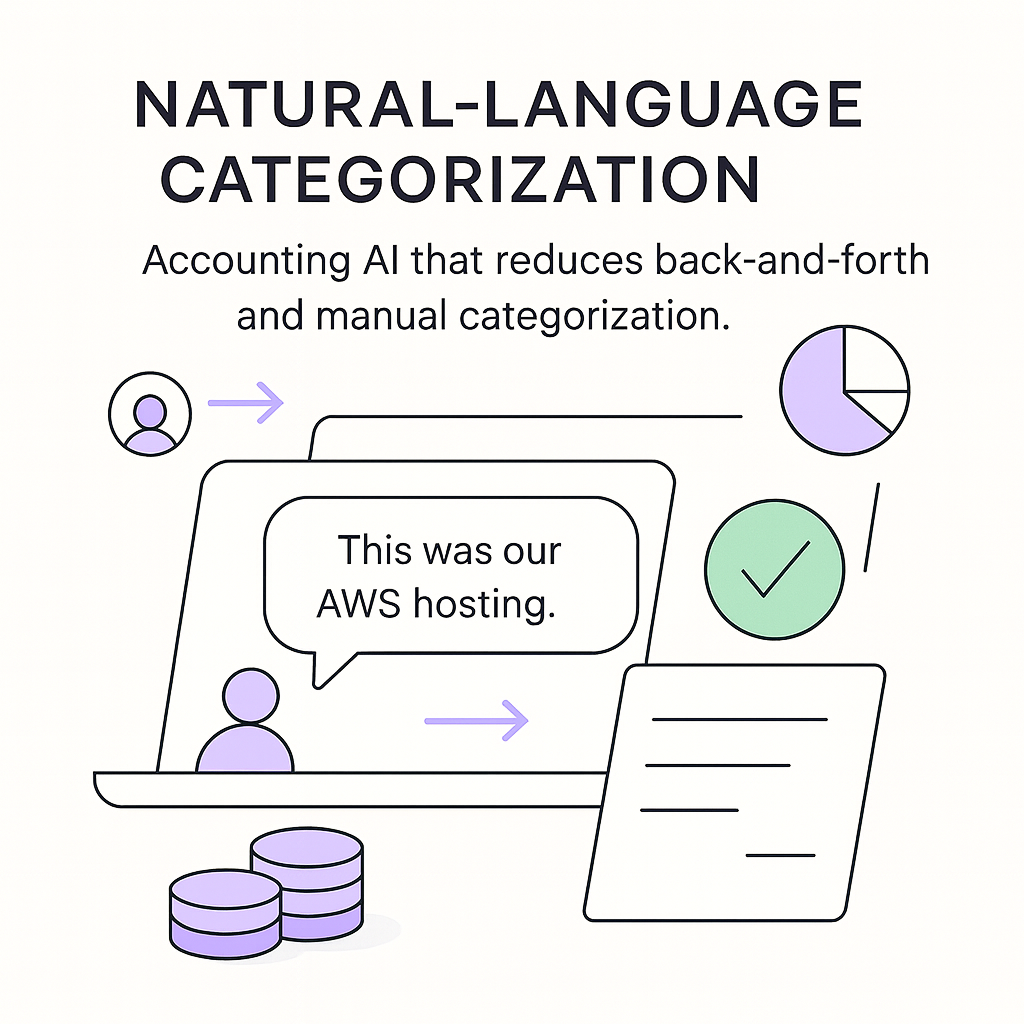
Natural-Language Categorization (2023)
Accounting AI that reduces back-and-forth and manual categorization.
Puzzle was one of the first platforms to use LLMs (ChatGPT 3.5 → 4) to categorize transactions from simple natural-language messages between accountants and their clients. Clients could reply in plain English:
“This was our AWS hosting payment.”
The system categorized it instantly — no rules to maintain, no manual tagging.
How this helps firms:
Fewer uncategorized transactions
Less time spent chasing client details
Faster month-end closes
This was Accounting AI used the right way — to support clear communication and remove friction.
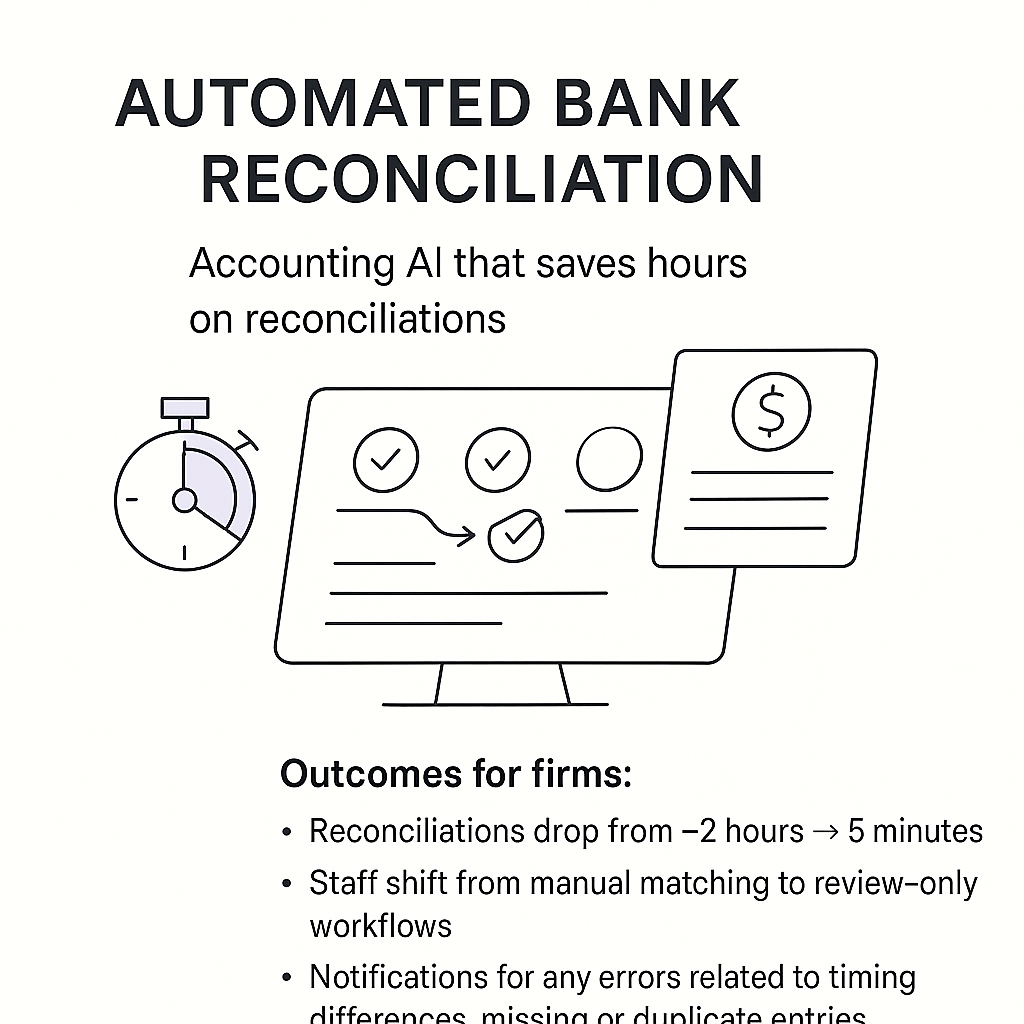
Automated Bank Reconciliation (2023)
Accounting AI that saves hours on reconciliations.
Accounting AI can not only read documents better, but can draft, assemble, review and identify anomalies better than historical OCR or machine learning.
Puzzle began matching transactions and balances automatically, reducing reconciliation time dramatically.
Outcomes for firms:
Reconciliations drop from ~2 hours → ~5 minutes
Staff shift from manual matching to review-only workflows
Notifications for any errors related to timing differences, missing or duplicate entries
Firms consistently cite this as one of the biggest time savings in their month-end close.
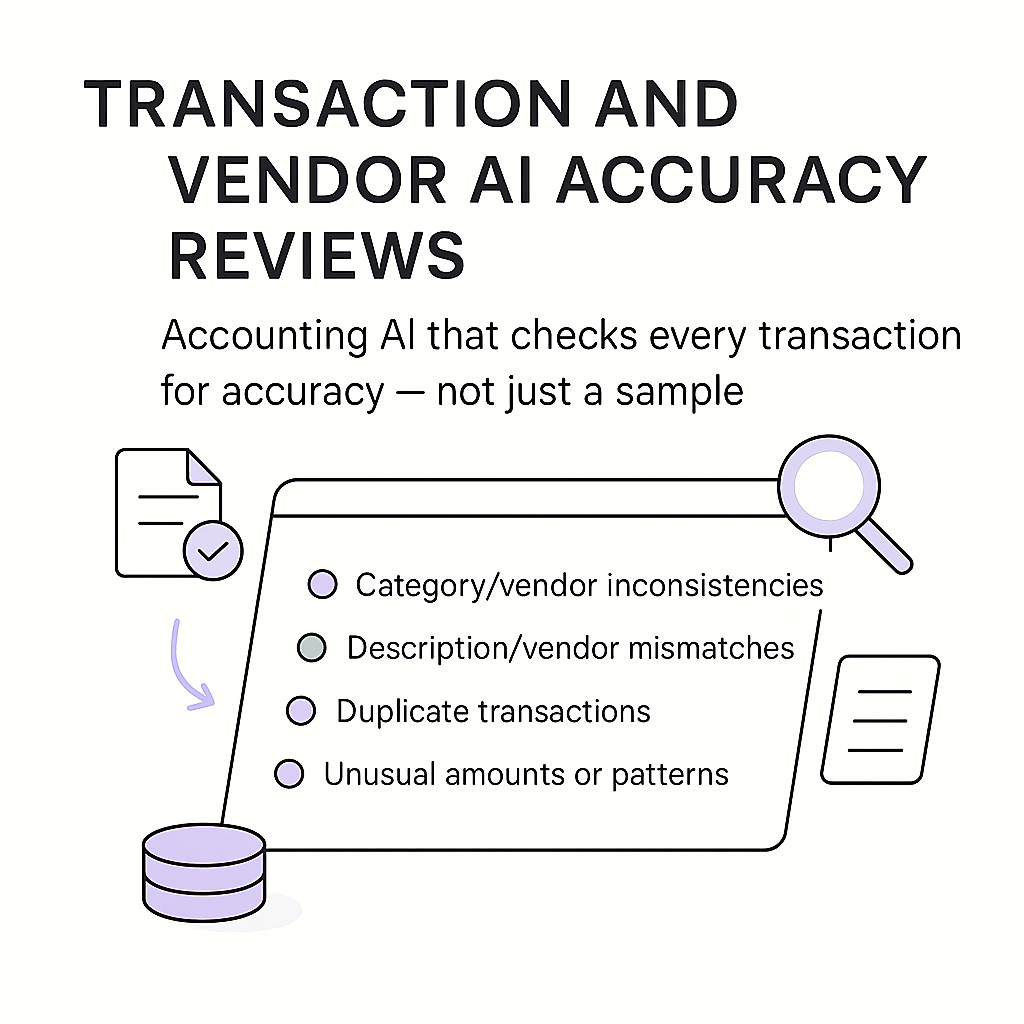
Transaction and Vendor AI Accuracy Reviews (2024)
Accounting AI that checks every transaction for accuracy — not just a sample.
Puzzle launched accuracy reviews that scan the full ledger for:
Category/vendor inconsistencies
Description/vendor mismatches
Duplicate transactions
Unusual amounts or patterns
Confidence scoring with explanations
How firms use this Accounting AI:
Issues are caught during the month, not after
Senior reviewers trust the numbers earlier
Books become audit-ready by default
This feature alone reduces review time by hours each month.
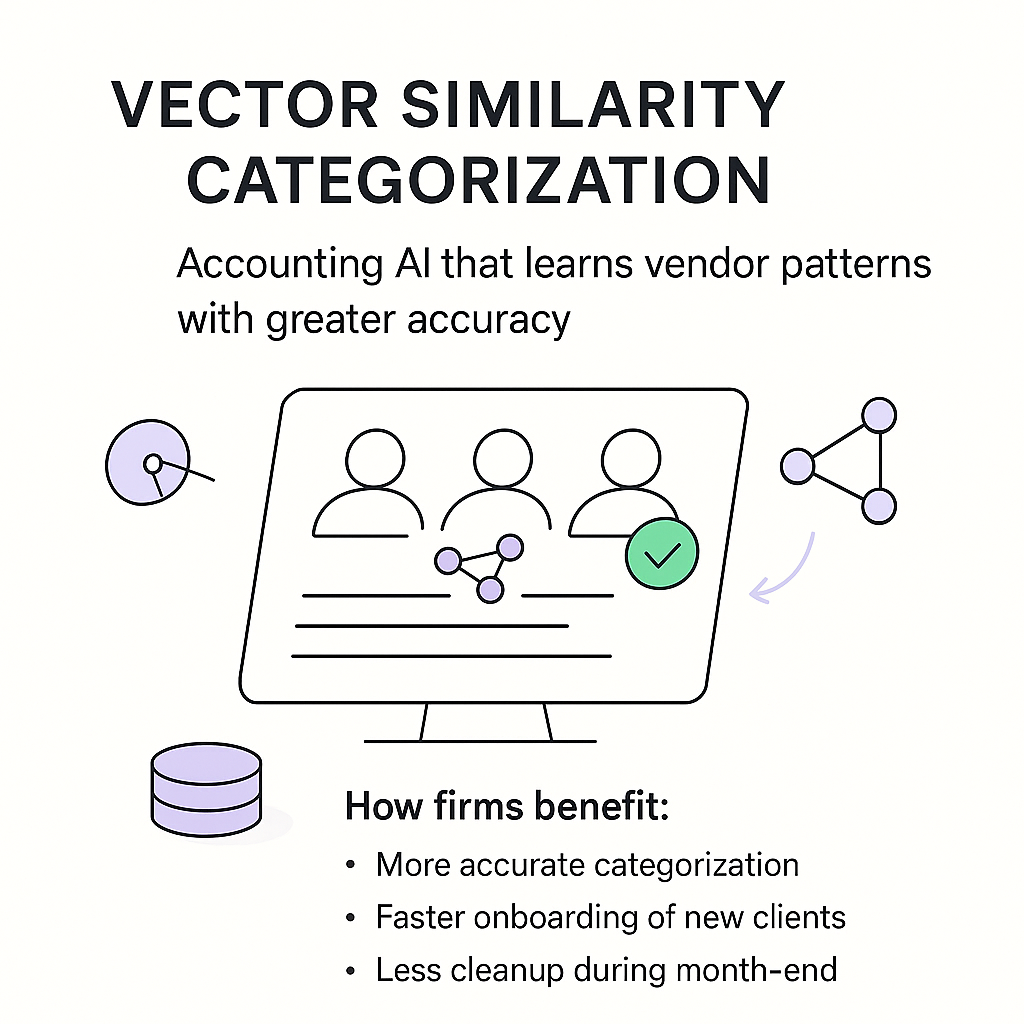
Vector Similarity Categorization (2024)
Accounting AI that learns vendor patterns with greater accuracy.
Puzzle quietly introduced vector-similarity categorization using Vertex AI to identify patterns across thousands of vendors and transaction descriptions.
This improves classification accuracy for edge cases and reduces the need for custom rules.
How firms benefit:
More accurate categorization
Faster onboarding of new clients
Less cleanup during month-end
This matters because categorization quality impacts every downstream workflow.
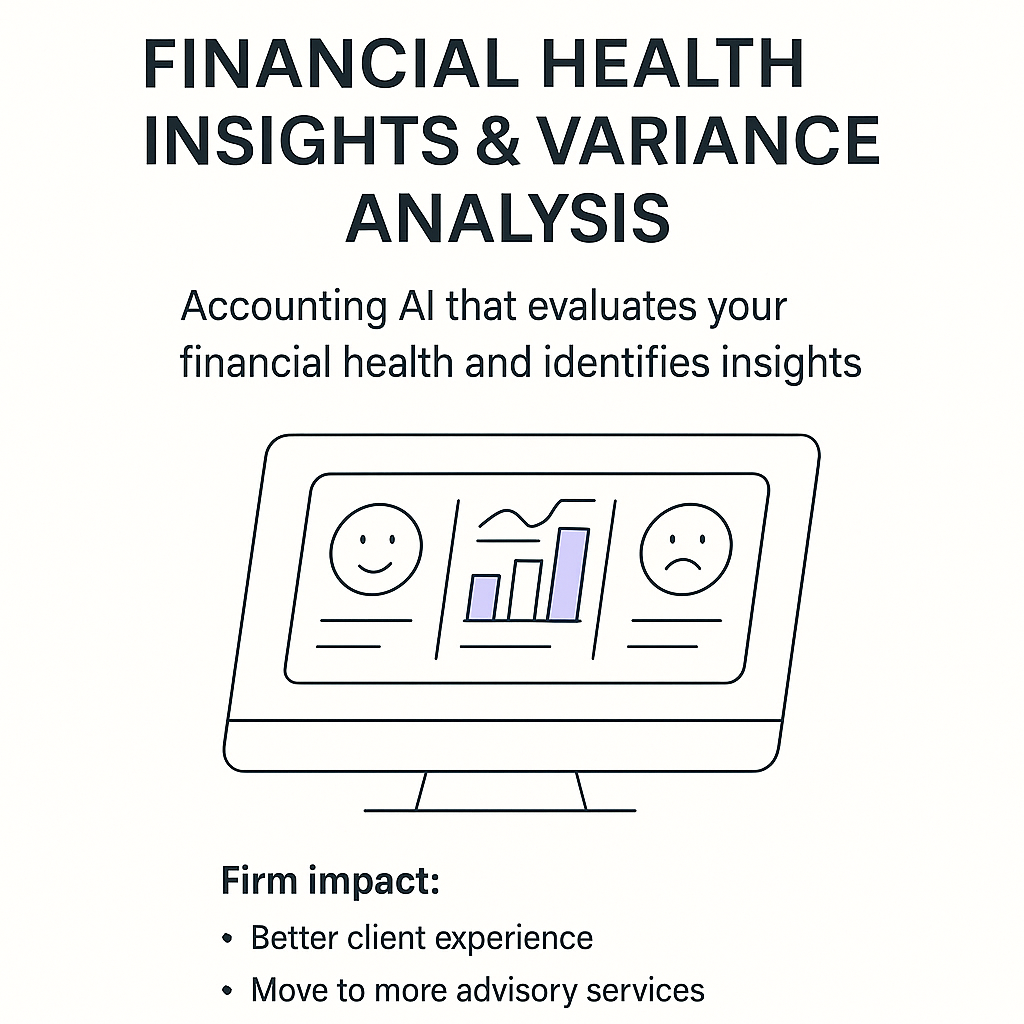
Financial Health Insights & Variance Analysis (2025)
Accounting AI that evaluates your financial health and identifies insights
This AI acts like a financial analyst, telling you financial health and insights in multiple ways. The good, bad and ugly, which we call “Steve Jobs” style (formerly Elon Musk style), a blend of good and bad, which we call “like a friendly investor” style, and just the good stuff, which we call “don’t hurt my feelings” style.
Firm impact:
Better client experience
Move to more advisory services
Easier upsell to customers on Quickbooks
Accounting AI doesn’t replace judgment. It ensures nothing gets overlooked.
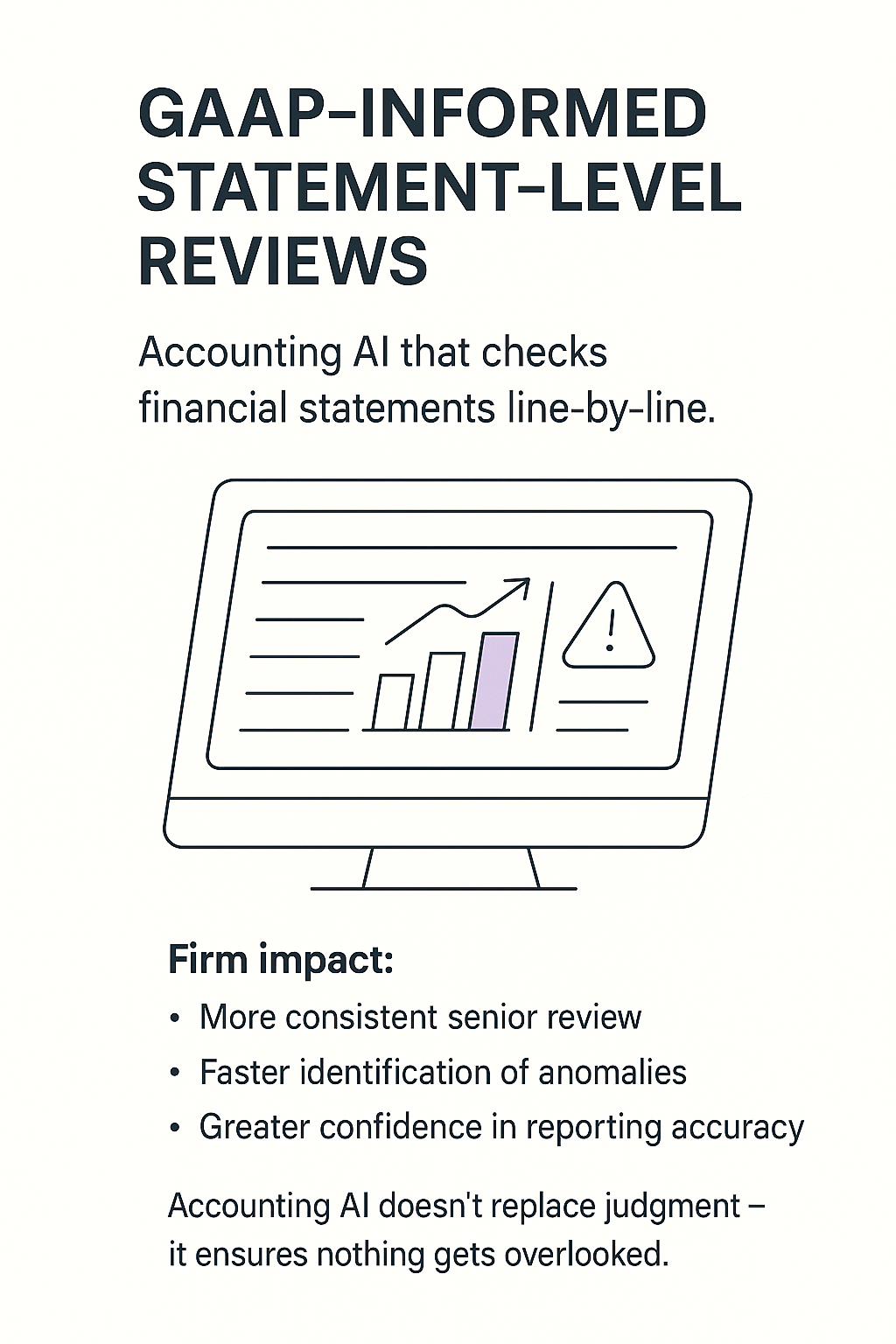
GAAP-Informed Statement-Level Reviews (2025)
Accounting AI that checks financial statements line-by-line.
This AI reviews books using GAAP-aligned logic to identify misstatements or unusual trends.
Firm impact:
More consistent senior review
Faster identification of anomalies
Greater confidence in reporting accuracy
Accounting AI doesn’t replace judgment — it ensures nothing gets overlooked.
Accrual agents (2025, in alpha)
Accounting AI that drafts accruals, prepaids, depreciation, and revenue recognition entries.
Models: ChatGPT 5, Claude (testing)
Puzzle is already well known for automating accruals native in software, a breakthrough first developed by Puzzle through a mix of software and design.
Prepaids
Fixed asset depreciation
Revenue recognition
Deferred revenue
Accruals
Benefits for firms:
Fewer spreadsheets to maintain
More consistent accounting across staff
Faster move from cash → accrual
Easier delivery of higher-margin advisory services
This is Accounting AI that supports better accounting, not shortcuts.
Puzzle Accounting AI Features at a Glance
Feature
Released
Key Outcome
Natural-Language Categorization
2023
Fewer uncategorized transactions; less time chasing client details
Automated Bank Reconciliation
2023
Reconciliation time drops from ~2 hours to ~5 minutes
Transaction & Vendor AI Accuracy Reviews
2024
Every transaction scanned for errors; books audit-ready by default
Vector Similarity Categorization
2024
More accurate edge-case classification; faster client onboarding
Financial Health Insights & Variance Analysis
2025
AI financial analyst surfacing good, bad, and unusual trends
Fewer spreadsheets; faster move from cash to accrual
Why Accounting Firms Switch to Puzzle for Accounting AI
1. More clients per accountant
Puzzle’s automation reduces categorization and reconciliation workloads so firms can grow without proportional hiring.
2. Faster month-end close
Review-only workflows replace manual matching, checking, and spreadsheet-heavy processes.
3. Higher accuracy
AI Accuracy Reviews and accrual drafting catch issues before they become problems.
4. Better staff satisfaction
Accountants spend less time on repetitive tasks and more time on client-facing work.
5. Competitive differentiation
Tech-forward firms using Puzzle deliver faster reporting and cleaner books — a major advantage in today’s market.
6. Accounting AI within the accountants control
Accounting that is drafted by software and AI, and reviewed and improved by accountants. No self driving accounting AI or changes made autonomously behind your back.
What Makes Puzzle’s Approach to Accounting AI Different
Puzzle is built on a modern ledger designed for real-time checks and error detection. We constantly test the best models on the market, so you don’t have to.
3. Transparent, explainable AI workflows
No hidden automation, no “books changed overnight.”
4. Built with real firm input
Features were co-developed with firms like Trivium, Burkland, and Decimal.
5. Clear, measurable benefits
Puzzle helps firms:
Reduce reconciliation time from 2 hours → 5 minutes
Take on (up to) 2x more clients per accountant
Close books 20-50% faster
This is Accounting AI with measurable business impact, not marketing claims.
Where Accounting AI Stands in 2026
The industry data has caught up to what early adopters already knew. According to Karbon's State of AI in Accounting Report 2026, 63% of accounting professionals now believe a firm's value drops if it doesn't use AI — up 7 points year-over-year. 87% cite speed and efficiency as the top benefit they're excited about, and 66% flag error reduction as a core driver of adoption.
The frontier has also shifted. In 2026, the conversation moved from "should we use AI?" to "which AI model is right for which task?" Agentic AI systems — ones that initiate actions rather than wait to be prompted — are now in pilot at early-adopter firms. The gap between firms that adopted AI deliberately and those that didn't is becoming measurable in client capacity, close times, and margins.
That's the environment Puzzle was built for. The features in this article aren't experiments — they're production capabilities that firms are using right now to stay on the right side of that gap.
Frequently Asked Questions
How are modern accounting firms using AI to reduce time spent on manual data entry and transaction categorization?
The most effective firms have replaced rules-based categorization with LLM-driven workflows. Instead of manually tagging transactions or maintaining long rule lists, accountants describe what a transaction is in plain English and the AI categorizes it instantly. Puzzle takes this further with vector-similarity matching across thousands of vendor patterns, so even edge-case transactions get classified correctly the first time. The result: categorization that once consumed hours of staff time each month now runs in the background — and accuracy reviews scan every transaction (not just a sample) to catch anything the model missed. Firms using this approach consistently report that their staff has shifted from data entry to review-only workflows, which is where AI bookkeeping automation and accountant judgment actually add value.
What's the best software for automating bank reconciliation at a seed-stage startup?
At seed stage — single entity, no controller, lean team — you need reconciliation that runs automatically without custom setup. Puzzle connects directly to your bank and fintech accounts (Mercury, Brex, Ramp, Stripe) and matches transactions and balances automatically, reducing reconciliation from roughly two hours to about five minutes per month. It also flags timing differences, missing entries, and duplicates so you're not discovering errors after the close. Legacy tools like QuickBooks were built for manual workflows; Puzzle was built AI-native, which means reconciliation is a background process, not a monthly project. For a seed-stage startup, that's the right size for the problem.
How does dual-basis cash and accrual accounting work, and what software handles it automatically?
Dual-basis accounting means maintaining both cash-basis and accrual-basis books simultaneously — cash so you can monitor daily burn and runway, accrual so your financials are GAAP-compliant for investors, auditors, and tax purposes. Most software forces you to pick one, or requires manual journal entries to reconcile between them. Puzzle maintains both bases natively in the same ledger, so your real-time cash position and your accrual statements are always in sync without extra work. The accrual agents (currently in alpha) also draft prepaids, depreciation, deferred revenue, and revenue recognition entries automatically — reducing the spreadsheets and manual entries that dual-basis accounting traditionally requires.
How do I automate payroll journal entries in my accounting software when using Gusto or Rippling?
Gusto and Rippling both offer native accounting integrations that push payroll journal entries automatically when payroll runs. The entries typically include gross wages, employer taxes, benefits deductions, and net pay — mapped to the GL accounts you configure in your accounting software. In Puzzle, payroll runs from Gusto or Rippling sync automatically and Puzzle's AI accuracy reviews flag any mismatches between payroll data and your chart of accounts, so errors surface before month-end rather than during review. If you're on the accrual basis, Puzzle's accrual agents can also draft wage accrual entries for pay periods that cross month boundaries — eliminating the manual journal entries that trip up most teams running payroll on a bi-weekly cycle.
How does Puzzle handle payroll journal entries for providers without a native integration, like ADP — and can AI agents automate this from uploaded reports or PDFs?
For payroll providers without a native Puzzle integration (ADP being the most common), the standard path is to upload the payroll summary report — typically a PDF or CSV export — and create the corresponding journal entry manually or with AI assistance. Puzzle's accrual agents are being extended to accept uploaded payroll reports and draft the journal entries from them: gross wages, employer taxes, benefits, and net pay mapped to the correct GL accounts. This is in active development. In the interim, Puzzle's AI accuracy reviews will still flag any payroll-period mismatches or missing entries when they're detected against your bank transactions — so gaps don't stay hidden until the close.
How does Puzzle's AI Close agent work, and how do AI credits apply to a monthly close?
The AI Close agent runs your month-end checklist automatically — scanning for uncategorized transactions, reconciliation gaps, accrual entries that need drafting, and statement-level anomalies — and surfaces everything that needs attention before you sign off. Available agents and templates include bank reconciliation, accrual drafting (prepaids, depreciation, deferred revenue), accuracy reviews, and GAAP-informed statement checks. AI credits are consumed per agent run; the number of credits a monthly close uses depends on entity size and which agents you enable. Firms on partner plans typically receive a credit allocation sized for their client book. Your Puzzle account will show credit usage per client so you can track it across your portfolio.
How does Puzzle's support and onboarding differ for accounting firm partners versus direct business customers — do firms get prioritized?
Yes — firm partners get a dedicated onboarding path that direct customers don't. Puzzle's partner program includes a dedicated partner success contact, priority support routing, and access to firm-specific training on multi-client workflows, the client portal, and AI feature rollouts. Direct business customers receive standard onboarding and support. The distinction matters operationally: when you're managing 30+ clients, you need answers fast — a ticket queue built for individual founders doesn't serve that. Firms interested in the partner program can apply at puzzle.io/for-accounting-firms.
How do I handle a QuickBooks migration when my historical books are messy — should I import raw transactions, wait until they're cleaned up, or start fresh?
The right answer depends on how far back the messiness goes and what you actually need from those historical records. The three approaches each have a real cost: importing raw transactions means inheriting the errors and cleaning them inside Puzzle; waiting until the books are clean delays your go-live; starting fresh with a beginning balance is the fastest path but loses transaction-level history. Most firms migrating messy books choose a hybrid: import a clean beginning balance for each account as of a cutoff date (typically the start of a fiscal year or quarter), bring in raw transactions only for the most recent period you'll actively work in, and archive the older QuickBooks file for reference. Puzzle's AI accuracy reviews will flag inconsistencies in whatever you import, so errors surface quickly rather than quietly compounding. If you have a controller or CPA helping with the migration, the cutoff-balance approach is almost always the cleaner call.
How does Puzzle handle bank account syncing when personal and business accounts share the same bank login — and how do I remove incorrectly imported transactions?
When personal and business accounts are connected through the same bank login (common with Mercury, Chase, or Bank of America), Puzzle pulls all accounts visible under that credential. During setup, you choose which accounts to activate — you can connect the login without syncing every account it touches. If personal transactions are imported accidentally, you can exclude or delete them from the transaction list; they won't affect your books until they're categorized and posted. For ongoing separation, the cleanest approach is to ensure your business banking is fully separated at the institution level — a dedicated business account under a separate login eliminates the problem permanently. If transactions were already categorized incorrectly, Puzzle's accuracy reviews will flag the anomalies so you can correct them before close.
What accounting software lets a bookkeeping firm manage 50+ clients without adding headcount?
The constraint isn't client count — it's how much manual work each client requires. Puzzle reduces per-client work by automating categorization, reconciliation, and accrual drafting, so the same accountant can handle significantly more clients without proportional hiring. Firms using Puzzle report taking on up to 2x more clients per accountant by shifting from manual-entry workflows to review-only workflows. For a firm at 50+ clients, the compounding effect matters: every hour saved on reconciliation and categorization across the book of business adds up to meaningful capacity. Puzzle also supports multi-client accounting software natively, so firms get visibility across their entire client base — not just one entity at a time.
Closing: Accounting AI That Empowers Accountants
The future of accounting isn’t AI that replaces accountants, it’s AI that empowers them to deliver better service at scale.
Puzzle gives firms:
More accurate books
Faster closes
Reduced manual work
Better staff retention
A modern advisory-ready workflow
That’s why more firms are adopting Puzzle as their Accounting AI platform — and why the most forward-thinking teams see it as their competitive advantage for the next decade.