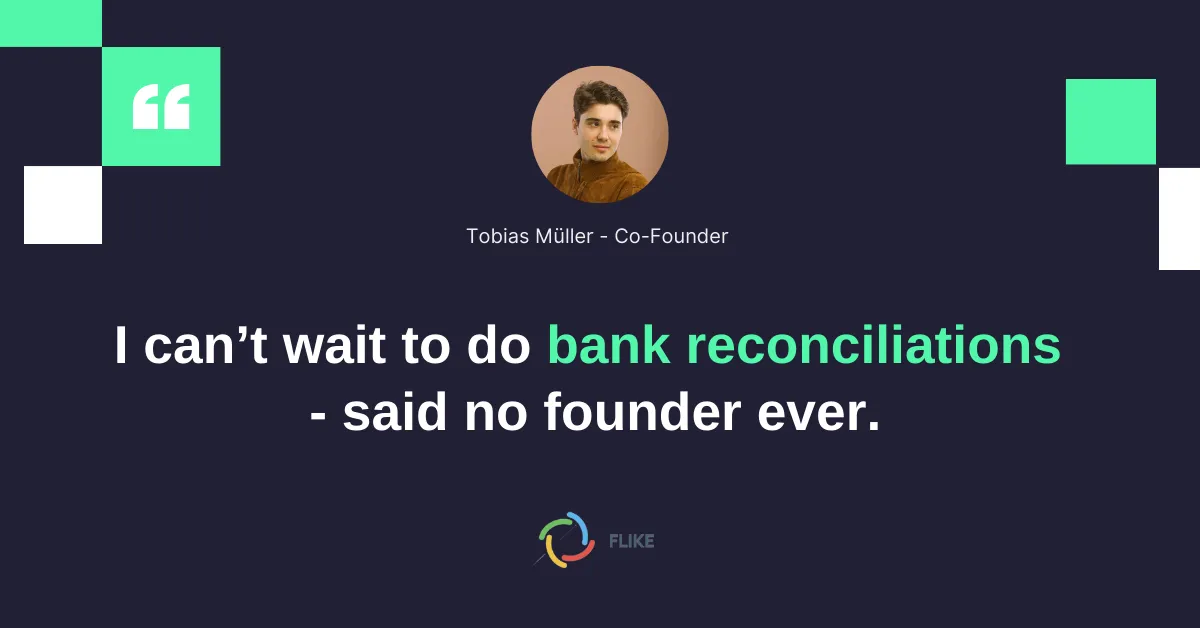
Say goodbye to the days of struggling with time-consuming manual accounting tasks, especially if you're a founder or an accountant of an early-stage Y Combinator backed startup like Flike. Flike (YC S22) was an AI sales co-pilot for modern go-to-market teams — acquired by FirstQuadrant in June 2024 — and before that acquisition, it took a big step towards automating its accounting processes.
TLDR:
In accounting, the first step involves making sure the matching process of all the financial data between systems is accurate, a process known as bank reconciliation.
All thanks to Mercury's statement API integration with Puzzle, Tobias Mueller, co-founder of Flike, no longer needs to rely on a bookkeeper to manually reconcile bank statements and stress about understanding the bank reconciliation process.
Today, we’re diving deep into Mercury’s API as a part of our Fintech for Founders series.
Mercury's API benefits founders, CFOs, and accountants by syncing every bank account transaction with Puzzle in real-time.
This unique integration fully leverages Mercury's API, delivering a wealth of automation and giving founders and accountants the most precious gift of all—time. The direct connection ensures reliable data, including metadata not typically found in a traditional bank feed, and access to historical balances through the statements API.
For founders, time is a precious resource that should be used wisely. Traditional bank reconciliations are notorious for being a drain on time and energy.
Simply put, performing a bank reconciliation is a month-end close process that ensures your company's cash records match your bank statements and bank transactions.
Before this integration, manually cross-referencing transaction matching between your bank and accounting software was a painstaking task.
Founders like Tobias spent an eternity matching transactions between their accounting records and bank statements.
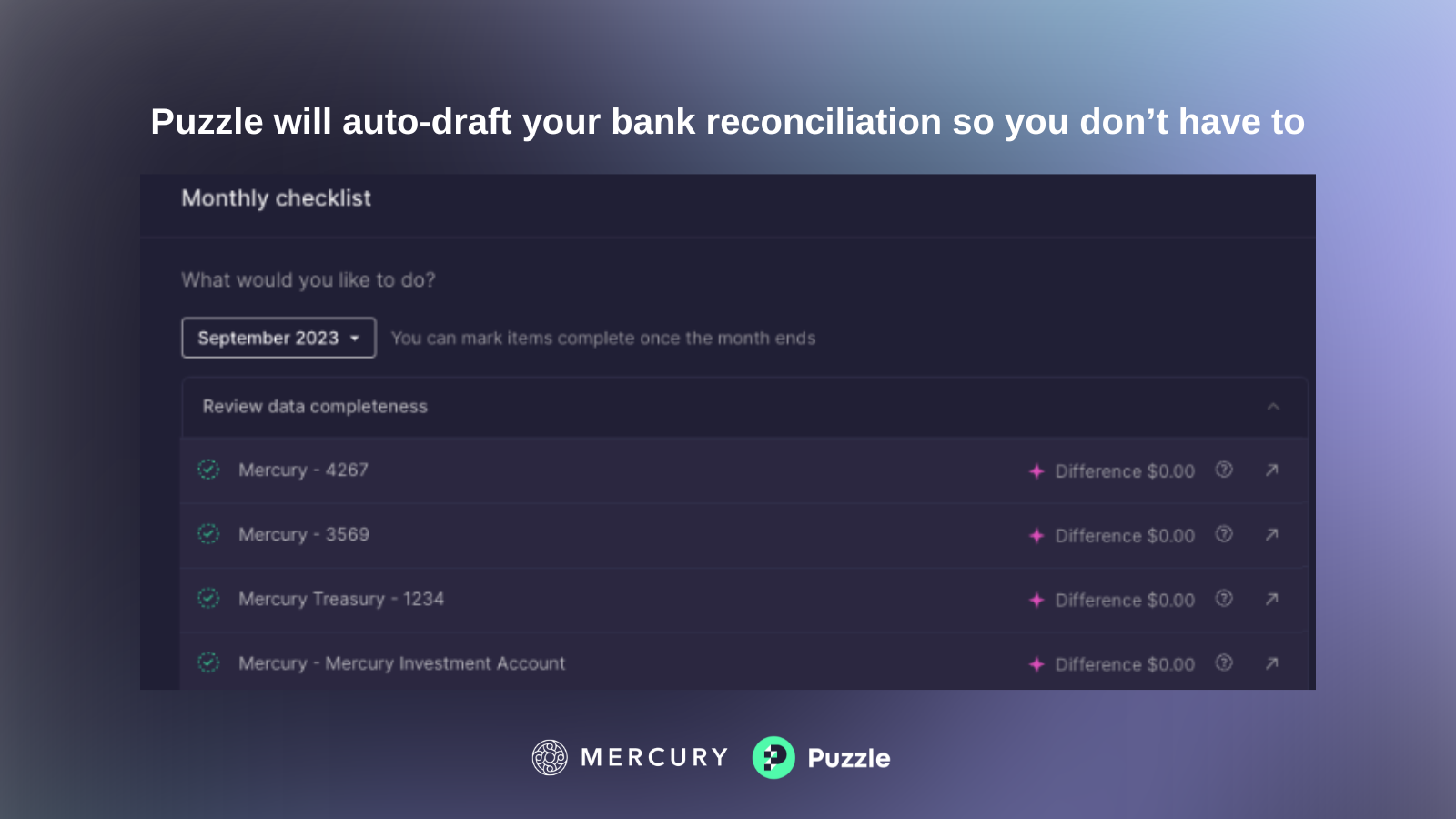
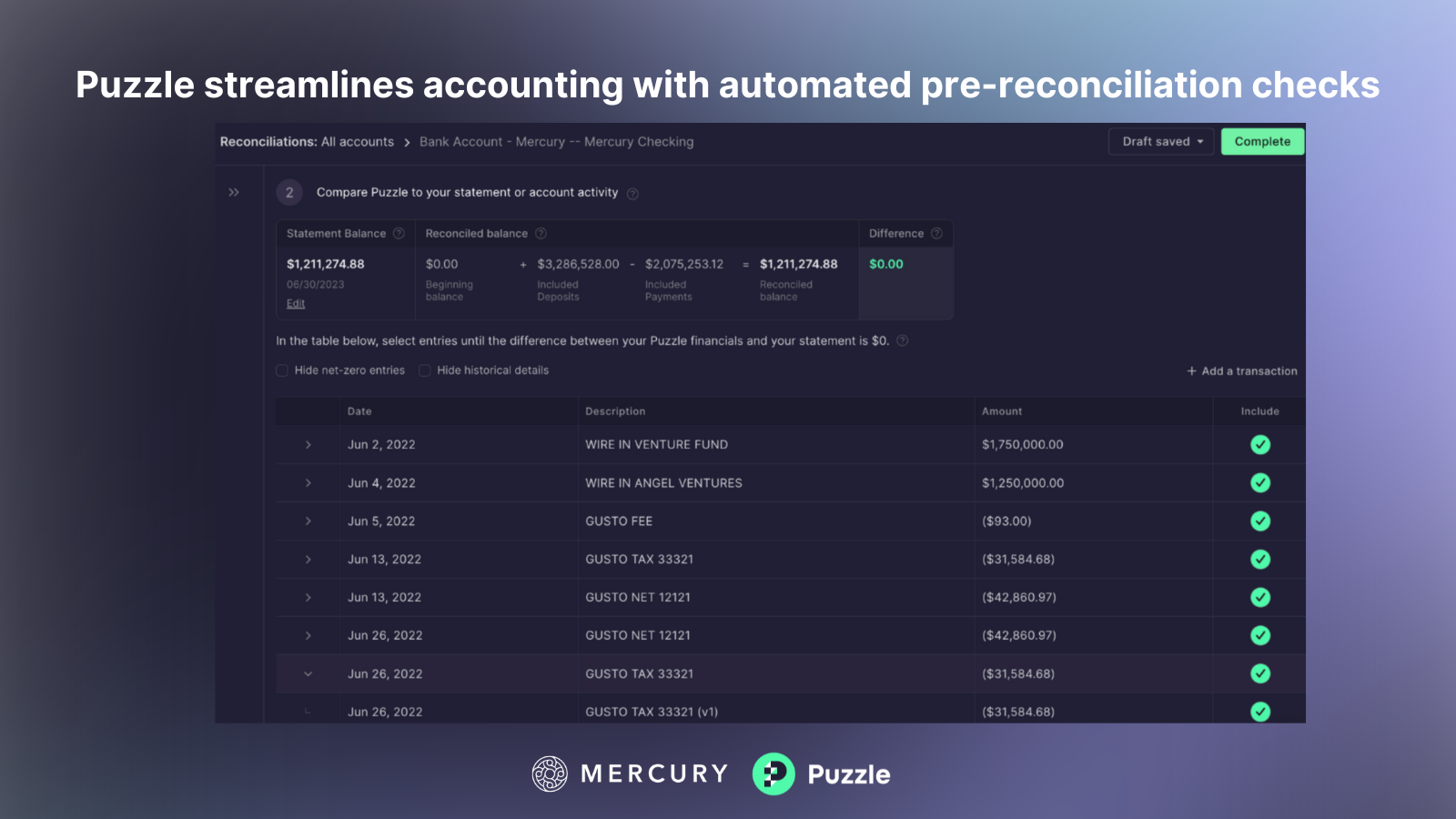
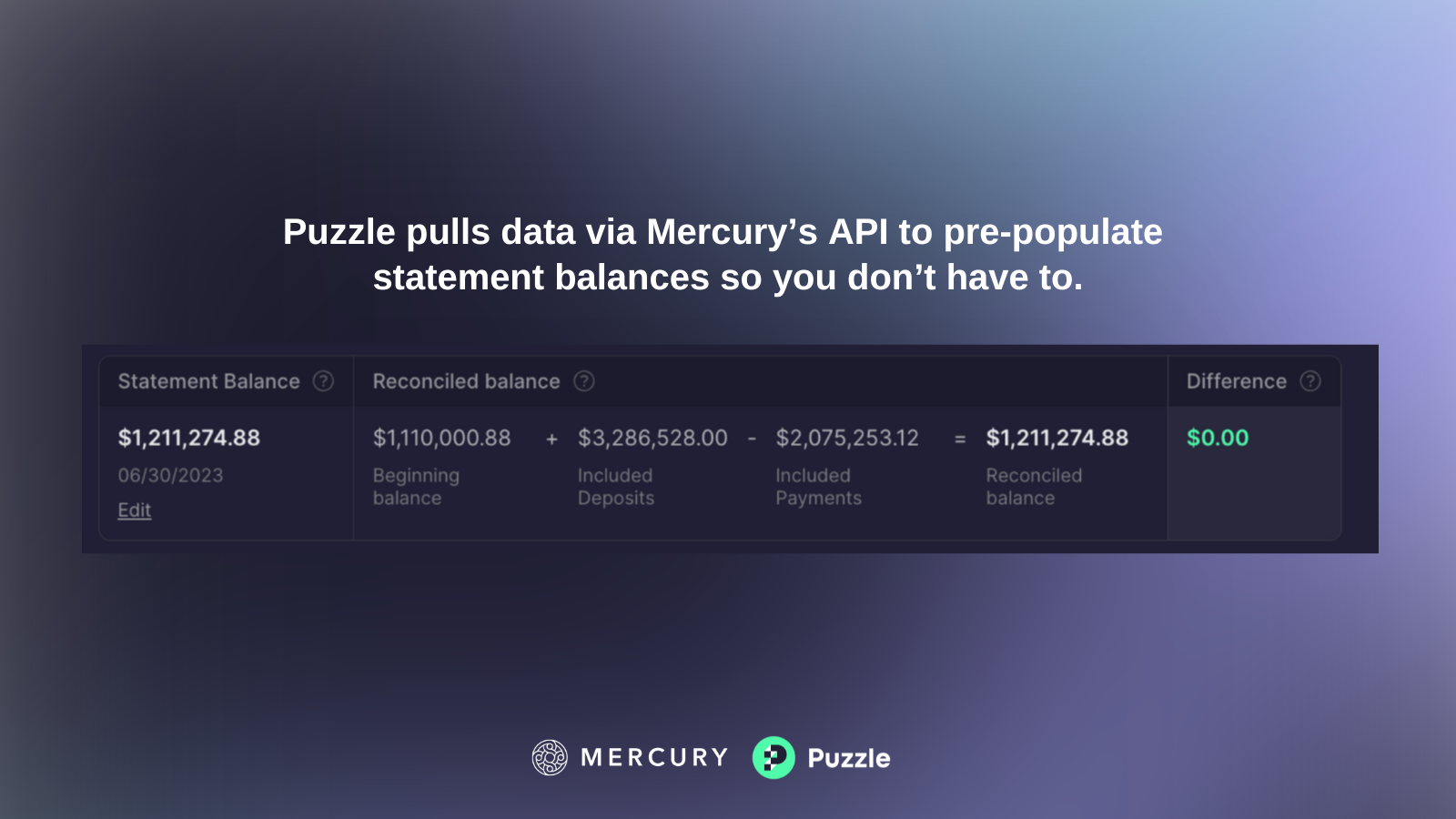
Beyond reconciliations, here’s how Puzzle, thanks to its direct Mercury integration, changes the game for founders and finance teams:
| Automation Feature | What It Does | Founder Benefit |
|---|---|---|
| Automated Bank Statement Imports | Mercury's API pushes bank statement data directly into Puzzle, eliminating manual imports and separate system dependencies. | Audit-ready books with no manual file exports — financial accuracy and traceability built in. |
| Automated Transaction Metadata Sync | Syncs full transaction metadata from Mercury — descriptions, memos, and notes — directly into Puzzle's ledger. | Meticulous record-keeping without manual journal entries or spreadsheets, with fewer errors at month-end. |
It's more than time-saving; it's liberating. As a first-time founder, Tobias can now focus his time and energy on the strategic aspects of growing Flike.
With Puzzle's automation, I can trust that our financial operations are set up correctly, giving me the time to steer Flike toward growth. Puzzle has empowered founders like me to work smarter, not harder.
The accounting automation landscape has changed dramatically since Flike first adopted this integration. AI-native reconciliation is now a defined category — and auto-match rates of 90%+ have become table stakes across platforms. What separates the tools that actually save founders time from those that just claim to: the quality of the underlying bank data.
Mercury's continued investment in its API reflects this shift. In April 2026, Mercury acquired Central (YC S24), an AI-native payroll, benefits, and compliance platform — a signal that the company is building toward a more complete financial operating system for startups. That same month, on April 27, 2026, Mercury received conditional OCC approval to establish Mercury Bank, N.A. — a structural shift that would give Mercury direct control over deposits, compliance, and data rather than relying on partner banks. That trajectory accelerated further in May 2026 when Mercury raised $200M at a $5.2B valuation, led by TCV with participation from Sequoia, Andreessen Horowitz, and Coatue. For Puzzle users, that trajectory matters: richer bank data, more metadata, and deeper integrations mean reconciliation keeps getting faster without adding headcount. If you're evaluating how Mercury fits into your broader setup, our guide to accounting tools for the startup banking stack covers the full picture. For a full walkthrough of how the connection is configured, see our Mercury bank accounting integration guide.
As of August 2026, Mercury has cleared conditional OCC approval and is in its bank organization phase — satisfying remaining requirements from the OCC, FDIC, and Federal Reserve before final charter approval is granted. The practical implication for API users is worth watching: a federally chartered Mercury would control its own deposit infrastructure directly, eliminating the partner-bank layer that currently sits between your transactions and the API. That means fewer intermediary-introduced delays, richer first-party metadata, and a reconciliation data stream that gets cleaner over time without any action on your end. Nothing changes today, but founders building on the Mercury + Puzzle stack are already positioned to benefit from that infrastructure shift as it completes.
For early-stage founders running lean, the real advantage isn't the headline automation rate — it's not having to hire a bookkeeper just to keep your books clean between funding rounds.
In March 2026, Mercury launched support for the Model Context Protocol (MCP) — a standard that lets you securely connect your Mercury account to AI assistants like ChatGPT and Claude. In practice, that means asking an AI tool "What did we spend on software last month?" and getting an answer pulled directly from your live Mercury transaction data — no CSV export, no dashboard login required.
For founders already using Puzzle's native Mercury integration, this creates a compounding effect: Mercury feeds clean, real-time transaction data into Puzzle automatically, and MCP gives you a conversational layer on top of that same data stream. Your books stay current without any action on your end, and your AI tools can reason over them on demand. The kind of setup that used to require a BI tool, a data warehouse, and an analyst is now a configuration step.
Want the same cash flow management efficiencies as Tobias? Check out Mercury and Puzzle and learn more about Mercury for startups and accounting teams.
Yes. Puzzle's AI-native engine categorizes transactions continuously as they arrive from Mercury — no manual intervention required. Because Mercury's API pushes data in real-time rather than batching it overnight, your books update the moment a transaction clears. Automated pre-reconciliation validation runs on a schedule, so by the time you check in, the reconciliation is already done or flagged for a single-click review. For most early-stage startups, that means a month-end close that used to take hours now takes minutes — without logging in daily to trigger anything.
Yes. If you're not using a live API connection, Puzzle can extract transactions directly from uploaded bank statement PDFs and use them to build your general ledger. The system parses the statement, maps each line to the correct account, and creates the corresponding journal entries — no manual data entry required. That said, the Mercury API integration delivers meaningfully richer data: real-time syncing, full transaction metadata (memos, descriptions, counterparty details), and automated pre-reconciliation validation that PDF parsing can't replicate. If you're on Mercury, the API route is faster and more accurate.
Modern accounting software categorizes transactions by combining two layers: a rules engine and a machine-learning model trained on your transaction history. When a transaction arrives — via bank feed, direct API, or uploaded statement — the software checks it against explicit rules first (payee name, amount range, account type). If a rule matches with high confidence, the category is applied automatically. If no rule matches, the ML model infers the most likely category based on patterns it has learned from your historical data and, in some cases, aggregated patterns across similar companies.
The data source matters significantly here. A standard bank feed delivers a limited data payload — typically just the amount, date, and a truncated description. A direct API like Mercury's pushes the full transaction metadata: memos, counterparty details, and descriptions. More signal at ingestion means higher auto-match rates and fewer transactions that land in an "uncategorized" queue. For founders on Mercury, that metadata advantage is one of the concrete reasons the Puzzle integration outperforms a generic bank feed connection.
High-confidence matches post automatically. Low-confidence matches surface for a single-click review — you confirm or correct, and that decision feeds back into the model. Over time, the system learns your specific patterns: a transaction from "AWS" always goes to Cloud Infrastructure; a monthly charge from "Gusto" always splits between Payroll Expense and Employer Taxes. The more you use it, the fewer items reach the review queue.
Modern platforms like Puzzle use a combination of rules-based matching and machine learning trained on your historical transaction patterns. When a new transaction arrives via bank feed or API, the system checks it against existing rules (payee name, amount range, account type), then falls back to ML-inferred categories when no rule matches. High-confidence matches are applied automatically; low-confidence ones are surfaced for one-click approval.
The learning loop works like this: every categorization decision you confirm or correct becomes a signal. Puzzle updates its model on your transaction history, so the more you use it, the fewer low-confidence items surface. When you manually override a category, Puzzle asks whether to create a rule — "always categorize transactions from this vendor as Software" — and applies that rule to all future matching transactions automatically. Rules stack: a payee-level rule overrides the ML default, and an account-level rule overrides both. You can review, edit, or delete rules at any time from the rules manager.
The critical difference between a standard bank feed and a direct API like Mercury's: the API delivers richer metadata — memos, descriptions, counterparty details — that gives the model more signal at ingestion and dramatically increases auto-match accuracy. More metadata in means fewer uncategorized transactions to touch at month-end.
Yes — Puzzle's AI goes beyond passive categorization. You can ask it to split a transaction across multiple accounts or cost categories, flag potential fixed assets based on amount and vendor type, or pull a quick P&L snapshot for a given period. These aren't manual workarounds; they're tasks you'd typically hand to a bookkeeper. The key distinction: Puzzle surfaces the AI's work for your review before anything is committed to the books, so you maintain accuracy without losing the time savings. For founders running lean, that means fewer fire drills at month-end and no surprise reclassifications.
Puzzle supports multi-entity accounting — you can manage separate legal entities, each with their own chart of accounts and bank connections, under a single login. If you're running multiple funds, subsidiaries, or holding structures, Puzzle keeps the books isolated per entity while giving you consolidated visibility across all of them. Each Mercury account maps to its entity directly via the API, so transactions route to the right books automatically. For early-stage startups with a single entity, this is overhead you don't need yet — but the structure is there when your cap table gets complicated.
Most accounting platforms connect to Ramp, Gusto, and Rippling through third-party connectors — which means data arrives in batches, metadata gets stripped, and payroll journal entries still require manual cleanup. Puzzle integrates natively with all three. Ramp transactions sync in real-time via direct API, so card spend is categorized and reconciled the moment a charge clears — no CSV exports. Gusto and Rippling push payroll data directly into Puzzle's ledger, creating the corresponding journal entries automatically: gross wages, employer taxes, and benefit deductions each map to the right accounts without a bookkeeper touching them. For a deeper look at how Ramp accounting integrations handle payroll journal entries, see our dedicated guide. For a lean startup running payroll every two weeks, that's the difference between a clean close and a backlog of unposted entries. QuickBooks and Xero support these integrations too, but through middleware that adds lag and reduces the metadata available for auto-categorization. Puzzle's direct connections — along with its native Mercury bank accounting integrations — mean your payroll, spend management, and bank activity all reconcile to the same source of truth — automatically.
These are two different things, and the distinction matters at audit time or when an investor asks for a GAAP cash flow statement. Puzzle's cash activity report is a real-time view of money moving in and out of your accounts — think of it as a live cash ledger. It's useful for daily burn tracking and runway visibility, but it's not a formal GAAP Statement of Cash Flows. For a deeper look at how cash vs. accrual accounting works for startups, see our dedicated guide.
A full GAAP Statement of Cash Flows — prepared under ASC 230 — classifies every cash movement into one of three sections: operating, investing, and financing. The indirect method (the standard approach for most companies) starts with net income and works backward, adjusting for non-cash items and working capital changes to arrive at cash from operations. Puzzle supports the indirect method natively: it uses the accrual books it maintains in parallel to generate the adjustments automatically, so you're not building the reconciliation by hand in a spreadsheet.
For a pre-seed startup, the cash activity report is usually enough for internal decisions. You'll need the full GAAP SCF for your first audit, most institutional fundraises, and any lender that requests GAAP financials. Puzzle generates both from the same underlying data — no separate preparation required.
Digits bets on autonomy as its core model: the AI categorizes, reconciles, and closes with minimal human involvement — which means by the time you see the output, the decisions are already made. Kick takes a similar approach, optimizing for hands-off bookkeeping. Puzzle inverts that model: the AI does the work, but you approve before anything touches the books. For a founder who wants fast books without a bookkeeper, the difference shows at audit time — or when you need to explain a number to an investor. Puzzle's direct Mercury API integration also gives it a data quality edge: richer metadata at ingestion means higher auto-match rates and fewer uncategorized transactions to review.
For SaaS companies, every subscription payment creates a liability — deferred revenue — that has to be recognized ratably over the service period. Under ASC 606, that means recording a journal entry at the time of payment, then releasing revenue incrementally as the obligation is fulfilled. Done manually, this compounds fast: a few hundred subscribers generates hundreds of recurring journal entries a month, and a single missed reversal can misstate your P&L for the quarter. The right fix isn't a spreadsheet — it's a direct integration between your billing system and your general ledger. Puzzle connects natively to Stripe, so when a subscription charge processes, Puzzle automatically books the deferred revenue liability and schedules the recognition entries over the contract period — no manual journal entries, no month-end spreadsheet. Stripe Revenue Recognition handles the recognition waterfall on Stripe's side; Puzzle handles the GL entries on yours. For a 10-person SaaS startup without a controller, that means ASC 606-compliant books without a finance hire. If you're evaluating your options, our guide to revenue recognition software for subscription businesses covers what to look for. QuickBooks and Xero can connect to Stripe, but revenue recognition automation typically requires a separate add-on or manual configuration — Puzzle's native integration handles it out of the box.
The tools that actually deliver real-time visibility — without a finance hire — share one trait: they pull data directly from your bank and spend accounts via API rather than waiting for nightly syncs or manual exports. Mercury gives you a live ledger of cash in and out. Ramp tracks card spend the moment a charge clears. But raw transaction data isn't the same as financial clarity. The missing layer is an accounting platform that translates those transactions into burn rate, runway, and P&L in real time.
Puzzle connects natively to Mercury, Ramp, Stripe, Gusto, and Rippling — so every payment, payroll run, and card charge flows into your books automatically. Your burn and runway update daily without anyone logging in to trigger a sync. Forecasting tools like Runway and Jirav can sit on top of that data for scenario modeling, but they depend on clean books underneath. Float is useful for cash flow projections if you're managing tight runway, but it reads from your accounting system — if your books are stale, so is your forecast.
For a seed-stage startup without a controller, the right stack is: Mercury for banking, Ramp or a card for spend, and Puzzle to close the loop into real-time financials. No bookkeeper required to keep the numbers current.
At the seed stage, the reconciliation problem is simple in theory and painful in practice: you need your accounting records to match your bank balance every month without paying a bookkeeper to do it manually. If you're evaluating your options, our roundup of the best Mercury bookkeeping software for startups covers the leading choices. The tools that solve this split into two categories.
Direct-API platforms like Puzzle connect to Mercury via a native integration that pushes the full transaction payload — amounts, dates, memos, counterparty details — directly into the ledger in real time. Automated pre-reconciliation validation runs on a schedule, so your statement balance is already populated and cross-checked before you open the reconciliation screen. For founders on Mercury, this is the fastest path to a clean close: auto-match rates above 90%, no CSV exports, and no separate reconciliation tool required.
Close-automation tools like Numeric and FloQast are built for finance teams that already have a controller and a volume problem — they layer workflow and approval logic on top of an existing accounting system. Rho combines banking and expense management with built-in reconciliation tooling, which works well for teams that want everything in one place but trades away some integration depth. Brex's accounting automation similarly focuses on spend reconciliation within its own ecosystem.
For a seed-stage startup using Mercury and running lean, Puzzle is the purpose-built choice: the Mercury API integration eliminates the manual reconciliation step entirely rather than making it faster to do manually. QuickBooks and Xero connect to Mercury too, but through bank feed connectors that deliver less metadata and require more manual matching at month-end.
Most accounting platforms connect to Stripe, Mercury, and Ramp — but "connect" covers a wide range. QuickBooks and Xero support all three through third-party connectors (Plaid for Mercury bank feeds, Stripe's QuickBooks/Xero integration, Ramp's accounting sync). Those connectors work, but they batch data, strip metadata, and often require manual cleanup at month-end. NetSuite supports deeper integrations at enterprise scale, but the configuration overhead is significant for a team under 20 people.
Puzzle integrates natively with all three — without middleware. Mercury's API pushes full transaction data (including memos, counterparty details, and statement balances) directly into Puzzle's ledger in real time. Ramp syncs card transactions the moment a charge clears, categorized automatically. Stripe handles revenue and deferred revenue recognition natively, mapping subscription payments to the right GL accounts without manual journal entries. For a deeper comparison, see our guide to accounting tools for Mercury and Stripe startups.
The practical difference: with native integrations, your books update continuously and reconciliation is mostly done before you start. With connector-based integrations, you're reconciling against data that's already been filtered and delayed. For a startup running Stripe for revenue, Mercury for banking, and Ramp for spend, Puzzle is the only platform where all three connect directly — giving you a single, real-time source of truth across your entire fintech stack.
For a 10-person SaaS startup running Stripe for revenue and Mercury for banking, Puzzle is purpose-built for exactly that stack. Puzzle connects natively to both: Mercury's API syncs every transaction in real-time with full metadata, and Stripe's integration handles revenue recognition and deferred revenue automatically — critical for SaaS companies that need clean accrual books without a full-time controller. If you're comparing your options, see our roundup of the best accounting software for SaaS startups using Stripe and Mercury. QuickBooks and Xero can connect to both tools, but through third-party connectors that add lag and strip metadata. Puzzle's direct integrations mean your burn, runway, and MRR are always current without manual reconciliation or exports.
When you connect a bank login that has both personal and business accounts attached, Puzzle imports all accounts visible under that credential by default. During setup, you choose which accounts to activate — only the ones you select flow into your books. If a personal account slips through, you can disconnect it from the Connections settings without affecting your other linked accounts under the same login.
If transactions from an unintended account have already been imported, you can remove them from within Puzzle's transaction ledger. Select the transactions, mark them as personal or exclude them, and they're removed from your GL without affecting the underlying bank connection. For transactions that were already categorized or posted, you'll want to void or delete the associated journal entries before removing the transactions — otherwise your account balances will show a discrepancy. If you're unsure which entries to clean up, Puzzle's pre-reconciliation validation will surface the imbalance so you can trace it back to the source. When in doubt, reach out to Puzzle support before deleting posted entries; a few minutes of guidance upfront is faster than untangling a reconciliation discrepancy later.
Puzzle is not a white-label or embedded accounting engine — it's a direct-use product for startups and their accounting firms. There is no public API today that lets a third-party SaaS platform embed Puzzle's ledger or UI under their own brand. If you're evaluating Puzzle as infrastructure to power another product, that's not the current use case.
What Puzzle does offer is a rich set of inbound integrations: Mercury, Stripe, Ramp, Gusto, Rippling, and others connect directly so that data flows into Puzzle automatically. For accounting firms, Puzzle provides a partner portal that lets firms manage multiple client books under one login — which covers the multi-client workflow without requiring API access to the underlying ledger.
If your question is about programmatic access to your own financial data (for exports, BI tools, or custom reporting), Puzzle's roadmap has included data export capabilities — reach out to the team directly for current availability and what's planned.
The two tracks are deliberately different. Direct customers — founders and finance leads onboarding their own company — get self-serve setup with guided onboarding flows, in-app help, and access to Puzzle's support team. Most early-stage startups are live with clean books within a few hours of connecting their bank and fintech accounts.
Accounting firm partners get a different experience by design. Puzzle's partner program gives firms a dedicated onboarding path, a firm-level portal to manage all client entities under one login, and direct access to the Puzzle team for questions that go beyond standard support. The intent is that firms should be able to onboard clients efficiently and run Puzzle as a core part of their service delivery — not troubleshoot it on their own.
Firms are not deprioritized — they have their own support channel. But the nature of the support differs: direct customers get product help; firm partners get both product help and practice-level guidance on how to build Puzzle into their client workflows. If you're evaluating Puzzle as a firm, ask the team about the current partner program structure before assuming the direct-customer experience applies to you.
Stay tuned for more guides from our Fintech for Founders series!