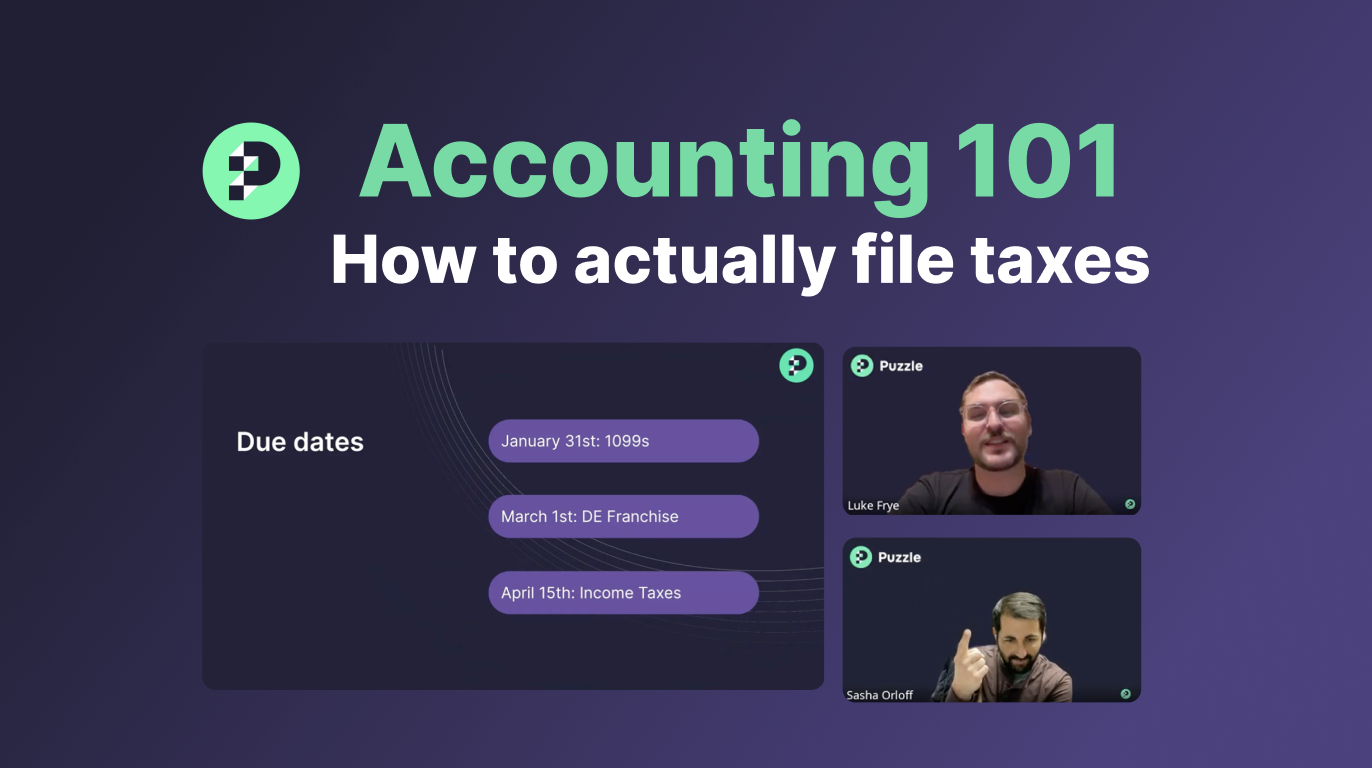
Tax season is closer than it looks: Delaware franchise tax is due March 1, 2027 and income taxes are due April 15, 2027. Here are the answers to the hard questions.
How do you actually file taxes as a founder?
Welcome to Accounting 101: the series that teaches startup founders how to tackle their own accounting, without a hassle or big time commitment.
Today, we're covering tax filing for founders - what's required, the types of taxes, and how to manage them effectively.
TLDR:
This lesson will cover:
The tax filings you need to comply with, such as:
Important upcoming deadlines and how to prepare for them:
The best tools to make tax season a breeze.
| Tax Type | Who It Applies To | Key Deadline |
|---|---|---|
| Income Taxes | All founders / entities | April 15, 2027 (S-corps & partnerships: March 15, 2027, or Sept 15, 2027 if extended) |
| Delaware Franchise Tax | Delaware-registered companies | March 1, 2027 |
| Sales Taxes | Founders selling taxable goods/services | Varies by state |
| Franchise Taxes | Entities registered in applicable states | Varies by state |
| State Registrations | Founders operating across multiple states | Varies by state |
The 2025 extension deadlines have passed: September 15, 2026 for S-corps and partnerships, and October 15, 2026 for individuals and C-corps. If you filed for a tax extension and haven't submitted yet, talk to your CPA right away about next steps. The next dates to plan around are March 1, 2027 (Delaware franchise tax), March 15, 2027 (S-corp and partnership returns) and April 15, 2027 (individual and C-corp returns).
Beyond the upcoming deadlines, a few 2026 developments are worth knowing:
The IRS resets these dollar limits every fall, so check each figure above against current IRS guidance with your CPA before you file.

On November 5, 2026, the IRS released its tax year 2027 inflation adjustments in IRS announcement IR-2026-133, with the full details in Revenue Procedure 2026-35. These figures generally apply to returns filed in 2028, so they won't change what you file this spring. They do matter if you are setting 2027 salary or timing equipment purchases now:
For the filings coming up first, the 2026 numbers earlier in this post still apply. Your Delaware annual report and franchise tax for 2026 are due on or before March 1, 2027, per the Delaware Division of Corporations. With roughly four months until that date, November is a good time to get your books current so your CPA starts January from reviewed numbers instead of a backlog.

If you paid a business expense out of pocket (a flight, a client dinner, a software subscription on your personal card), getting it onto your books accurately is what matters. Your CPA will need the amount, the date, the business purpose, and a receipt: the earlier you log it, the less you're reconstructing from memory in April.
In Puzzle, you can upload receipts and log personal transactions directly in the app, then categorize them as founder reimbursements. That creates a clean paper trail: the expense hits the right account on your books, it's backed by a receipt, and you (or your CPA) can pull the full record at tax time without digging through email. Log it as you go and your tax prep becomes a review, not a rescue operation.
A SaaS chart of accounts follows US GAAP and gives every tax obligation in this post its own home, so your CPA can pull numbers by filing instead of sorting through one catch-all expense line. For a Delaware C-Corp, these are the accounts that matter most at tax time:
Puzzle's default chart of accounts is built for SaaS and startup structures, and it maintains cash and accrual books at the same time. If your CPA or investors expect a specific layout, you can upload your own chart of accounts and add sub-accounts inline. Puzzle does not provide tax services or tax advice, so treat this as a bookkeeping structure and have your CPA confirm how each account maps to your returns.
It depends on how far behind you are and how much of your week you can spare. If you are one or two months behind and your accounts are connected, you can often catch up yourself: Puzzle's AI categorizes about 90% of transactions automatically (about 85% finalized), and you review the rest, which Puzzle estimates at about 15-20 minutes a week once the books are current (your time will vary with transaction volume). Catch-up bookkeeping starts at $300 per month of books, delivered by a Puzzle bookkeeper or a vetted partner firm in the same ledger you see. It's a good fit if you are many months behind or want someone accountable for the result. Either way, a CPA files your returns: Puzzle does not offer tax filing, so book your CPA early. Work backward from the deadlines in the TL;DR at the top of this post.
Start by connecting your bank, card and payroll accounts so Puzzle can categorize transactions as they arrive instead of at the deadline. From there, work through the transactions flagged for review and use the No Documentation filter to find anything missing a receipt. Customers who fully onboard and connect supported integrations are eligible for Puzzle's 50% Faster Close Guarantee: a refund of subscription fees if month-end close time does not drop by at least 50% within 60 days. If you are too far behind to do it yourself, add catch-up bookkeeping. Timelines depend on how many months are outstanding and how clean your source data is, so ask for a realistic estimate before you commit to a filing date.
Puzzle is an AI-native accounting firm, so you can choose your level of involvement. You can run the books yourself with the AI suite (AI Chat and AI Cowork). You can add Expert Reviewed bookkeeping, from $99 per month per entity, where a bookkeeper reviews, corrects and closes the books every month. Or you can add Full Service, from $499 per month per entity, where a named bookkeeper runs the full monthly close and you approve the month. Services are a separate add-on that sits on top of a Puzzle software plan, and they are delivered by Puzzle's own bookkeepers or vetted partner firms. The Puzzle MCP (alpha) connects tools like Claude and ChatGPT to your ledger, and the headless API is waitlist-only, so neither is a substitute for a bookkeeper today.
With legacy software and manual month-end workflows, you often see numbers weeks after the month ends, when it is too late to change a decision. In Puzzle, cash position, P&L and balance sheet update daily, and burn rate, runway and ARR/MRR are tracked automatically. Founders use that to check runway before a hire, spot an unusual vendor charge in the same week it happens, and pull investor-ready statements without asking anyone. On Core and above, AI Chat answers questions in plain English from your actual books, such as "what was our burn last month?"
Puzzle has native integrations with Mercury, Stripe, Brex, Ramp, Gusto, Rippling, Deel, Carta and BILL, and most supported connections take about two minutes. Data flows into the ledger and gets categorized as it arrives, which replaces the spreadsheet exports and manual entry that eat up bookkeeping time. Daily bank matching runs natively with Mercury and Ramp, while other banks need manual CSV uploads. Rippling payroll carries an extra $2 per month per employee and contractor, and payroll providers Puzzle does not integrate with (such as ADP) work through a report upload.
No. Puzzle supports USD and US entities only, and it does not offer multi-currency accounting. Its books follow US GAAP and its workflows are built for US startups, such as Delaware C-Corps. Puzzle is not set up for accounting or reporting rules in other countries (the UK or the EU, for example), so a company with a foreign subsidiary or books kept in another currency needs a different tool for that entity. If you are a US entity that bills customers in USD, including customers located abroad, Puzzle fits. If multi-currency or non-US reporting is a requirement today, confirm that before you migrate, and check any local filing questions with a CPA who works in that country. Puzzle does not provide tax advice.
Investors in a Series A or Series B diligence process look for accrual-basis, GAAP-based financials, revenue recognized over the right period (ASC 606), and a clear audit trail behind every number. Your software needs to produce those without a month-long cleanup, and it should not be an ERP built for problems you do not have yet. The right pick depends on your entity structure and how much finance staff you have:
| Your situation | Best fit |
|---|---|
| US Delaware C-Corp, USD only, SaaS or tech-forward, one entity or a few, no controller yet | Puzzle: dual-basis (cash and accrual) books, automated revenue recognition, audit log, statement of shareholders' equity, and a native Carta integration for equity journal entries |
| Multiple entities that need consolidations and eliminations, multi-currency, or a controller-run close | An ERP such as NetSuite, Sage Intacct, Rillet or Campfire, built for that complexity |
| Still on QuickBooks Online with books that investors keep asking questions about | Migrate to Puzzle before diligence starts ($149 per system moved), ideally with a cleaned opening trial balance |
Puzzle is built for startups from pre-seed through Series B with revenue up to $25M, so many Delaware C-Corps never need to leave it during a priced round. Know the boundaries before you commit: revenue recognition is Stripe-centric (other billing systems need manual journal entries), there are no native consolidations across parent and subsidiary entities (a partner integration handles that), and there is no multi-currency or inventory support. Rillet and Campfire are well-funded AI-native ERPs aimed at companies scaling toward IPO or replacing NetSuite, so they fit a later and more complex stage. Puzzle does not provide tax advice, so confirm your round-related tax questions with your CPA.
At seed stage you need reconciliation that runs without a bookkeeper and without a weekly block of your time. Puzzle matches bank activity to the ledger as it arrives. One Puzzle customer, Trivium, cut bank reconciliations from 2 hours to 5 minutes (up to 96% faster), with 81% completing without human intervention. Outgoing credit card payments from a checking account are also matched and cleared to the card account automatically, which removes the duplicate expense entries that make manual reconciliation painful.
Fit depends on your bank. Daily automatic reconciliation works natively with Mercury and Ramp, Brex connects directly, and other banks connect through Plaid or need manual CSV uploads. Expect about 15-20 minutes a week of review to finalize transactions, and expect accuracy on a brand-new account to start lower until Puzzle learns your patterns and rules. The Starter plan is $30 per month, and every plan includes unlimited transactions and automated reconciliation.
Puzzle does not give tax advice, so your CPA makes the final call on what is deductible. As a bookkeeping rule of thumb, an expense belongs on the company's books when it has a clear business purpose that you can document with a receipt, an amount and a date. Keep personal spending off company accounts where you can. When a mix happens anyway, log the business items as founder reimbursements, attach the receipts, and leave the personal items out of the business expense accounts. In Puzzle, you can upload receipts, flag transactions with no documentation, and categorize each item, so your CPA gets a clean record instead of a shoebox of guesses.
In Puzzle's conversations with founders, the complaints about legacy bookkeeping tools that come up most often are poor usability, no easy way to drill into the source data behind a number, hours of manual categorization, and reports that arrive after the decisions were made. Puzzle was built AI-native from day one, so categorization and accuracy checks run in the background as data comes in. Expect about 90% of transactions categorized automatically and about 85% finalized, with accuracy on a brand-new account starting lower until Puzzle learns your patterns and rules. Migration is $149 per system moved. By Puzzle's own estimates, a QuickBooks Online migration takes a couple of days because it uses a direct integration, while QuickBooks Desktop, Xero or Zoho Books take about five to seven days because they are moved manually. If your historical books are messy, a cleaned opening trial balance or a fresh go-live date keeps the switch simple.
Puzzle does not offer tax filing, tax advice or R&D studies, so your CPA or tax preparer files your returns. What Puzzle gives them is clean, current books: GAAP-based income statement and balance sheet, cash and accrual views side by side, an audit log, receipts attached to transactions, 1099 vendor export and a CSV tax package export. Because the books stay current during the year, tax season becomes a review of numbers your CPA already trusts. Add Expert Reviewed or Full Service bookkeeping services for startups if you want a bookkeeper closing each month before your CPA starts.
If you want tax season to be a review of current books instead of a scramble, Luke (me!) your resident CPA is on standby to help. Sign up for Puzzle and reach out to me in-app to book an onboarding call.