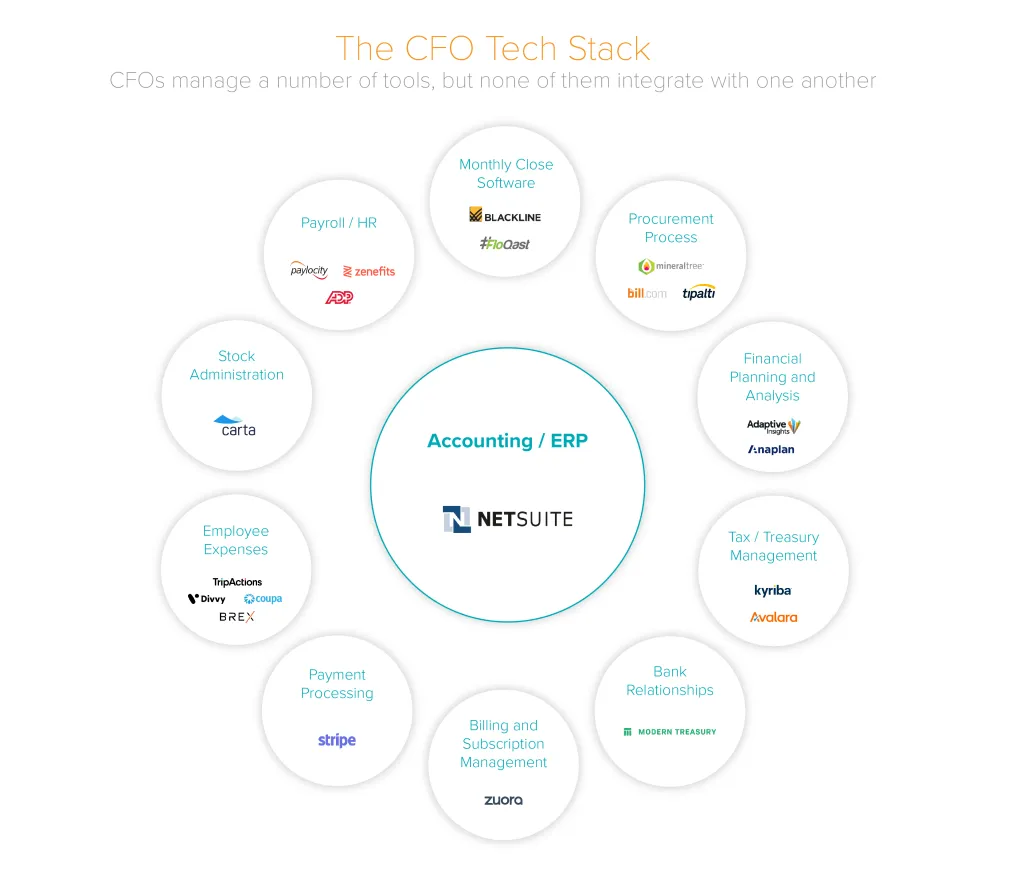
Esteemed venture capital firm Andreessen Horowitz (a16z) outlined a call for new tools to built for the office of the CFO, after decades of complacency by the two monopolies that sit at the core of the CFOs office - the accounting ledger and ERP.
Helen Chong
7.28.22
In article:
Accounting. Simplified
A bad product lacks competitive advantage. Successful businesses have something unique that's hard to copy. It could be cost efficiency, brand power, or proprietary tech. Without this, you're just waiting to get outperformed. Think of physical retailers being outperformed by e-commerce.
Thank you for being part of our Puzzle community. Stay tuned!
Oops! Something went wrong while submitting the form.
In 2020, venture capital firm Andreessen Horowitz (a16z) outlined a call for new tools to be built for the office of the CFO, after decades of complacency by the legacy systems at the core of the CFO's office — the accounting ledger and the broader back-office software stack built around it.
New times call for new tools. With help from early Puzzle advisor Sharon Olexy, a16z came up with a few key insights we agree with:
TLDR:
a16z identified 4 gaps in CFO software: intelligent building blocks, integrated data layer, banking operations, and automated reporting.
Finance teams spend up to 60% of their time on data gathering and reconciliation, per McKinsey.
The Office of the CFO software market sits at $77 billion and is projected to reach $118 billion by 2030, per Clipperton's Office of the CFO report.
Puzzle targets 3 of the 4 a16z opportunities with AI-native accounting, native fintech integrations, and automated month-end close workflows.
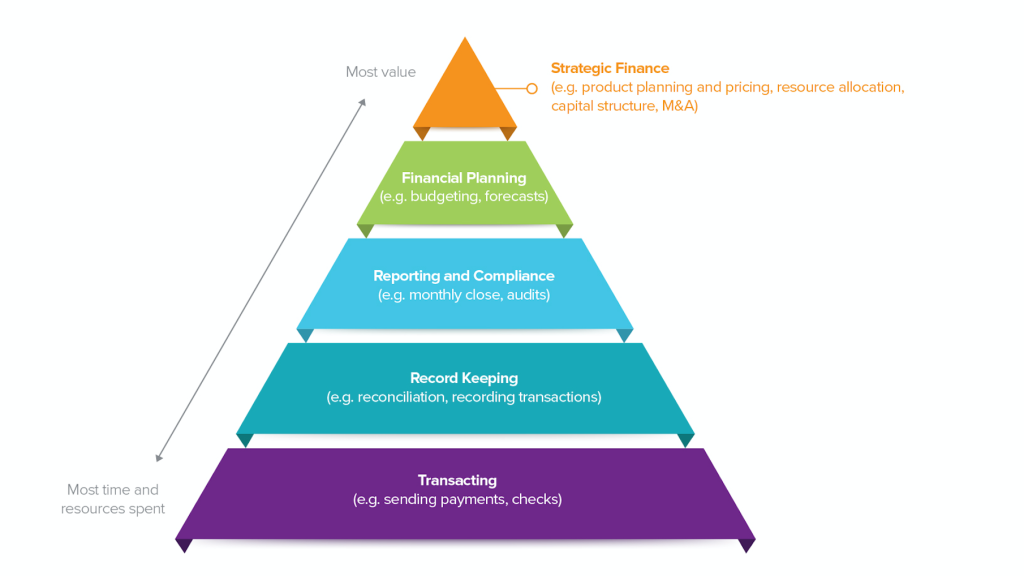
They created a really interesting hierarchy of needs for the new CFO. In the current economic crisis, businesses have been forced to make difficult decisions around resource allocation and cash flow planning. The person most critical in helping the CEO make those high-stakes calls—the CFO—is more vital than ever. Over the years, the CFO role has become highly strategic. Yet despite an influx of data on which to base business decisions, the tools at the CFO’s disposal have not kept pace. Accounting reporting has transformed to headcount planning, cash flow analysis, resource allocation and heavy involvement in sales and revenue prediction.
What ends up happening is output becomes data is stale, limited or hard to access. Manual journal entries and reconciliations consume almost all the month: a problem that our AI agent workflows for month-end close addresses — but expectations of the CFO are growing.
A16Z predicts 4 big opportunities:
Intelligent building blocks
Integrated data layer
Banking operations
Automated data entry and reporting
Puzzle targets #1, #2, and #4 directly, and partners with industry-layer specialists tackling #3.
Opportunity
What It Means
Puzzle's Role
1. Intelligent building blocks
Modular, AI-native tools that replace rigid legacy software
Attacking — AI-native accounting layer with automated categorization and real-time close
2. Integrated data layer
A single source of truth connecting fintech tools, banks, and the ledger
Attacking — native integrations with Mercury, Stripe, Ramp, Brex, and Gusto
3. Banking operations
Embedded banking, payments, and treasury management
Partnering — working with industry-layer specialists
4. Automated data entry and reporting
Eliminating manual journal entries, reconciliations, and reporting lag
Attacking — AI agent workflows replace manual month-end close tasks
Where Things Stand in 2026
The a16z thesis has aged well — and the pace of change has accelerated. Driven by AI-native tooling, cloud ERP modernization, and a wave of consolidation replacing fragmented point solutions with integrated platforms, finance software has moved from back-office plumbing to one of the most strategically important battlegrounds in fintech.
AI has gone from experiment to table stakes. McKinsey estimates finance teams spend up to 60% of their time on data gathering and reconciliation — exactly the kind of work that accounting agent software for startups was built to eliminate. Deloitte's 2026 CFO tech guide confirms that AI is moving from pilots to measurable impact across forecasting, variance analysis, and real-time reporting.
The four opportunities a16z flagged — intelligent building blocks, an integrated data layer, banking operations, and automated data entry — are no longer predictions. They're the product categories every modern finance stack is now built around. The 30-year-old ledger is still at the center, but the layer of intelligent tooling surrounding it has never been thicker.
Can Puzzle help a brand-new startup get its accounting set up correctly from the start?
Yes — and starting clean is the single best thing a new startup can do for its financial health. Puzzle is designed to be your accounting layer from day one: it connects to your bank accounts, cards, and fintech tools, categorizes transactions automatically, and keeps your books current without manual data entry. That means when tax season arrives, you're not paying an accountant to untangle a year of uncategorized transactions — the work was already done, continuously, in the background. The founders who skip proper setup early are the ones who end up paying for expensive retroactive cleanup right before a fundraise or an audit. Starting with Puzzle means that cleanup never becomes necessary.
How does Puzzle integrate with tools a startup already uses, like Mercury, Stripe, and Ramp?
Puzzle connects natively to the fintech stack most startups already run on: Mercury, Stripe, Ramp, Brex, Gusto, and more. These are direct integrations — not CSV exports or third-party sync hacks — so transactions flow into Puzzle continuously and your books stay current in real time. When a Stripe charge hits or a Ramp expense is approved, it's in Puzzle. That live data layer is what makes real-time burn rate, runway, and cash flow visibility actually possible. The integrated data layer a16z identified as the critical gap is exactly what Puzzle's native integrations are built to close.
How does Puzzle handle migrations from legacy accounting systems like QuickBooks or Sage?
Migrating from a legacy system (QuickBooks Desktop, Sage 100/300, or any other non-cloud tool) doesn't require a big-bang cutover. Puzzle lets you set a starting balance date so you can run both systems in parallel during the transition: your old system stays live for historical records while Puzzle takes over going forward from a clean, verified opening balance. That parallel-run approach eliminates the risk of a gap in your financials. Once you're confident the new setup is accurate, you decommission the old system on your own timeline. For firms managing this transition for clients, Puzzle's approach means no emergency cleanup, no data loss, and no gap period where the month-end close goes dark.
What tools should a fractional CFO use to deliver real-time financial insights to clients?
A fractional CFO's technology stack in 2026 centers on one non-negotiable: the accounting data has to be live, not two weeks stale. That means starting with an AI-native accounting layer — one that syncs with your fintech stack (Stripe, Mercury, Ramp, Brex, Gusto) continuously and closes the books without a manual reconciliation marathon. On top of that foundation, a strong startup finance stack typically includes: an FP&A tool for scenario modeling and forecasting, a cash flow forecasting layer, and a financial reporting tools layer for client-facing visibility.
The bottleneck is almost never the dashboard — it's the data underneath it. If your accounting integration runs nightly batch syncs or requires manual journal entries to close, no FP&A tool will give clients truly real-time insight. The right sequence: get the accounting layer automated and always current first, then layer the forecasting and reporting tools on top. That's the architecture a16z flagged as the critical gap — an integrated data layer — and it remains the right starting point for any fractional CFO building a modern client stack.
Let us help you solve your financial puzzles.
Thank you for being part of our Puzzle community. Stay tuned!
Oops! Something went wrong while submitting the form.