Product Updates
Startup Accounting
Ramp-Puzzle Integration: 50% Less Manual Categorization – October 2026
Streamline accounting with Ramp's Accounting API and Bill Pay API! Save time, eliminate manual work, and become more efficient.

8.22.23
Streamline accounting with Ramp's Accounting API and Bill Pay API! Save time, eliminate manual work, and become more efficient.
Ramp’s Bill Pay, Ramp Reimbursements, and Ramp’s Accounting API help founders and accountants save 50% of manual categorization work through 99% auto-categorization, when paired with Puzzle.
As a part of our Fintech Tools for Founders series, today, we want to talk about Ramp.
Got a growing startup on your hands? Congrats! this can be both a blessing and a curse. Bookkeeping tasks can steal your precious time. And you're likely to be incurring more expenses and reimbursements thanks to the venture-capital funding you’ve received.
They can feel like a real puzzle for a startup founder.
If you’re a founder, it’s difficult to understand complex accounting processes and how to categorize expenses correctly.
If you’re a client-facing accountant with many accounts, you are not embedded in any of your client’s operations, so categorization is also highly time-consuming. It requires a lot of back and forth with each client to understand the nature of the expense, get context, and obtain supporting documentation.
Let's talk about how you can eliminate 50% of your manual accounting categorization and ramp up your process, quite literally, with Ramp and Puzzle.
TLDR:
Ramp is a leading all-in-one spend management, bill payments, and vendor management solution that recently released an Accounting API to help companies save time.
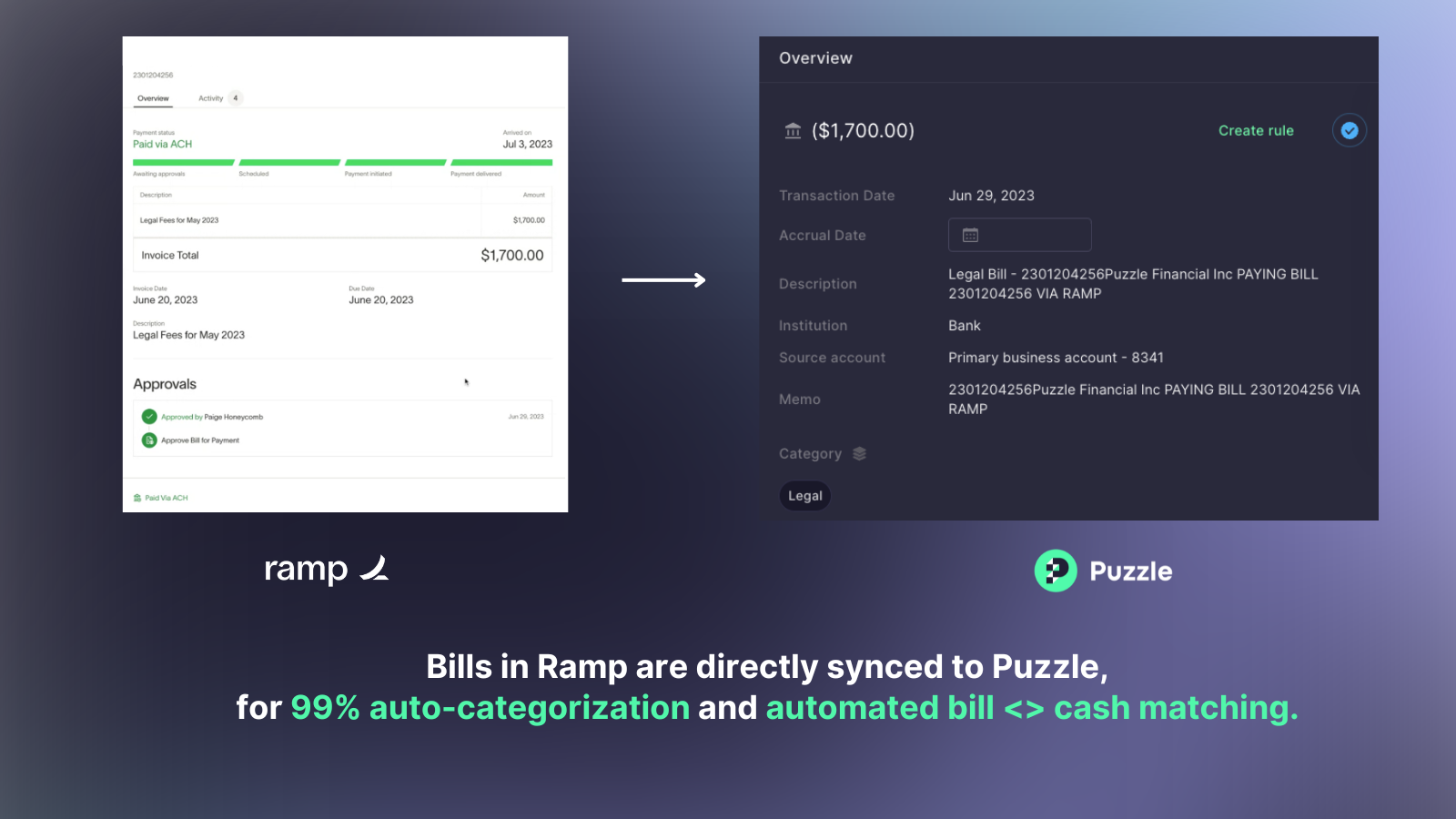
When you use Ramp and Puzzle (real-time accounting software), all company expenses via card, bills, and reimbursements in Ramp are pushed directly into Puzzle via API, reducing manual work and duplication of transactions. Ramp also matches cash payments to originating bills, cutting the process down further.
The benefits? Less manual work, 50% to be exact!
Less manual bill matching, less transaction matching, and less categorization. It’s no wonder Ramp helps companies close their books 8x faster!
Ramp Bill Pay is an accounts payable feature that allows users to automate bill entries, approvals, and payments with built-in financial controls.
When you categorize a bill or transaction in Ramp, Puzzle ingests those bills back into Puzzle through the API. When a cash transaction is recorded, Puzzle auto-matches the cash out (on the bank side) to the bill that came through Ramp.
Here’s how Ramp and Puzzle work together.
When you use Ramp’s Bill Pay API with Puzzle, this completely eliminates all the challenges around gaining context and category details around reimbursements.
When an employee reimbursement is made via Ramp, Puzzle syncs the data around singular line items back into Puzzle with details in the memo line description and a copy of the original receipt. This eliminates 100% of the time you would have been spent looking up expense reimbursement details!
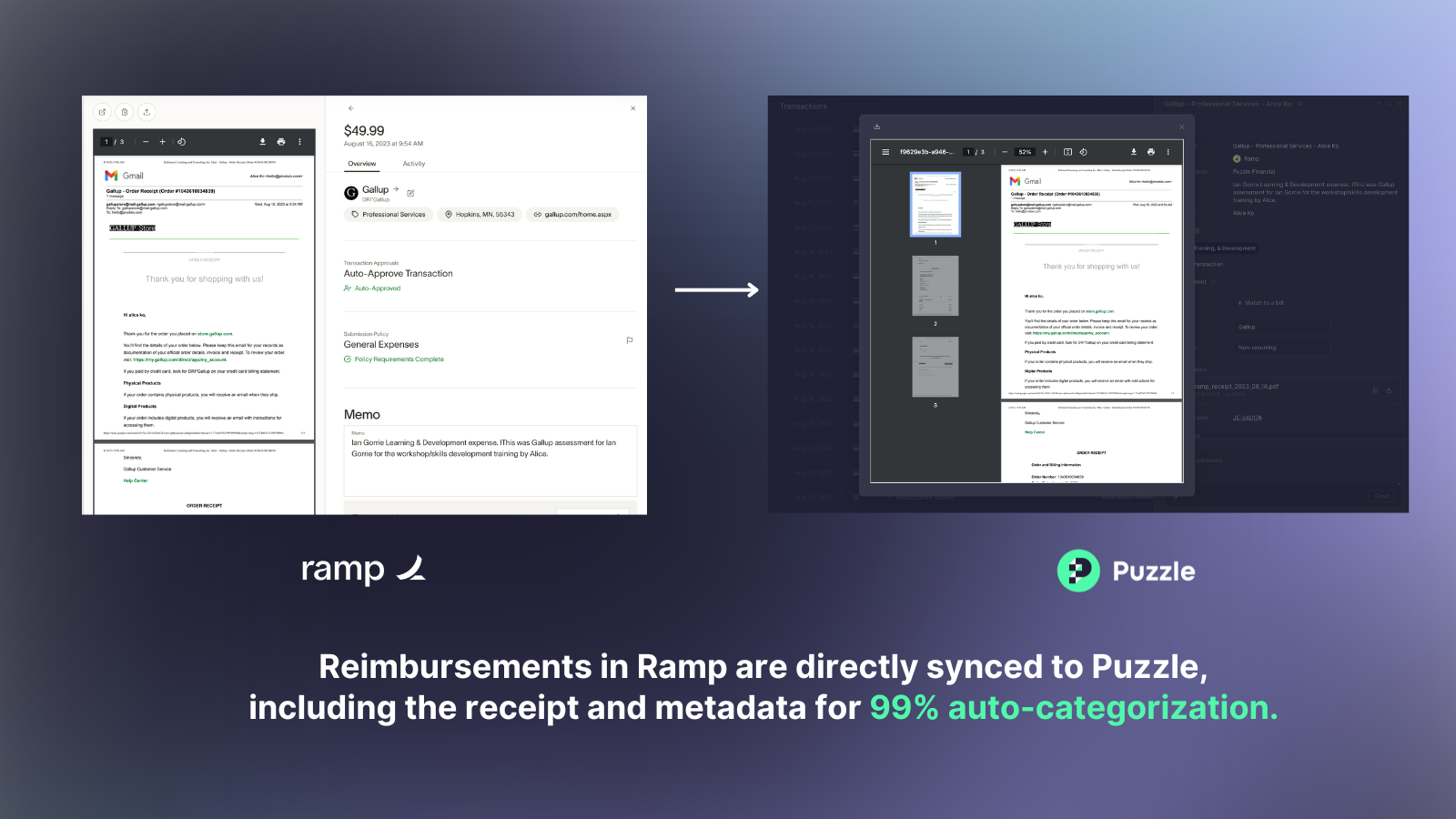
Ramp's Reimbursements feature eliminates the challenges of understanding and categorizing expense reports.
Companies prefer Ramp for employee reimbursements because it includes the option to pay back employees for out-of-pocket expenses made anywhere in the world, in just two days or less.
But expense reports are frustrating to understand, especially when they are paid out in a lump sum total, without any additional context to how they should be coded.
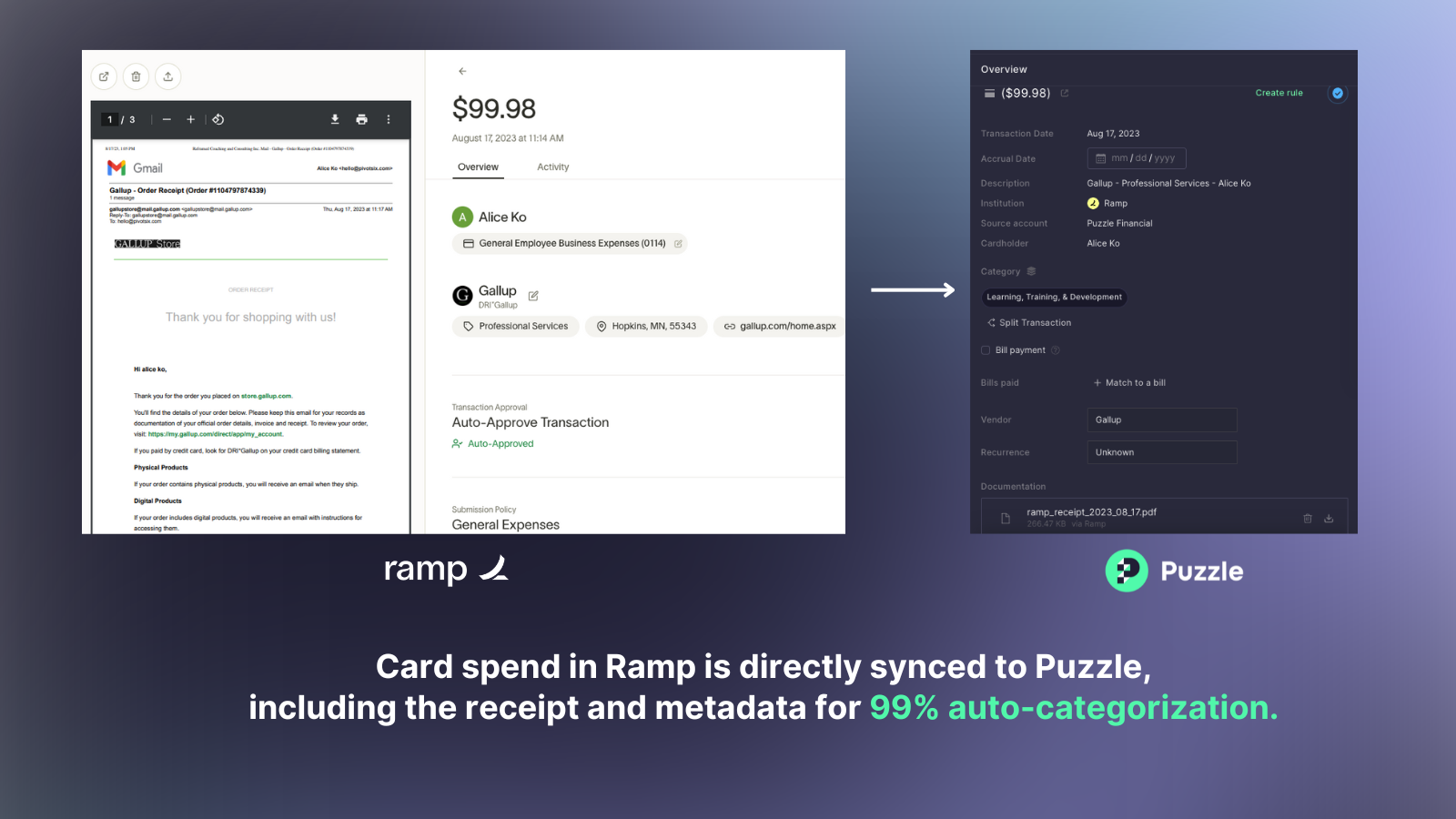
Card spend in Ramp is directly synced to Puzzle, including the receipt and metadata for 99% auto-categorization.
Bills in Ramp are directly synced to Puzzle, for 99% auto-categorization and automated bill <> cash matching. Puzzle also automatically connects cash payments to their original bills and transfers the category information from the bill to the cash transaction.
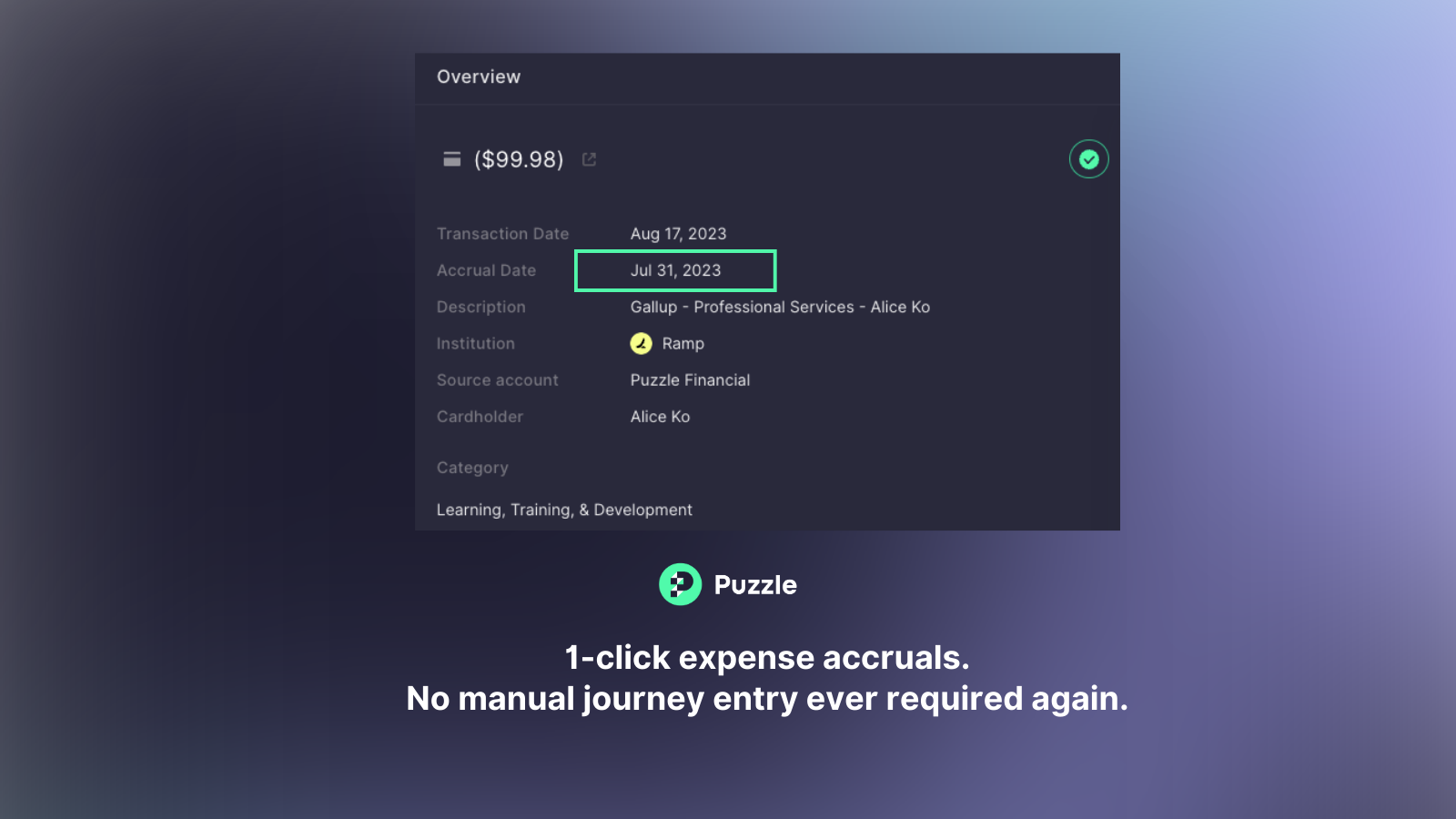
But that's not all! Puzzle goes a step further by identifying the dates of the originating bill and cash transaction.
With a simple checkbox, users can create an auto-accrual based on the cash transaction. This auto-accrual feature is the first of its kind in any accounting solution available today.
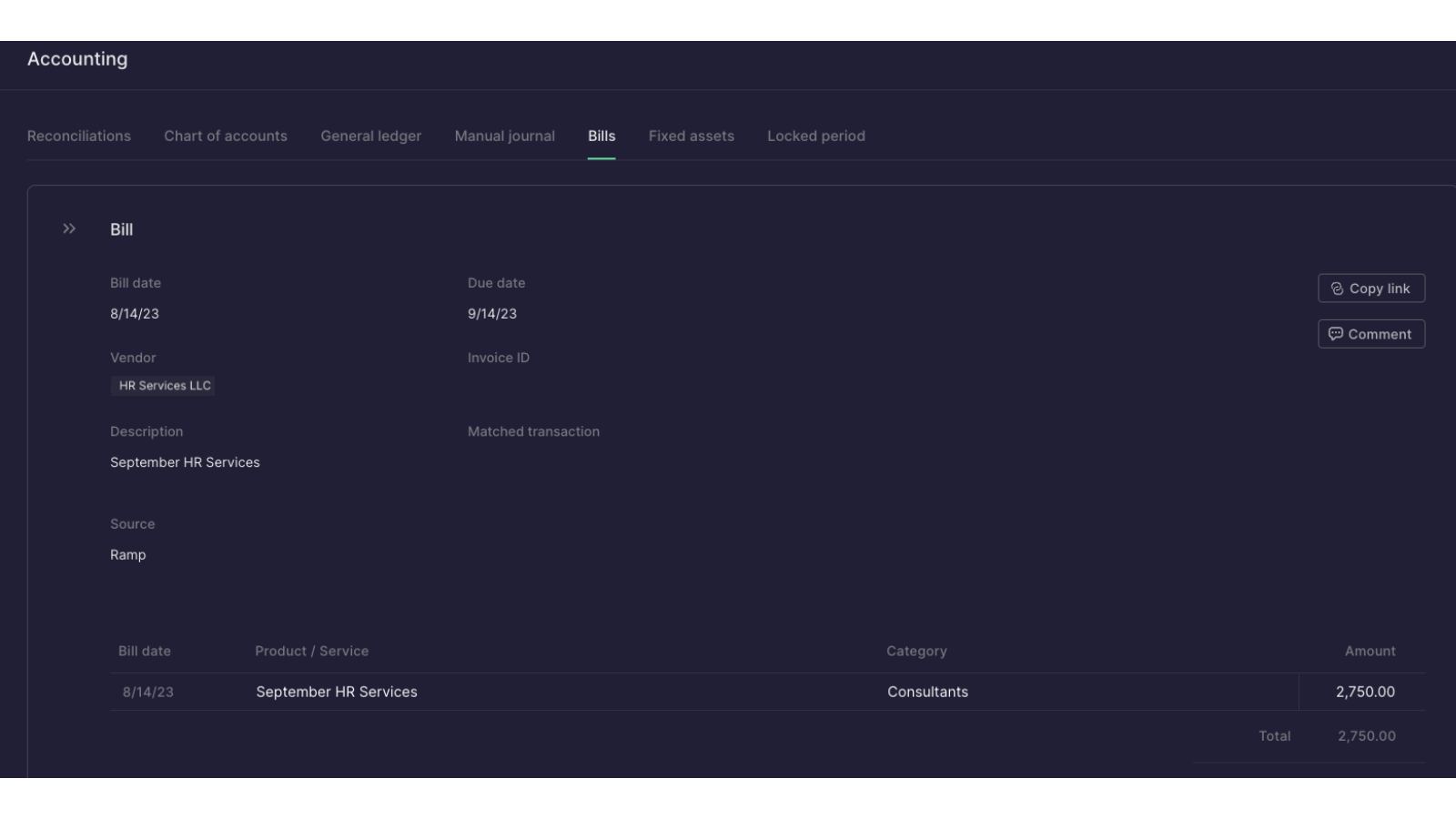
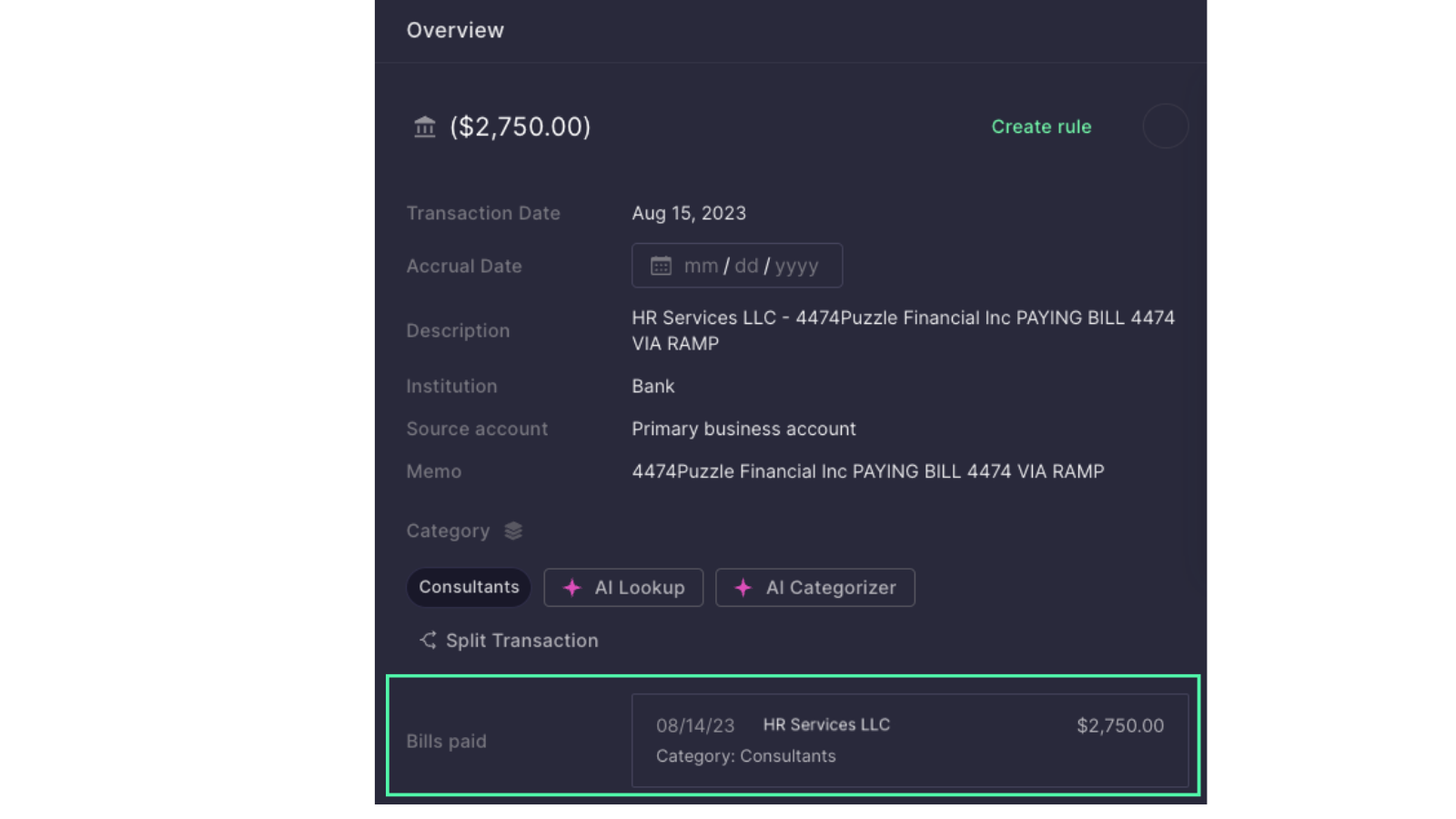
Puzzle's automation workflow immediately links this payment to the corresponding accounts payable bill and automatically reduces the accounts payable balance.
The Ramp + Puzzle integration has only gotten more powerful this year. In June 2026, Ramp launched Payment Runs for Bill Pay, letting AP teams group approved vendor payments into named batches, review them together, and release funds in one action instead of one-by-one. For startups scaling their vendor base, this directly cuts the time your team spends on payment approvals each month.
Ramp also added VAT-compliant reimbursement statements in July 2026, automatically including entity VAT and registration details on reimbursement exports: a meaningful unlock for any portfolio company with EU, UK, or Canadian operations.
The broader industry shift mirrors what Ramp and Puzzle have been building toward: agentic AI that acts as a reviewer, not a replacement for your judgment. According to NetSuite's 2026 expense management trends report, AI agents now route submissions to the correct approvers, predict expense categories from vendor data, and surface compliance discrepancies automatically — reducing the back-and-forth that used to kill close week. The global expense management software market is on pace to reach $17 billion by 2032, driven almost entirely by demand for real-time, automated, cloud-native workflows. Ramp + Puzzle is already that stack.
By using Ramp's Accounting API and Bill Pay API with Puzzle, companies cut 50% of their manual categorization time and become more efficient with 99% auto-categorization.
| Ramp Data Type | What Syncs to Puzzle | Auto-Categorization | Manual Work Eliminated |
|---|---|---|---|
| Corporate Card Spend | Transaction, receipt, and metadata | 99% | Manual transaction upload & categorization |
| Bills (Bill Pay API) | Bill details, payment, account category, cash matching | 99% | Manual AP entry, bill-to-cash matching, accrual creation |
| Employee Reimbursements | Line-item details, memo description, original receipt | 99% | Chasing context, manual coding, back-and-forth with employees |
It’s not a surprise that companies who use Ramp save 400 hours per month on expense reports, speed up reconciliation time by 8x, and close their books 10x faster.
For a Delaware C-Corp at Series A or Series B, you need software that produces GAAP-compliant financials investors can trust, closes fast so you're never scrambling before a board meeting, and scales without requiring a full ERP implementation. Puzzle is built for this stage: it maintains both cash and accrual books simultaneously, automates categorization for cards, bills, and reimbursements via its Ramp integration, and updates burn rate and runway daily. QuickBooks can handle early-stage basics but piles on manual work as transaction volume grows. NetSuite is the right fit once you have a full-time controller and multi-entity complexity; most Series A companies are not there yet. Puzzle gives you NetSuite-level accuracy at a fraction of the setup cost, sized for your stage.
Puzzle integrates natively with Stripe, Mercury, and Ramp: the three financial tools most commonly used by SaaS startups with Stripe and Mercury at seed through Series B. Mercury bank feeds flow directly into Puzzle with automatic bank matching. Stripe revenue data syncs natively so deferred revenue, refunds, and fees are categorized without manual imports. Ramp card spend, bills, and reimbursements push into Puzzle via API with 99% auto-categorization, as covered throughout this post. For a 10-person SaaS startup on this stack, Puzzle eliminates the manual data-entry layer entirely: transactions arrive already categorized, bank accounts sync and clear automatically, and your books stay current daily, through month-end and beyond.
Accounting firms using AI-native tools like Puzzle + Ramp are cutting manual categorization work by 50% or more. Here's what that looks like in practice: instead of pulling bank exports, coding each transaction, and chasing clients for receipts, the workflow becomes review-and-approve. Ramp's API pushes every card transaction, bill, and reimbursement (including the receipt and memo) directly into Puzzle, pre-categorized against the client's Chart of Accounts. The firm's accountant reviews flagged exceptions and skips handling every line item from scratch. AI agents now also route submissions to the correct approvers and surface compliance discrepancies automatically, reducing the back-and-forth that used to dominate close week. The result: firms close client books faster, handle more accounts per accountant, and shift time toward advisory work instead of data entry.
Puzzle integrates natively with Ramp, Gusto, and Rippling — covering the full spend-and-payroll stack for most venture-backed startups. Ramp card spend, bills, and reimbursements sync automatically as described above; see how Ramp accounting integrations handle payroll journal entries for the full picture. Gusto payroll journal entries post directly into Puzzle, mapping wages, employer taxes, and benefits to the correct GL accounts without a manual import step. Rippling payroll and HR data sync similarly, automatically generating the journal entries needed to keep your books current after every pay run. This means your payroll costs hit the books the same day payroll runs — no manual journal entry required, no reconciliation surprises at month-end.
Puzzle's AI categorization is adaptive, not rule-based. It learns from your Chart of Accounts and the coding decisions you make over time, so recurring vendors and transaction types get categorized correctly without you building a rule for each one. When Ramp pushes card spend, bills, or reimbursements into Puzzle via API, Puzzle already has the vendor metadata, memo, and receipt to inform categorization. Outliers surface as flagged exceptions for your review, not silent miscategorizations. The result: up to 99% of transactions land in the right GL account automatically, and the system gets more accurate the longer you use it.
Puzzle does not have a permanent free tier. It offers a 14-day free trial across all plans, after which you move to a paid subscription. Plans are tiered by stage: Starter ($25/mo billed annually) for getting your first books set up, Core ($60/mo) as a QuickBooks replacement with burn and runway insights, Complete ($100/mo) with AI-powered categorization, reconciliation, and revenue recognition, and Scale ($300/mo) for high-volume accounting. There is no pay-as-you-go or metered billing. For current pricing details, visit puzzle.io/pricing.
Puzzle is not currently positioned as a white-label or embedded accounting engine for third-party SaaS platforms. It is a standalone accounting product designed for venture-backed startups and the firms that serve them. Puzzle does expose integrations via API — including the Ramp Accounting API and Bill Pay API covered in this post — but those are inbound data connections, not an embeddable accounting layer for another company's product. If your use case is building accounting functionality into your own SaaS platform, that is outside Puzzle's current scope.
Puzzle supports automated revenue recognition for subscription businesses by letting you define recognition policies at the invoice or product line level. Once a policy is set — for example, ratably recognizing a 12-month SaaS contract over its service period — Puzzle automatically generates the journal entries each month without manual intervention. The key setup step is mapping each recurring invoice type to the correct deferred revenue and revenue GL accounts in your Chart of Accounts. After that initial mapping, new invoices of the same type follow the same policy automatically. For subscription-heavy startups, this eliminates the manual journal entry work that typically consumes hours at each month-end close.
Puzzle's Bill.com integration syncs bills and payments directly without routing transactions through a clearing account, unlike QuickBooks and Sage Intacct, which typically require a clearing account that adds extra matching steps. When a bill is paid in Bill.com, Puzzle matches the cash outflow to the originating bill automatically using bill metadata and amount. For ambiguous or duplicate payments, Puzzle surfaces the conflict for manual review and avoids making an assumption that could distort your AP balance. One known limitation: Puzzle currently does not import Bill.com's native bill-to-payment linkage data, so its matching logic relies on Puzzle's own matching engine, not Bill.com's pre-linked records. In practice, this works cleanly for the majority of standard payments; edge cases like partial payments or multi-invoice settlements may require a brief manual review.
Want speedier close and automatic accounting categorizations? Check out Ramp's Bill Pay API with Puzzle.
Want to see it in action? Watch Ramp and Puzzle in action.
Stay tuned for more guides in our Fintech Tools for Founders series!