SuperFocus is a venture-backed AI startup founded by Tushar Sheth and Steve Hsu in 2020 that builds AI tools for private-data use cases. SuperFocus is still a small team, with Tushar handling much of the operations and fundraising himself alongside a lean group of engineers. At this stage, every hour spent on bookkeeping is an hour not spent on product or customer conversations. For an AI startup pitching investors on its own technical rigor, having burn rate and runway numbers that are wrong or out of date sends the opposite message of what the pitch is trying to make. Accurate, real-time financials give Tushar a credible story to tell about the business and not merely the technology.
As a growing startup, SuperFocus uses Puzzle as its central source of truth for financial metrics and accounting. For a broader look at how AI startups approach their books, see accounting for AI startups.
TLDR:
SuperFocus recognized the need to organize its financial operations for fundraising and tax filings as it grew in early 2023. Initially relying on multiple Google Sheets for accounting, the process proved chaotic and hard to manage. Tushar had no daily view of burn rate or runway, so financial health was always a lagging picture pieced together after the fact instead of something he could check in real time. That gap became a real problem when fundraising deadlines hit: investors expect clean, audit-ready financials on short notice, and spreadsheets maintained by hand just don't hold up under that kind of scrutiny. A spreadsheet can't produce a GAAP-compliant financial statement, can't tie cleanly to a cap table story, and leaves no audit trail showing how a number was calculated or who touched it last. For a founder walking into diligence, that's a hard set of gaps to explain away. The risk compounds for a pre-product-market-fit startup, where spending often moves faster than anyone realizes day to day. Without a daily read on burn rate and runway, a founder can be weeks behind on knowing how much cash is actually left, which is a dangerous blind spot heading into a raise. That lag adds up fast: a founder who last checked the numbers a month ago can walk into a pitch meeting with a cash position that's already stale, and investors notice the gap between what's claimed and what the books actually show. More investors now ask founders to know their burn rate, runway, and spend trends cold before the first meeting, not after a follow-up request. Showing up without those numbers memorized can read as a lack of control over the business, even when the underlying company is healthy. External parties even suggested hiring a Big 4 accounting firm for regular reporting, taxes, and compliance, but that path came with its own cost reality. A Big 4 firm or a full-service bookkeeper would run $10-20K or more per year, a sizable line item for an early-stage AI startup still watching every dollar. Tushar faced a real tradeoff: pay that premium for peace of mind, or risk walking into investor diligence with books that raised more questions than they answered.
Recognizing the cost and complexity of QuickBooks, SuperFocus CEO Tushar actively sought an AI-native QuickBooks alternative that would automate and organize their financial data without requiring a lot of time to manage. QuickBooks itself came with a steep learning curve and required him to build out manual categorization rules before it was usable. He compared a handful of other tools during his search, and most fell short too: some lacked native connections to the fintech stack SuperFocus already used, and others demanded weeks of onboarding before they delivered any value.
Puzzle stood out right away. Because it's AI-native accounting software built from the ground up, transactions were being categorized automatically from the first sync, with no rules engine to configure. Puzzle's categorization runs at up to 98% automated accuracy, compared to the 20-40% range Tushar had seen from legacy tools that rely on manual rule sets. There were no manual rules for him to build, and no edge-case transaction that broke a rule and quietly threw off a report weeks later. The categorization stayed consistent from the first transaction onward, so Tushar wasn't stuck revisiting old entries or second-guessing whether a new vendor would get sorted correctly. That consistency is a big part of why his monthly accounting time dropped to about 30 minutes: there was simply far less to check, fix, or re-categorize by hand. Native integrations with SuperFocus' fintech stack (Mercury, Stripe, Ramp) each connected in about two minutes, and real-time financial data was available within the first day of setup.
The onboarding experience sealed it. Getting Puzzle up and running took far less time than a traditional accounting tool typically requires, letting Tushar get back to running the business instead of managing spreadsheets and chasing down bookkeeping tasks.
| Benefit | What Puzzle Does | Impact for SuperFocus |
|---|---|---|
| Time savings | Automates expense capture & categorization via bank/credit card integrations | ~30 minutes/month on accounting tasks |
| Accurate financials | Real-time generation of financial reports | Confidence in records; ready for board meetings & stakeholders |
| Simplicity | Centralized platform with all accounting in one place | Hands-off management with complete financial control |
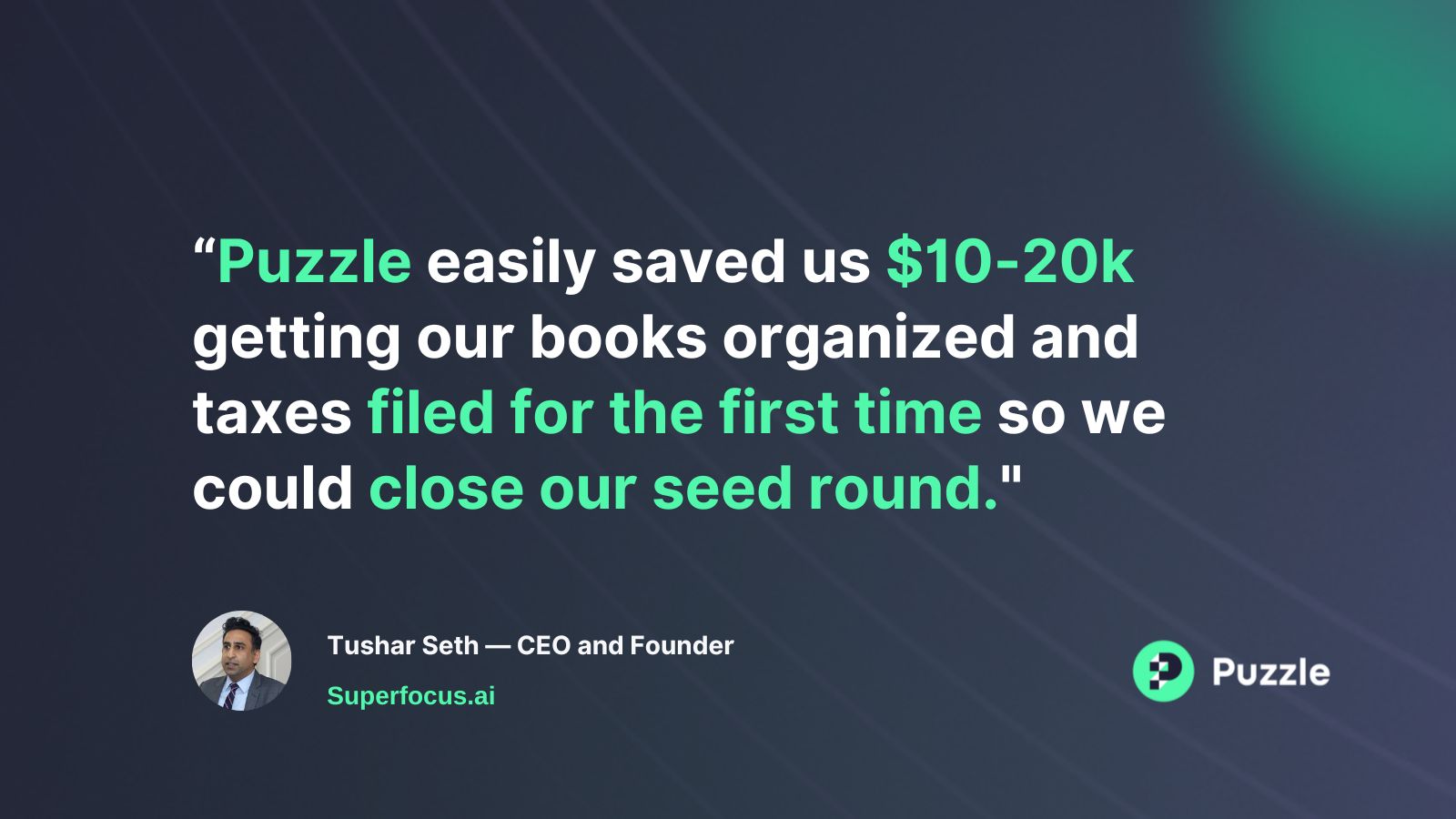
| Cost savings | Eliminates need for dedicated bookkeeper; certified accounting referral network for taxes | Estimated $10-20K saved |
One centralized source of truth: One of Tushar’s favorite things about Puzzle is the centralized nature of Puzzle, as having all financial metrics and data in one place is essential to him. One core source of truth keeps their financial data organized, up-to-date, and accessible, while giving the company room to focus on its core business goals. “It feels like everything is all in one. Everything is here and everything is going to get done in one place. I want to be in one universe.”
For a fast-moving AI startup, that matters more than it might seem. When your numbers are always current, you're not scrambling to pull together a board deck the night before a meeting, or digging through spreadsheets to answer an investor's question about burn rate and runway. If a prospective investor asks for a P&L or a burn-rate snapshot, Tushar can send it over in minutes instead of waiting days for a bookkeeper to pull the numbers together. Fundraising diligence stops feeling like a fire drill because the data was already right, every day, and not merely the week before a raise. Tax season got simpler too: through Puzzle's referral network, Tushar was connected with Accountalent for filings, so he didn't have to spend weeks cold-vetting accounting firms on his own.
Setup takes about a day, with bank and card integrations (Mercury, Stripe, Ramp) each connecting in roughly two minutes. Once your accounts sync, Puzzle starts categorizing transactions automatically, with no rules engine to configure and no manual data entry to migrate from your spreadsheets.
Yes. SuperFocus estimated $10K to $20K in annual savings by skipping a dedicated bookkeeper, while still producing accurate, GAAP-compliant financials for board meetings and fundraising diligence. For tax filings, Puzzle's certified accounting referral network connects you with vetted partners like Accountalent, so you get professional oversight without paying Big 4 rates year-round.
QuickBooks requires you to build out manual categorization rules before it's usable and achieves only 20 to 40% automated categorization accuracy. Puzzle is AI-native, meaning categorization starts from the first transaction sync at up to 98% accuracy, with no rules to configure and no edge cases quietly breaking reports weeks later. For a founder who needs burn rate and runway numbers that are right every day, and not merely at month-end, the gap is real.
Customers who fully onboard and connect their supported integrations are eligible for a refund of subscription fees if they don't see at least a 50% reduction in month-end close time within 60 days. The guarantee applies when you complete onboarding and connect the integrations Puzzle supports natively. It's a concrete commitment, not a marketing claim.
SuperFocus founder Tushar Sheth estimates about 30 minutes per month for reviewing AI-categorized transactions instead of doing manual data entry or reconciliation. Puzzle's AI flags low-confidence categorizations for human review instead of guessing, so the time you do spend is on exceptions, not reconstruction.
For pre-seed and seed-stage founders still running books in spreadsheets, the math is worth sitting with. Switching to Puzzle takes about a day to set up, with bank and card integrations connecting in minutes. Staying in spreadsheets costs more the longer it goes on: every month of messy books is another month of diligence risk sitting in front of an investor. Puzzle backs this up with its 50% Faster Close Guarantee: customers who fully onboard and connect their integrations are eligible for a refund if they don't see at least a 50% reduction in month-end close time within 60 days. That kind of commitment matters when you're a founder with a hundred other things competing for your time, and no room to babysit your books. If you're in a similar spot, juggling fundraising, product, and a growing team, and you're tired of wondering whether your numbers are right, see how Puzzle works for yourself: book a demo.