Building an AI Accounting Bot With Puzzle APIs | October 2026
Customer Stories
Building an AI Accounting Bot With Puzzle APIs | October 2026
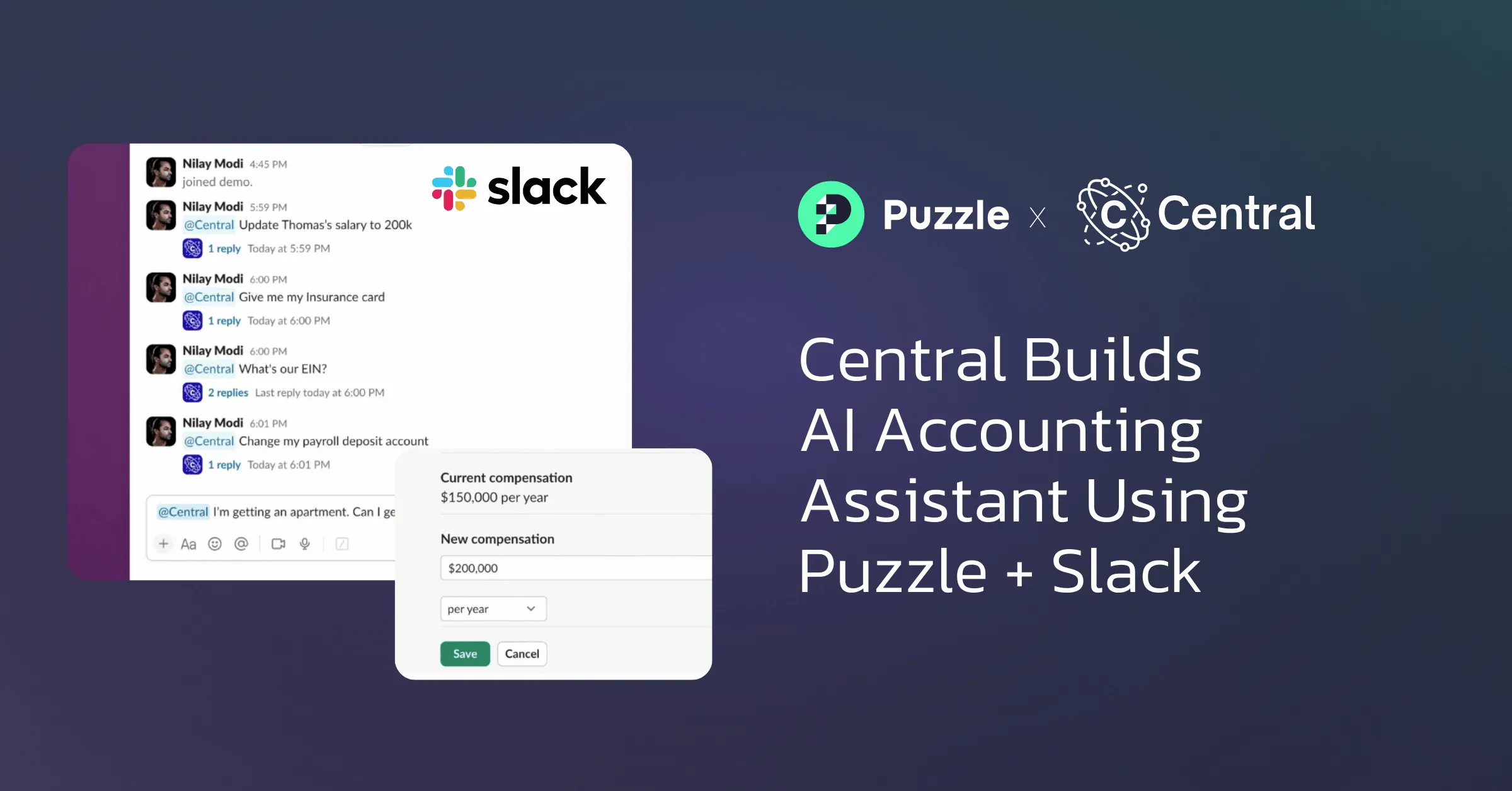
Central, a Y Combinator-backed fintech, redefined bookkeeping by creating an AI-powered Slackbot using Puzzle’s modern accounting APIs. After facing limitations with QuickBooks, Central leveraged Puzzle’s real-time data, developer-friendly APIs, and AI-ready platform to build a Slack-integrated solution that automates tasks, provides instant financial insights, and enhances customer experience. Learn how this innovation transformed their operations and set a new standard for accounting in fintech.
Denny Hollick
1.28.25
In article:
Accounting. Simplified
A bad product lacks competitive advantage. Successful businesses have something unique that's hard to copy. It could be cost efficiency, brand power, or proprietary tech. Without this, you're just waiting to get outperformed. Think of physical retailers being outperformed by e-commerce.
Thank you for being part of our Puzzle community. Stay tuned!
Oops! Something went wrong while submitting the form.
Central, an AI-native HR and fintech company (now part of Mercury following its April 2026 acquisition), partnered with Puzzle to eliminate back-office headaches for startups. By building on Puzzle's modern general ledger and powerful APIs, Central rebuilt the way they deliver bookkeeping services: real-time transaction categorization, AI-native Slack queries, and a unified place for payroll, benefits, and accounting.
TLDR:
Legacy software like QuickBooks blocked Central from building an AI bookkeeping bot due to limited APIs.
Central's Slackbot auto-categorizes transactions and answers burn rate questions from live general ledger data.
AI adoption in accounting surged from 22% to 40% in one year; 73% of finance teams say growth outpaces their manual capacity.
Puzzle's AI-native general ledger and developer APIs made Central's Slack-based back office possible.
Held back by legacy software
As a technology-first company automating back-office and financial operations, Central built an all-in-one solution for payroll, benefits, bookkeeping, tax filing, and other government compliance requirements (like state tax account registrations, unemployment insurance rate changes, and CTA Beneficial Ownership Information Reporting). The goal: a "no-headache" experience so founders could focus on their businesses, not on administrative overhead. (Central has since joined Mercury, expanding that mission further.)
But bringing bookkeeping into that same frictionless experience was challenging. Central's engineering team needed a modern accounting platform that offered real-time data access, deep APIs, and the flexibility to build an AI-powered Slackbot. The tools they initially tried (like QuickBooks) were limited by outdated architecture and lacked the deep API integration that Central's vision required. Startups seeking AI accounting alternatives to QuickBooks run into this same wall repeatedly.
"QuickBooks just wasn't built for the kind of product we wanted to create," explains Josh Wymer, CEO of Central. "The APIs were limited, and trying to build workarounds was frustrating and time-consuming. We needed a platform that could handle all the great ideas we wanted to build."
Puzzle: embedded accounting API for modern fintechs
Central found in Puzzle a modern general ledger and accounting software purpose-built for developer success. By partnering with Puzzle, Central now automates everything needed to operate a compliant startup, from payroll to real-time bookkeeping, and can embed accounting functionality where their customers spend the most time: Slack. Key capabilities that made their vision possible:
Developer-friendly APIs
Easy integration: Puzzle's APIs made it easy for Central to add accounting features into their platform and Slackbot.
Scalability: Because Puzzle is built with modern technology, it can handle the growing demands of Central's rapidly expanding user base.
Real-time data access
Instant visibility: Founders can see up-to-date financial information, instead of waiting for week-old or month-old reconciliations.
Proactive compliance: Built-in features help Central stay on top of government reporting requirements without manual updates.
AI-native platform
Intelligent transaction categorization: Using Puzzle's categorization technology, Central automatically sorts most transactions (a practical example of AI bookkeeping automation vs. judgment), eliminating spreadsheets and endless back-and-forth with an accountant.
Efficient workflows: For any remaining uncategorized transactions, Central's Slackbot prompts users in real-time to confirm transaction details.
By combining Puzzle's general ledger with Central's payroll, benefits, and compliance offerings, they've created an AI-native, automated back office for startups.
"Puzzle's APIs and real-time data flow were the key," notes Wymer. "We didn't have to fight the platform to make it work for us. Instead, Puzzle felt like it was built to support exactly the kind of forward-thinking tools we're creating."
Results: reshaping bookkeeping through automation
With Puzzle under the hood, Central has realized four major outcomes to eliminate back-office busywork, a model for what accounting agent AI automation looks like in practice:
Outcome
What It Means in Practice
Unified Back Office
Payroll, benefits, and accounting in one AI-native interface: no tab-switching between tools.
Faster Book Closing
Puzzle auto-categorizes most transactions; founders confirm the rest via a quick Slack prompt, no spreadsheets.
Real-Time Financial Answers
Users ask cash flow, burn rate, or tax questions directly in Slack and get answers sourced from live general ledger data.
Faster Feature Development
Modern API architecture lets Central prototype and ship new features quickly, something impossible with legacy accounting systems.
A unified place for the back office
Founders can access payroll, benefits, and accounting all in one interface, and it is all AI-native. Central has become a strong solution for busy operators who hate administrative hassle.
Spend less time on month-end close
Central's Slackbot automates or greatly simplifies bookkeeping tasks. Most transactions get intelligently categorized by Puzzle; for the rest, founders just give the bot a quick explanation. No tedious spreadsheets required.
Get instant financial answers
Central bot already handles payroll changes, health benefits info, and expenses. Now, with Puzzle's powerful query APIs, users can ask real-time questions about their company's finances (like cash flow status or upcoming tax obligations) directly in Slack.
Continuous development speed and iteration
With a modern API architecture, Central's team can quickly prototype and launch new features, something that wasn't possible with legacy accounting systems. This keeps them ahead of the competition in a fast-moving fintech environment.
"Puzzle has fundamentally improved our bookkeeping processes," says Wymer. "The tight integration with our Slackbot has allowed us to create something just not possible before: an entire accounting back office based in Slack using ChatGPT and Puzzle."
The bigger picture: AI accounting goes mainstream in 2026
Central and Puzzle's partnership didn't just solve a single workflow problem: it positioned both companies squarely at the center of the industry's biggest shift. AI adoption among accounting professionals has surged from 22% to 40% in the past year alone, according to Thomson Reuters, and the global AI-in-accounting market hit $10.87 billion in 2026, growing at a 44.6% CAGR. For context on what AI agents in accounting actually do, that growth reflects a genuine shift in how books get closed. Automated bookkeeping is the fastest-growing sub-segment of that market, and that is exactly where Central operates.
The pressure is real: 73% of finance professionals say their business is growing faster than their team can handle manually. Legacy tools like QuickBooks have responded with bolt-on AI features, but the architecture gap remains. Platforms built on modern, developer-friendly general ledgers (not retrofitted onto decades-old systems) are the ones actually delivering continuous, real-time books. For startups comparing accounting agent software, that architectural difference is the deciding factor. That's the bet Central made, and the data is catching up to it.
What mid-2026 data says about the execution gap
By mid-2026, the "AI in accounting" narrative has split in two. On one side: adoption metrics that look strong on paper. 98% of accounting professionals globally report using AI in some form, and the AI-in-accounting market hit $10.87 billion this year, growing at a 44.6% CAGR (Mordor Intelligence). On the other: an execution gap that's widening. Gartner's latest data shows 59% of finance leaders actively use AI in their finance function, nearly flat from 58% in 2024, and 73% of AP teams have still not fully automated their core workflows. Over 40% of agentic AI projects are forecast to be cancelled by end of 2027, largely because teams adopted tools before their data and integrations were ready to support them.
That gap is exactly where Central and Puzzle operate. The firms closing books in real time (not fighting to match up week-old data) are the ones that started on modern, API-first infrastructure. Bolt-on AI features layered onto legacy architecture don't fix the underlying data problem; they just paper over it. Central's Slackbot works because the general ledger underneath it is live. That's an architectural bet, not a product feature, and the 2026 data is making clear which side of that bet is paying off.
August 2026: agentic AI moves from pilot to production
The signal that defined mid-2026 wasn't a single product launch: it was a category shift. Accounting Today's 2026 Top New Products report put it plainly: standalone AI no longer impresses. What's winning is embedded AI that runs near-invisibly inside core accounting systems, handling complex workflows as an ambient layer, not a bolt-on tool. That's the architectural bet Central and Puzzle made years ago, and the industry has now caught up to the framing.
The investment side confirms the momentum. AI accounting startups are attracting serious capital in 2026: audit automation platform DataSnipper crossed a $1 billion valuation on the back of a $100 million Series B, citing 90% automation of menial audit tasks and a doubled customer base. Danish startup Light closed a $30 million Series A in August to push its AI accounting automation into the US market. The thesis across these rounds is consistent: the firms that redesign their workflows around AI from the ground up outperform those that add AI features to existing processes. That's Central's entire product premise, and it's why the Puzzle general ledger underneath it matters as much as the Slackbot on top.
The workflow benchmarks arriving in August 2026 put numbers to what that architectural difference actually costs in practice. Firms that adopted AI-native platforms between 2023 and 2025 now report bank reconciliation dropping from four hours a day to fifteen minutes, a 93% reduction. Invoice processing that once consumed two hours runs in ten minutes. The Journal of Accountancy's August 2026 coverage framed it plainly: AI adoption is no longer a differentiator; at 85% of mid-size and large firms (up from 58% in 2024), it is table stakes. What separates the leaders is whether the AI is running on a live general ledger or a legacy data model. The firms that closed that gap early are the ones posting those numbers. Central and Puzzle closed it at the architecture level, before the benchmarks existed to prove it.
Frequently asked questions
What does adopting an AI-powered month-end close workflow look like in practice, and what milestones should firms expect?
For most firms onboarding onto Puzzle, the workflow breaks into three phases. In the first week, you connect your client's bank accounts and fintech integrations (Stripe, Mercury, Ramp, Brex, Gusto) and Puzzle's AI begins categorizing transactions immediately, typically hitting 95%+ auto-categorization within the first few days as it learns your chart of accounts. In weeks two through four, you review the flagged transactions, set category rules for recurring vendors, and close your first month. That close is the real milestone: it's the moment you know the books are live and accurate. From month two onward, the workflow is largely automated: Puzzle runs the categorization, surfaces exceptions, and maintains both cash and accrual books simultaneously. Teams building out AI agent workflows for month-end close will recognize this pattern as the standard adoption arc. For firms just getting started, the practical milestone sequence is: connected → first clean close → rules tuned → ongoing review-only workflow.
Does Puzzle offer a self-serve setup, or is a guided onboarding call required? And how long does it take?
Puzzle supports both paths. If you're a startup or solo founder with a straightforward setup (single entity, standard fintech stack), you can connect your accounts and have live books running in under an hour, no call required. If you're an accounting firm onboarding multiple clients, or if you have a more complex chart of accounts or historical data to import, Puzzle's team offers guided onboarding to make sure the setup is right from day one. In either case, the goal is the same: your first month close should feel routine, not painful. Most firms report being fully live within one to two weeks of starting.
How does Puzzle's onboarding and support differ for direct business customers versus accounting firm partners?
Direct business customers (founders using Puzzle to run their own books) get self-serve onboarding with access to Puzzle's support team for questions. Accounting firm partners get a dedicated onboarding experience: a partner success contact, priority support, and access to firm-specific workflows like multi-client dashboards and white-label options. Puzzle's partner model is built on the premise that the firm's expertise is irreplaceable. The platform handles the automation so your team can focus on advisory, not data entry. If you're considering Puzzle for a firm, start with the partner track over the standard signup flow.
What does it take to start and run a bookkeeping business on Puzzle, and is it suited for firms just getting started?
Puzzle works well for early-stage bookkeeping firms, even those without a large existing client base. The platform scales from one client to hundreds, and per-client overhead stays low because automation handles most of the categorization work. To get started: sign up as a firm partner, onboard your first client, and run one full month-end close. That first close tells you everything about fit. The key advantage for new firms is margin: because Puzzle automates the grunt work, a two-person team can serve clients that would otherwise require three or four staff. The platform is also built with clean audit trails and cash and accrual books maintained simultaneously from day one, so you're not accumulating technical debt you'll have to clean up later.
How does Puzzle read transactions from uploaded bank statement PDFs without a live bank connection?
For accounts that don't support direct bank feeds, Puzzle can extract transactions from uploaded PDF bank statements using document parsing and OCR. The system reads the statement structure, identifies the transaction table, extracts dates, amounts, and descriptions, and imports them directly into the general ledger with no manual re-entry required. From there, the same AI categorization logic applies: merchant recognition, chart-of-accounts matching, and rule-based logic run on the extracted transactions exactly as they would on live-feed data. This is especially useful for accounts at smaller banks or credit unions that don't support Plaid or direct API connections. The resulting ledger entries are indistinguishable from those sourced via live feed.
Can Puzzle's AI chat handle specific tasks like splitting transactions, identifying fixed assets, or generating a mini P&L?
Yes. Puzzle's AI chat is designed for task-level accounting work, going beyond simple question-answering. You can ask it to split a transaction across multiple expense categories (for example, a mixed SaaS invoice that covers both software and professional services), flag potential fixed assets based on amount thresholds and vendor type, or generate a point-in-time P&L summary filtered by date range or account. Central's Slackbot is built on top of these same capabilities: founders ask real questions about cash balance, upcoming tax obligations, and burn rate, and get accurate answers sourced directly from Puzzle's general ledger. The underlying model has access to your actual books, which is what makes task-level actions reliable and precise.
How can my accounting firm scale client capacity without hiring more bookkeepers?
The constraint isn't headcount: it's how much manual work sits between a transaction and a closed book. Firms that scale without hiring do it by eliminating that gap. On a modern AI-native platform like Puzzle, auto-categorization handles 95%+ of transactions from day one, which means a bookkeeper's time moves from data entry to review and exception-handling. A two-person team can realistically serve the client load that previously required four staff, because the categorization, rule application, and ledger maintenance run automatically. The second lever is workflow standardization: when every client onboards to the same connection stack (Stripe, Mercury, Ramp, Brex, Gusto) and the same chart-of-accounts structure, your team stops context-switching between bespoke setups. Each new client becomes a repeatable process, not a custom project. The third lever is the month-end close itself: firms using Puzzle report that close time compresses from days to hours because exceptions surface automatically, not buried inside a manual reconciliation. Taken together, these three levers (auto-categorization, standardized onboarding, compressed close) are how accounting firms grow revenue per staff member, not headcount in lockstep with clients.
How do accounting firms use AI to deliver real-time client dashboards instead of monthly PDFs?
The shift from monthly PDFs to live dashboards is an infrastructure problem, not a reporting problem. PDFs are monthly because the underlying books are monthly: the close happens once, the report gets exported, and the client waits 30 days for the next one. When the general ledger is live (transactions categorized in real time as they hit the bank feed), the data needed to power a dashboard is always current. Firms on Puzzle give clients access to a live view of burn rate, cash position, and runway that updates daily, not because someone ran a report, but because the ledger underneath never stops. For advisory-focused firms, this changes the client relationship: instead of presenting history, you're discussing what's happening now and what to do about it. The practical step is straightforward: connect the client's accounts, let Puzzle's AI run categorization continuously, and point the client to their dashboard. The monthly PDF becomes optional context, not the primary deliverable.
How do I migrate from QuickBooks to a modern AI accounting platform without losing historical data?
The safest migration path starts with a clean export before you cut over. From QuickBooks Online, export your Chart of Accounts, all transaction history (including journal entries), and your audit log via the Reports section. Most modern platforms (including Puzzle) support importing that data in standard formats (CSV or QBO file). Puzzle's onboarding team maps your existing categories to the new chart of accounts so historical transactions carry over accurately. The key rule: never cancel your QuickBooks subscription until you've completed at least one full month-end close in the new platform side-by-side. That overlap period is your safety net. Central's team went through this same transition and chose Puzzle because its API-first architecture made it possible to connect their existing payroll and compliance data without rebuilding from scratch.
How does automated transaction categorization work in modern accounting software?
Modern platforms like Puzzle use a combination of machine learning trained on large transaction datasets, merchant name recognition, and rule-based logic applied to your bank feeds. When a transaction comes in (say, a charge from AWS), the system matches the merchant against known categories (cloud infrastructure → software & hosting), checks prior categorizations for that vendor in your account, and applies the most confident label automatically. Transactions that fall below a confidence threshold get flagged for human review instead of being auto-categorized, which is how accuracy stays high without introducing errors. Central built its Slackbot on top of Puzzle's categorization APIs: most transactions are categorized instantly; for the remainder, the bot surfaces a quick prompt to the founder in Slack to confirm the category, no spreadsheet required.
How do I automatically track ARR, MRR, and net revenue retention inside my accounting software?
Most accounting software was not built to surface SaaS metrics natively; ARR, MRR, and net revenue retention (NRR) have to be calculated from revenue data already in your books. The cleanest path depends on where your subscription revenue originates. If you bill through Stripe, Stripe's revenue recognition module tracks MRR and ARR at the contract level and pushes recognized revenue into your general ledger via accounting integrations. For Puzzle users, Stripe connects directly: subscription revenue lands categorized and dated in the GL in real time, so the raw data for MRR calculations is always current, not waiting on a month-end import. ARR is your current MRR annualized (MRR x 12 for a snapshot). NRR compares contracted MRR at the start of a period to contracted MRR at the end, accounting for expansion, contraction, and churn within the same cohort. The straightforward answer on native dashboards: most general ledgers, including Puzzle, track revenue accurately but do not surface ARR/MRR/NRR as a built-in metric; that layer typically lives in a billing tool (Stripe, Chargebee) or a SaaS metrics product (Baremetrics, ChartMogul) that reads from the GL. What Puzzle provides is the real-time revenue data those tools depend on: because the GL is live, your MRR dashboard in Baremetrics or your Stripe revenue recognition report reflects actual recognized revenue, not last month's export. The practical setup for Puzzle-connected startups: Stripe into Puzzle for recognized revenue in the GL, plus Stripe Revenue Recognition or Baremetrics for the ARR/MRR/NRR dashboard layer. Your accounting books and your SaaS metrics draw from the same live source of truth.
How do I automate payroll journal entries in my accounting software when using Gusto or Rippling?
If you're running payroll through Gusto or Rippling, the general ledger entry for each payroll run (gross wages, employer taxes, net pay, and benefit deductions) needs to land in your books automatically, not as a manual journal entry each cycle. Puzzle's integrations pull payroll data from Gusto and Rippling in real time: each pay run creates the corresponding journal entries in the general ledger, split by the correct expense accounts and mapped to the right liability accounts for taxes and deductions. For teams using Ramp accounting integrations and payroll journal entries, the same native connection applies. Central's platform sits on top of this architecture, meaning founders who run payroll through Central get those journal entries reflected in their books immediately, with no accountant needed to log in and post entries after every payroll date.
How does AI-powered transaction categorization learn and improve over time, and how are automated rules created?
The categorization model improves through two mechanisms: account-level learning and explicit rule creation. When Puzzle first sees a new vendor, it matches against a trained merchant dataset (AWS → cloud infrastructure, Stripe → payment processing) and applies a starting category. Each time you confirm or correct a categorization, that signal is recorded against your account. After two or three consistent corrections for the same vendor, Puzzle locks in a rule: every future transaction from that merchant is categorized the same way, automatically, with no review prompt. You can also create rules manually (by vendor name, transaction description pattern, or amount range) and they apply to all future and historical transactions in scope. The practical effect: the first month has the most review work; by month three, the exception queue is a fraction of what it was on day one. Central's Slackbot is built on this same rule engine: most transactions categorize silently, and only genuine edge cases surface as a Slack prompt.
How can accounting firms use AI to analyze client financials without sending sensitive data to public AI models like ChatGPT?
The risk is real: if your AI tool sends transaction data, client names, or revenue figures to a public model like the free tier of ChatGPT or a third-party API with no data processing agreement, you have potentially violated your engagement letter and, depending on jurisdiction, applicable data protection rules. The answer is not to avoid AI; it is to use AI that keeps your data inside a secure boundary. There are three practical architectures firms are adopting in 2025 and 2026. First, enterprise API agreements: OpenAI's enterprise tier and Microsoft Azure OpenAI both contractually commit that your data is not used to train their models and is processed in isolated environments, which is materially different from the consumer ChatGPT product. Second, private deployment: some firms run open-weight models (Llama, Mistral) on-premises or in a private cloud instance where no data leaves their infrastructure at all. Third, platform-native AI: tools like Puzzle run AI on your data inside their own secure infrastructure, governed by their data processing agreement with you, so your client's transactions never route to a public endpoint. Puzzle's AI categorization, query, and close-checklist features all operate this way: the model has access to your general ledger, but that data stays within Puzzle's infrastructure. For firms advising clients on compliance, the NIST AI Risk Management Framework's Govern function covers third-party AI data handling; defining what data flows where is now a governance expectation, not a mere best practice. Before deploying any AI tool on client data, confirm it has a signed data processing agreement, clearly states whether your data is used for model training, and identifies where computation happens.
How does Puzzle stand apart from QuickBooks, and how do I use that as a selling point with clients?
The core difference is architectural, not cosmetic. QuickBooks was built in the 1990s and has added AI features on top of a legacy data model, which means live bank feeds, real-time categorization, and developer APIs are bounded by what that underlying structure can support. Puzzle was built AI-native from day one: the general ledger is live, the APIs are first-class, and automation is baked into the data model, not layered on top. In practice, that gap shows up in three places clients care about. First, close speed: firms on Puzzle report compressing month-end close from days to hours because categorization runs continuously, not in a batch at month-end. Second, real-time answers: clients can check burn rate or cash position any day of the month, even outside the close window. Third, developer flexibility: Central's entire Slackbot (real-time financial queries, auto-categorization, payroll journal entries) runs on Puzzle's APIs because the architecture supports it. QuickBooks' API limitations are exactly why Central switched. When positioning this to clients, lead with the outcome: "Your books are current every day, even outside the close window," then explain the architectural reason why.
How does AI automation handle reconciliation and accruals, and how much manual work can it actually eliminate?
Reconciliation and accruals represent two of the biggest time sinks in a traditional close, and they work differently on an AI-native platform. For reconciliation: because Puzzle's general ledger ingests transactions from live bank feeds and categorizes them continuously, the reconciliation step at month-end becomes a review of exceptions, not a line-by-line matching exercise. Most firms report that reconciliation time drops from several hours to under 30 minutes per client, because the ledger is already aligned with the bank by the time you open the close checklist. Firms adopting agentic AI for month-end close report the same compression pattern. For accruals: Puzzle maintains both cash and accrual books simultaneously from day one, so you're not running a manual conversion at close; the accrual entries exist in real time alongside the cash view. Prepaid schedules, deferred revenue, and recurring accruals can be templated and applied automatically. Taken together, the manual work that remains is genuinely exceptional: edge cases, unusual vendors, and judgment calls that should have a human involved anyway. The data-entry-and-matching work (which accounts for the bulk of close hours in a legacy setup) is largely gone.
Looking forward
Central and Puzzle's partnership continues to evolve. "We're automating everything needed to operate a compliant startup, "Wymer explains. By offering a unified place for back-office tasks, Central reduces the risk of missed deadlines or fines and frees up founders to focus on growth.
As more startups demand real-time insights, less manual data entry, and integrated compliance, Central is positioned to deliver an ever-expanding suite of AI-native back-office services. By building on Puzzle's developer-friendly APIs, Central can push the boundaries of what an all-in-one back-office solution can do, eliminating "back-office BS" for good.