Why Funded Startups Love Brex and Puzzle (Updated 2026)
Product Updates
Why Funded Startups Love Brex and Puzzle (Updated 2026)
Discover why 1 in 4 venture-backed startups choose Brex for their fintech needs. Learn about seamless integrations with Puzzle, efficient cash management, and benefits tailored for tech founders. Read more on Puzzle.io.
Sasha Orloff
8.24.23
In article:
Accounting. Simplified
A bad product lacks competitive advantage. Successful businesses have something unique that's hard to copy. It could be cost efficiency, brand power, or proprietary tech. Without this, you're just waiting to get outperformed. Think of physical retailers being outperformed by e-commerce.
Thank you for being part of our Puzzle community. Stay tuned!
Oops! Something went wrong while submitting the form.
More and more startups are seeking an all-in-one solution and one source of truth for their financial needs. They want integrated systems that communicate and unite to provide accurate, streamlined data that facilitates informed decision-making.
And that’s exactly why we’ll dive into Brex today as a part of our Fintech for Founders series.
In this guide, you'll learn:
Why so many venture-backed US startups select Brex for their fintech stack
What accounting platform works best with Brex
Why startups are syncing their operating account, credit card, and accounting solution
Why founders across the Brex ecosystem are making Puzzle their go-to accounting integration
TLDR:
Brex consolidates operating accounts, credit cards, bill pay, and expense management in one place, with up to $6M in FDIC coverage.
Managing banking across multiple providers costs you time and accuracy; Brex replaces that with a single dashboard for all company finances.
VCs now expect founders to show burn rate, runway, and cash position on demand, before the month-end close cycle finishes.
Puzzle auto-categorizes 99% of Brex credit card transactions via API sync, so you see real-time burn rate, runway, and ARR without waiting on your bookkeeper.
Why Brex?
Early stage, VC-funded startups choose Brex because they are a complete one-stop-shop for a startup’s complete cash management and spending needs in one platform.
Brex offers startups one place for their operating accounts, credit cards, spend monitoring, and unique travel and treasury solutions that other platforms do not.
The alternative? A startup working with three different companies and managing three different logins, accounts, and processes.
Having everything in one central place of truth like Brex is valuable, efficient, and improves decision-making.
✅ Business accounts
Brex offers business accounts through cash management accounts managed by Brex Treasury (a FINRA-registered broker-dealer). Similar to a bank account, founders can set up a Brex business account to send and receive payments via ACH, check, and wire (even internationally). All Brex customer funds are stored into either FDIC-insured accounts or money market funds. Other benefits of using the Brex business account:
Diversify your funds across Brex's FDIC-insured partner banks for up to $6M in coverage using just one account.
Invest your cash in a money market fund for a competitive yield, and still use it for daily expenses. (Note: yield rate changes frequently — check Brex's current rates for the latest figure.)
Access to a user-friendly experience.
✅ Credit cards, reimbursements, and expense management
Brex physical and virtual credit cards enable founders to earn up to 7x back and be redeemed for cash rewards, credits, or even marketing campaigns like billboards. With Brex's 24/7 customer support and a 5-star rated app on iPhone and Android, startup founders can view and manage global spend right from their phones. With a platform to enforce expense policies, reimburse employee expenses including travel, and even create and track expense budgets, startups can stay in control of their spend at all times.
✅ Bill pay
Startups can save hours with Brex’s bill pay automation. Teams can forward invoices by email, upload, or have vendors email them directly to Brex. Brex’s OCR technology automatically captures details and get bills ready to pay.
Brex offers startups several benefits over using just traditional banks. For instance, Brex allows startups to view all of their company finances in one place – even external bank accounts– in a single dashboard. Brex also offers integrations with other tools that startups are already using to manage their accounting, payroll, and team.
Traditional banks often have hidden fees and requirements like personal guarantees, credit checks, and account minimums. Brex customers do not need to worry about any of that. They get an all-in-one financial stack designed to scale with founders from incorporation to IPO and beyond.
What accounting solution works best with Brex?
Puzzle, real-time accounting software for startups, has a deep integration with Brex and eliminates time-consuming tasks for all users (startups founder and their accountants). This makes bank reconciliations, month-end close, and financial reporting preparation much easier than using other accounting platforms, like QuickBooks Online. Here’s how:
🧩 Reliable and accurate insights with 99% auto-categorization
The easiest banking-spend-accounting workflow
The bulk of financial reports are created from operating account and credit card transactions. Puzzle ingests Brex’s data via API so Puzzle automatically syncs all of Brex’s operating account and credit card data directly into Puzzle’s core accounting system.
In other words, every single transaction in Brex is synced to Puzzle in real-time through this API. This ensures all transactions are categorized more accurately than manual CSV imports used by platforms like QuickBooks — because Puzzle receives structured merchant data directly from Brex's API, rather than relying on the generic transaction strings that other platforms have to parse.
Users also eliminate context switching between systems. They don’t need to chase receipts, download or upload data - which means, both founders and accountants have the information they need, directly in the system to reconcile the books.
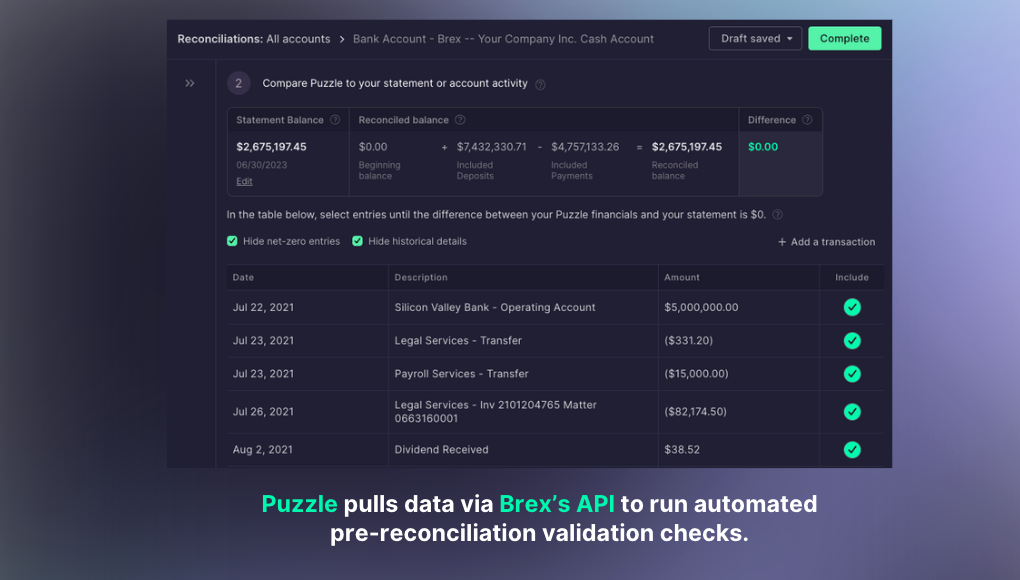
Also, Puzzle pulls the data via Brex’s API to run automated pre-reconciliation validation checks.
🧩 Faster business insights
The Brex-Puzzle integration allows data to be synced faster and with more accuracy. This allows business owners the freedom to log into Puzzle and access the startup metrics they need to run a business, while their bookkeeper validates and finalizes the more formal financial reports.
Puzzle's dashboard also gives founders the ability to see important startup metrics like burn, runway, cash, MRR, and ARR.
This means founders can quickly get the information they need to make important decisions. Other accounting systems can't do this because they aren't built with startup metrics in mind.
Startups choose Brex for startup expertise, ease of use, and a straightforward accounting integration with Puzzle
Navigating banking as a VC-funded startup can be quite the puzzle (no pun intended), given the special needs that founders have. When sizing up the perfect operating accounts, credit card, bill pay, and accounting solution for your startup, it's important to factor in industry expertise, user experience, and how easy it will be to maintain.
And guess what? That's exactly why the Brex-Puzzle integration is the favorite choice for startups.
Brex offers an all-in-solution for operating accounts, credit cards, bill pay and even expense management. Brex has startup expertise, and have services and rewards that appeal specifically to technology, biotech, and ecommerce founders over traditional platforms.
Puzzle is a real-time accounting solution for startups that was built with the startup founder in mind. Founders can access startup metrics like burn, runway, ARR, MRR instantly, while their accountants gain more accurate context about transactions through the Brex-Puzzle integration.
Getting set up correctly from the outset with both Puzzle and Brex will ensure you are set up for success from day one.
Stay tuned for more guides from our Fintech for Founders series.
The Brex-Puzzle stack in 2026: what's new
The case for consolidating your financial stack has only gotten stronger. A few developments worth knowing about as you evaluate your setup:
AI-native accounting is now table stakes. Through 2025 and into 2026, the gap between legacy platforms like QuickBooks and AI-native QuickBooks alternatives widened significantly. Startups running on older architecture are spending more time on manual categorization and reconciliation fixes — hours that compound quickly as transaction volume grows.
Brex has continued expanding its treasury and global payments capabilities. For startups operating across multiple currencies or scaling internationally, Brex's treasury solutions have matured into a meaningful alternative to managing separate banking relationships in each market.
Investors are asking for real-time financials earlier. In the current fundraising environment, many VCs increasingly expect founders to show burn, runway, and cash position on demand — not at the end of a monthly close cycle. The Brex-Puzzle integration is built for exactly this: your metrics update daily, so you're never caught flat-footed in a diligence call.
FAQ
How does the Brex-Puzzle integration improve transaction accuracy?
The integration uses API-based data syncing to automatically categorize 99% of Brex credit card transactions in Puzzle, pulling transaction details directly without manual uploads or downloads. This eliminates data entry errors and provides real-time context that improves categorization accuracy compared to other accounting platforms.
Can I access my financial metrics before month-end close?
Yes. The Brex-Puzzle integration syncs data in real-time, so you can log into Puzzle anytime to view startup metrics like burn rate, runway, cash position, MRR, and ARR while your bookkeeper works on finalizing formal financial reports. You don't need to wait for month-end.
What makes Brex better than using multiple providers for banking and credit cards?
Brex consolidates your operating account, credit cards, bill pay, and expense management into one platform, eliminating the need to manage multiple logins and accounts. You get up to $6M in FDIC coverage, can earn up to 7x cash rewards on spending, and view all company finances in a single dashboard.
How long does it take to connect Brex to Puzzle?
You can connect Brex to Puzzle with a 1-click integration that takes just minutes to set up. Once connected, all your Brex transactions automatically sync to Puzzle in real-time through the API without any manual data transfers.
When should a funded startup switch from cash to accrual accounting?
The trigger is usually your first institutional funding round. Once you take on investors, you're expected to produce GAAP-compliant financials — and GAAP requires accrual accounting. Cash-basis books can mask your true financial picture: they don't capture unpaid invoices, deferred revenue, or outstanding bills, which means your P&L can look very different from what you've actually earned or owe. Most VCs will ask for accrual-basis financials during diligence, so the longer you wait, the messier the transition.
Puzzle makes this transition easier than legacy platforms because it maintains both cash and accrual books simultaneously. You don't have to choose one or the other or pay a bookkeeper to restate months of history — Puzzle's AI-native architecture handles dual-basis accounting from day one, so your books are investor-ready without a painful cutover.
How do I get real-time burn rate and runway visibility as a seed-stage founder?
The short answer: connect your operating account and credit card to accounting software that's built to surface those numbers automatically. Most legacy tools (QuickBooks, Xero) treat burn rate and runway as outputs you calculate manually from reports — they don't surface them as live metrics on a dashboard.
With Brex and Puzzle connected, your burn rate and runway update daily. Every Brex transaction — operating account and credit card — syncs to Puzzle via API in real-time. Puzzle's dashboard then surfaces burn, runway, cash position, MRR, and ARR without any manual work on your end. You don't need a bookkeeper to run a report; you just log in. That matters most in startup fundraising, when a VC asks for your current runway and you need the number immediately — not at the end of a monthly close cycle.
What's the best software for automating bank reconciliation at a seed-stage startup?
For a seed-stage startup using Brex, the most automated reconciliation path is Puzzle. Because Puzzle ingests Brex data via a direct API — not a third-party connector or CSV export — it can run pre-reconciliation validation checks automatically before a human ever touches the books. 99% of Brex credit card transactions are auto-categorized, which eliminates the bulk of the manual work that makes reconciliation slow and error-prone on other platforms.
Tools like Rillet and Numeric are built for more complex, multi-entity environments and tend to be right-sized for Series B and beyond — more capability than most seed-stage companies need, and priced accordingly. BlackLine is enterprise-grade. For a seed-stage founder who wants reconciliation that just works without a full-time controller, Brex plus Puzzle is the right-sized stack.
What's the best accounting software for early-stage startups that don't have a full-time accountant?
You need software that does the categorization and reconciliation work automatically, so the burden doesn't fall on a founder who didn't start a company to learn double-entry bookkeeping. Puzzle was built specifically for this: AI-native from day one, not retrofitted onto legacy architecture the way QuickBooks alternatives for startups often are.
In practice, that means Puzzle auto-categorizes the overwhelming majority of transactions, surfaces burn rate and runway on a live dashboard, and flags anything that needs human review — rather than dumping raw transaction data on you and expecting you to make sense of it. When you're ready to bring in a fractional CFO or external bookkeeper, they get a much cleaner system to work with than they would inheriting a QuickBooks file that's been manually maintained for 18 months. The Brex integration makes this even tighter: one connected account covers your operating account, credit card, and bill pay, with everything flowing into Puzzle automatically.
Why isn't the AI automatically identifying vendors and categorizing my Brex transactions correctly?
The 99% auto-categorization rate applies to Brex credit card transactions specifically — and it holds because Brex passes structured merchant data through the API that Puzzle uses to match vendors and apply categories. If you're seeing uncategorized transactions, the most common causes are: a new vendor Puzzle hasn't seen before, a transaction with a generic or ambiguous merchant name, or categorization rules that haven't been set yet for your chart of accounts.
Categorization rules in Puzzle work as persistent logic: once you categorize a transaction from a given vendor and save the rule, Puzzle applies that mapping automatically to every future transaction from the same vendor. The AI learns from your corrections over time. For transactions Puzzle can't confidently categorize, it surfaces them for your review rather than guessing — which keeps your books clean and avoids silent errors that compound at month-end.
What is the bank transfers and transit clearing account, and does it affect my Brex data?
When money moves between two accounts that Puzzle is tracking — for example, from your Brex operating account to a connected Mercury account — Puzzle routes the transaction through a transit clearing account rather than recording it as income or expense on either side. This prevents the transfer from inflating your revenue or expense totals.
The clearing account zeroes out once both sides of the transfer are recorded (debit on one account, credit on the other), so it disappears from your P&L. If you see a non-zero balance sitting in the clearing account, it usually means one side of the transfer hasn't synced yet — often because the receiving account isn't connected to Puzzle, or there's a timing difference in when the transaction posted. This is expected behavior, not a data error, and it resolves automatically once both legs of the transfer are present.
What happens if I reconnect my Brex account in Puzzle: will it override my existing data or beginning balances?
Reconnecting a bank integration in Puzzle does not automatically overwrite your existing data, but it does require care around the sync start date. If you reconnect Brex and the integration pulls in transactions from a date that overlaps with history you've already migrated or manually journaled, Puzzle will flag the duplicates for review — it won't silently overwrite your books.
The risk area is beginning balances: if you set a manual opening balance as part of a migration and then reconnect Brex with a start date that predates that balance, the imported transactions can conflict with the journal entry you used to establish it. The fix is to set the integration's sync start date to the day after your migration cutoff, so Puzzle picks up only live transactions going forward. If you're unsure about the right cutoff date, your accountant or Puzzle's support team can verify the correct configuration before you reconnect.
Let us help you solve your financial puzzles.
Thank you for being part of our Puzzle community. Stay tuned!
Oops! Something went wrong while submitting the form.